
Hello! Welcome back to our module on Customer Value and Segmentation Strategy.
In our previous lesson, we established a foundational understanding of business health by calculating historical Customer Lifetime Value (LTV) from cohort data. We saw how this backward-looking metric, when compared to Customer Acquisition Cost (CAC), allows you to evaluate the profitability of your past marketing efforts.
However, as a strategic leader, you're responsible for making decisions about the future, not just reporting on the past. How much should you invest today to acquire a customer whose full value won't be realized for months or years? This is where historical LTV falls short.
Your learning outcome for today is to explain the strategic difference between historical LTV and predictive LTV (pLTV). We will dissect these two approaches, clarifying not just what they are, but when to use them, what decisions they empower, and what risks they carry. Mastering this distinction is crucial for moving from a reactive, historical view of performance to a proactive, forward-looking strategy for growth.
1. The Rearview Mirror: Limitations of Historical LTV
Historical LTV tells you the profit generated to date from customers you acquired in the past. It is factual and grounded in reality, which makes it excellent for reporting and validation. The problem? It's a lagging indicator.
For a new or rapidly growing business, waiting 12-24 months to understand the value of your customers is not feasible. You need to make budget and channel decisions now. This is often called the "incomplete data" problem.
Let's watch a short clip that perfectly visualizes this challenge.
Customer Lifetime Value: Models, Metrics and a Multitude of Uses - Brian Bloniarz
This segment from a PyData talk by Brian Bloniarz clearly illustrates why relying only on the data you have today (historical data) is insufficient for making decisions about the future.
Watch from 10:25 to 12:17. Pay attention to the two graphs he shows. The first shows a complete customer lifetime, but it forces us to ignore new customers. The second, more realistic graph shows that for most of our customers, we have very little data. This is the fundamental problem that predictive LTV is designed to solve.
As the video explains, if you only use historical data, you are forced to make decisions based on either very old, potentially irrelevant cohorts, or you're trying to reason about brand new customers with almost no data at all. This leads to significant strategic risks.
This article from Stellans, a marketing analytics consultancy, frames the risk in business terms. It explains the direct financial consequences of relying on a purely historical view.
Read the section titled 'Why Your LTV Calculation Method Dictates Your Growth Strategy'. The key takeaway is that miscalculating LTV can lead directly to budget misallocation and over-investment in the wrong channels.
2. The Windshield: Introducing Predictive LTV (pLTV)
If historical LTV is the rearview mirror, predictive LTV (pLTV) is the windshield, combined with a GPS navigator. It uses statistical models to forecast a customer's likely future value based on their early behavior and characteristics.
- Historical LTV asks: "What was the total profit from a customer who signed up a year ago?" (Descriptive)
- Predictive LTV asks: "What is the expected total profit from a customer who signed up today?" (Predictive)
This forward-looking capability is what makes pLTV an essential tool for strategic decision-making.
Customer Lifetime Value (LTV): The Ultimate E-commerce ...
Let's get a clear, side-by-side definition of these two approaches. This guide from Rework provides simple formulas and examples that crisply define both methods.
Read the section 'LTV Calculation Methods: Historical vs Predictive', including the subsections for both 'Historical LTV' and 'Predictive LTV'. Focus on the 'Strengths' and 'Weaknesses' for each. This will build your mental model for when to apply each method.
3. The Strategic Difference: When and Why to Use Each
Understanding the definitions is step one. The critical skill for a leader is knowing which tool to use for which job. You wouldn't use a historical report to set a real-time bidding strategy, nor would you use a predictive forecast to close last quarter's financial books.
Here's a framework for thinking about their strategic roles:
-
Historical LTV is for Evaluation and Validation. Use it to answer questions about the past.
- Strategic Use Case: Reporting on the realized profitability of a marketing channel from last year.
- Analytical Use Case: Backtesting your predictive models to see if their forecasts from 12 months ago matched what actually happened.
-
Predictive LTV is for Activation and Optimization. Use it to make decisions about the future.
- Strategic Use Case: Setting the Customer Acquisition Cost (CAC) target for a new campaign launching tomorrow.
- Analytical Use Case: Segmenting new users based on their pLTV to provide high-value prospects with a premium onboarding experience.
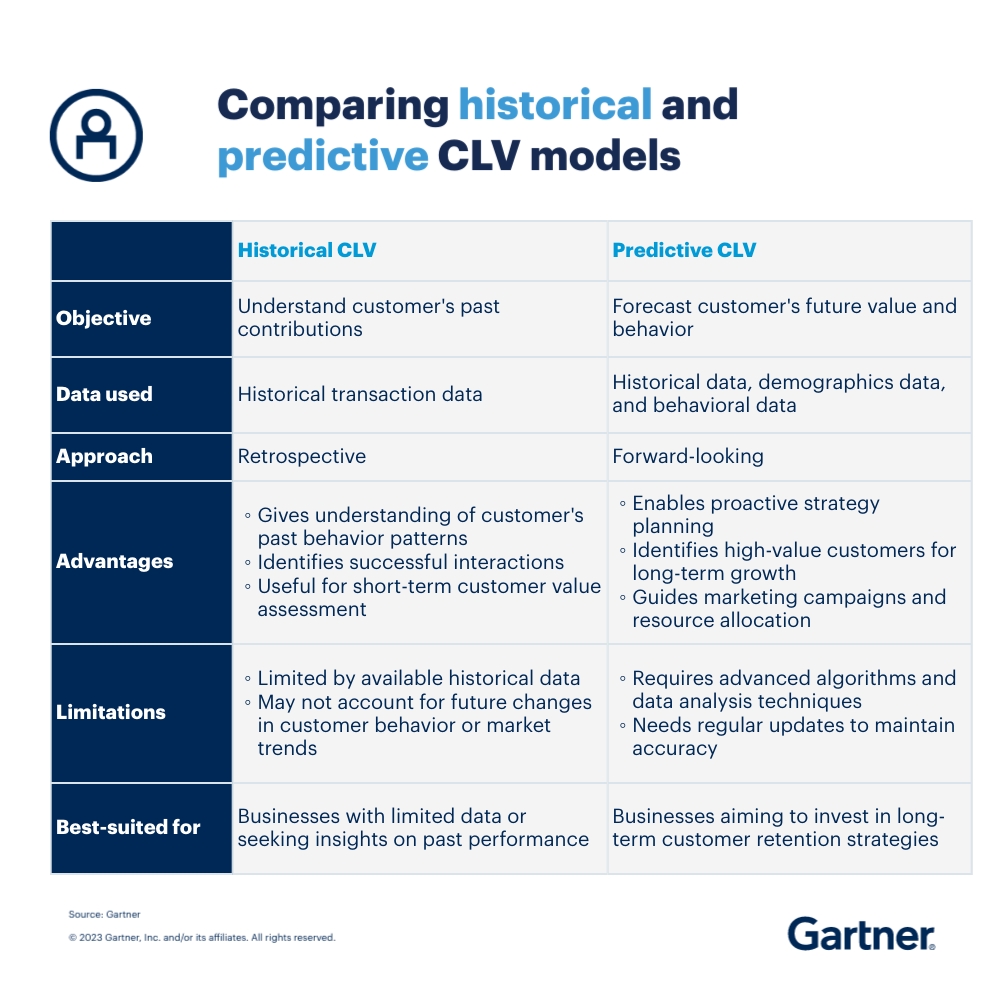
This table from Gartner provides an excellent visual summary of these differences.
4. How pLTV Works (At a Strategic Level)
While you don't need to build the models yourself, understanding the underlying concepts is vital for you to be able to question and trust the outputs from your analytics team.
Most pLTV models are built on a simple premise: not all customers are equal. Some have a high propensity to buy frequently and remain loyal, while others are likely to make one purchase and disappear. Your historical LTV, being an average, blends these groups together. Predictive models aim to tease them apart.
Customer Lifetime Value: Models, Metrics and a Multitude of Uses - Brian Bloniarz
Let's return to the PyData talk to understand the core logic behind these models. The speaker explains the concept of 'customer heterogeneity'—the idea that customer behavior is extremely variable—and why models are necessary to handle this reality.
Watch from 12:17 to 15:57 and then from 20:06 to 24:17. Don't worry about the specific model names (Poisson, etc.). Focus on these two strategic ideas: Models break the problem down, predicting things like 'probability to churn' and 'expected purchase count' to build a complete picture. A core job of the model is to handle 'customer heterogeneity'—the massive variability in behavior—so you're not relying on a single misleading average.
A crucial financial concept often incorporated into sophisticated pLTV models is the Discounted Cash Flow (DCF). This simply means that profit earned a year from now is worth less than profit earned today due to risk and opportunity cost. Incorporating a discount rate ensures your LTV is financially sound and defensible to a CFO, aligning marketing metrics with core business finance.
5. Your Role as a Leader: Asking the Right Questions
Your value is not in running the pLTV model, but in critically evaluating its output and using it to drive strategy. When your data science or analytics team presents you with a pLTV forecast, your job is to pressure-test it.
Test your understanding!
Imagine your analytics team presents a new pLTV model that suggests the lifetime value of customers from your Meta Ads campaigns is 50% higher than previously thought. Before you approve a major budget increase for Meta, what are three critical questions you would ask the team about their model?
Show answer
Here are three excellent questions to ask, reflecting a strategic mindset:
-
"How does this model's prediction for a 12-month-old cohort compare to the actual historical LTV we've observed for that same cohort?" This question is about backtesting. It grounds the predictive model in reality and checks its accuracy against what really happened. A large discrepancy needs to be explained.
-
"What are the key features driving the higher pLTV for Meta customers? Is it higher purchase frequency, lower churn probability, or higher order value?" This probes the 'why' behind the number. Understanding the drivers helps you validate the finding (e.g., "Does it make sense that Meta users are more loyal?") and informs creative and targeting strategy.
-
"How sensitive is this pLTV figure to the model's core assumptions, like the discount rate or the assumed churn curve?" This assesses the robustness of the finding. A model whose output changes drastically with a small tweak to an assumption is less reliable for major strategic decisions than one that is stable.
Conclusion
In this lesson, we drew a clear line between looking backward and looking forward. You now understand the distinct strategic roles of historical and predictive LTV.
Key Takeaways:
- Historical LTV is a descriptive, backward-looking metric. It is factual and best used for evaluating past performance and validating models.
- Predictive LTV (pLTV) is a probabilistic, forward-looking metric. It is an estimate, best used for activating future strategy, setting budgets, and optimizing channels in real-time.
- The primary weakness of historical LTV is its lag time and inability to account for new customers. The primary risk of predictive LTV is that it is based on assumptions that may be wrong.
- A sophisticated marketing organization uses both: pLTV to guide future decisions and historical LTV to validate that those decisions were correct over time.
Preview of the Next Lesson:
We've established that we can predict the value of individual customers. The next logical step is to use this insight to group similar customers together. In our next lesson, we will learn to evaluate customer segments derived from analytical models (e.g., RFM, clustering, pLTV). This will enable you to move beyond one-size-fits-all marketing and tailor your strategies to distinct, high-value customer groups.