
Welcome back. In the previous lesson, you learned to extract and compare quantities from tables, charts, and graphs without losing track of units, scales, or percentage bases. This lesson shifts to a different kind of information: statements that constrain what must be true.
In GATE General Aptitude, arrangement, syllogism, and conditional-logic questions are rarely about outside knowledge. Treat every given statement as a rule of a small formal world. Your task is to represent those rules carefully, then accept only conclusions that cannot be false while all the premises remain true.
By the end of this lesson, you should be able to draw a minimal arrangement diagram, test conclusions from “all/some/no” statements, and distinguish valid conditional reasoning from tempting but invalid reversals.
1. The standard of proof: “must follow,” not “sounds plausible”
A conclusion is valid if it is true in every situation consistent with the given premises. It is not enough for the conclusion to be possible or likely.
For example, consider:
- All database administrators are engineers.
- Some engineers are programmers.
It may be possible that some database administrators are programmers. But it is not guaranteed: the programmers could be engineers who are not database administrators. Therefore, the conclusion “Some database administrators are programmers” does not follow.
This gives you a dependable GATE test:
- Translate each premise into a small diagram or symbolic form.
- Derive what the diagram forces.
- For a doubtful option, try to imagine one valid arrangement or set relationship in which that option is false.
- If such a counterexample exists, reject the option.
Do not bring real-world assumptions into the question. If a statement says “All engineers are poets,” use it exactly as supplied. GATE tests logical consequences of the premises, not whether the premises resemble reality.
2. Arrangements: build a diagram before drawing conclusions
Arrangement questions typically concern people seated in a row, around a circle, or in a small set of positions. The most common error is trying to reason verbally for too long. Convert words into a diagram as soon as possible.
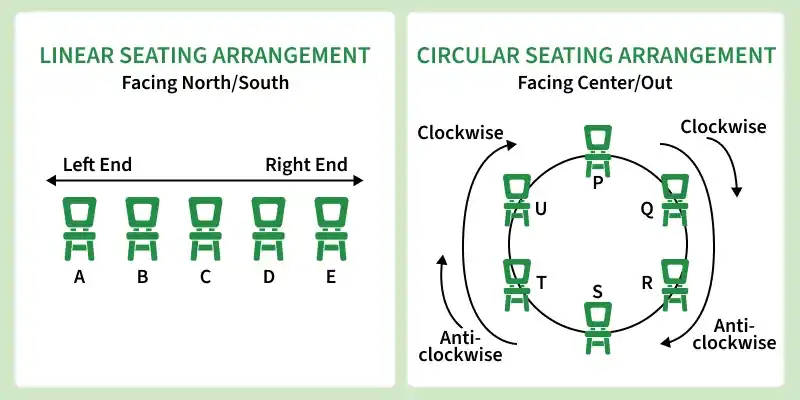
Linear arrangements
For a row, first draw empty slots. If there are five people, use:
Then mark every fixed condition.
Suppose five people sit in a row facing north:
- sits at the left end.
- sits immediately to the left of .
- sits immediately to the right of .
The three-person block must be:
Since occupies the left end, the only complete arrangement is:
Thus, several conclusions are forced: occupies the middle seat, is at the right end, and is immediately between and .
Two language details matter:
- Immediately left/right means adjacent; there is no intervening person.
- “Third to the left of ” means three seat positions left of , with two positions between them.
Facing direction changes left and right
A person’s left and right are determined from that person’s viewpoint.
For a horizontal row viewed from above:
| Direction faced by everyone | Person’s left appears on the page |
|---|---|
| North | Left |
| South | Right |
So, if everyone faces south, “ is to the left of ” places on the right side of the page relative to . Mark the facing direction before placing anyone.
Circular arrangements
In a circular arrangement, rotation does not change the arrangement. If nobody’s position is fixed, place one person arbitrarily at the top and use that person as an anchor.
For people facing the center:
- a person’s left is clockwise;
- a person’s right is anticlockwise.
For people facing outward, these directions reverse.
Suppose six people face the center:
- sits immediately clockwise of ;
- sits opposite ;
- sits immediately anticlockwise of .
Starting with at any convenient position, the relevant occupied positions in clockwise order are . Therefore, is immediately anticlockwise of . The remaining two people may occupy the remaining seats, but their identities do not affect this conclusion.
A compact arrangement workflow
Use this scratch-paper routine:
- Draw slots or a circle and note the number of positions.
- Write facing direction prominently.
- Place fixed information first: ends, opposite positions, or named seats.
- Bundle adjacent clues: “ immediately left of ” becomes one block.
- Use elimination last for remaining people or positions.
- Check every clue against the completed arrangement before choosing an option.
An arrangement conclusion is valid only when it holds in every permissible layout. If two different valid layouts remain, do not claim a relationship that changes between them.
3. Syllogisms: translate words into set relationships
Syllogism questions use categories such as “scientists,” “researchers,” “doctors,” or “artists.” Ignore the labels and focus on membership in sets.
The four basic statement types are:
| Statement | Set meaning | What it guarantees |
|---|---|---|
| All are | Every belongs to | |
| No are | Nothing belongs to both sets | |
| Some are | At least one object belongs to both | |
| Some are not | At least one lies outside |
The words all, no, and some determine the logic. A Venn-style sketch is usually faster and safer than reading the sentences repeatedly.
Lecture #12 | Logical Syllogism | GATE General Aptitude Course by Christy Varghese | Christy's Class
Watch “Lecture #12 | Logical Syllogism” from Christy’s Classes. It presents the four statement types visually and then applies them to a GATE problem, emphasizing why a reverse implication cannot be assumed.
Watch the Venn basics to see how “all,” “no,” “some,” and “some not” are represented. Then watch the GATE example, focusing on how the instructor checks whether each conclusion is forced rather than merely possible.
Chaining universal statements
Suppose:
- All algorithms are procedures.
- All procedures have finite descriptions.
- Some algorithms are recursive.
The first two statements give:
Therefore:
- All algorithms have finite descriptions.
- Some recursive objects have finite descriptions.
The second conclusion follows because “some algorithms are recursive” guarantees the existence of at least one recursive algorithm, and every algorithm lies inside the set of objects with finite descriptions.
However, this does not allow the reverse conclusion:
All objects with finite descriptions are algorithms.
The largest set may contain many objects outside the smaller set.
Combining “some” with “no”
Now consider:
- No cached items are disk reads.
- Some memory accesses are cached.
The “some” statement guarantees at least one memory access that is cached. Since no cached item can be a disk read, that same access cannot be a disk read.
A valid conclusion is:
Some memory accesses are not disk reads.
This is a common pattern: use a “some” statement to establish existence, then use an “all” or “no” statement to determine what must be true of that existing object.
What you must not infer
These invalid leaps appear frequently in options:
| Given premise | Invalid conclusion | Why it fails |
|---|---|---|
| All are | All are | The converse is not guaranteed |
| Some are | All are | One overlap does not establish full inclusion |
| No are | No are | Nothing was stated about and |
| All are | Some are | “All” does not formally guarantee that any exists |
The final row is especially useful when a question has only universal statements. Unless the premises explicitly establish existence through “some,” do not introduce a particular member of a set.
4. Conditional logic: sufficient and necessary conditions
A conditional statement has the form:
If , then .
Here, is a sufficient condition for , and is a necessary condition for .
For example:
If a program passes all mandatory tests, then it is accepted.
Passing all mandatory tests is sufficient for acceptance under this rule. Acceptance is necessary for the program to have passed all mandatory tests, assuming the statement is true.
The conditional is written as:
It is false in exactly one situation: is true but is false. In every other case, the rule has not been violated.
Conditional Logic | LSAT Logical Reasoning
Watch “Conditional Logic” from LSAT Lab for a precise explanation of sufficient conditions, necessary conditions, contrapositives, and linked rules. Although the examples are from LSAT preparation, the reasoning is directly applicable to GATE aptitude.
Watch conditional foundations to establish what a rule does and does not allow you to conclude. Then watch the contrapositive and chains and combinations. Focus particularly on the warning against moving from the consequence back to the condition.
The contrapositive: the equivalent form
The statement
is logically equivalent to its contrapositive:
In words:
If the consequence does not occur, then the original condition could not have occurred.
For example:
If a process holds a mutex, then it has acquired the lock.
Its contrapositive is:
If a process has not acquired the lock, then it does not hold the mutex.
The original statement and the contrapositive always stand or fall together.
The two valid direct argument forms
The most useful deduction patterns are:
| Premises | Valid conclusion | Name |
|---|---|---|
| , and | Modus ponens | |
| , and | Modus tollens | |
| , and | Conditional chain |
Consider the rule:
If a submitted application is complete, then it is evaluated.
If you know the application is complete, you can conclude that it is evaluated. This is modus ponens.
If you know the application was not evaluated, you can conclude it was not complete. This is modus tollens, using the contrapositive.
For a chain, suppose:
- If a task is submitted, it is evaluated.
- If a task is evaluated, its result is recorded.
Then a valid new rule is:
If a task is submitted, its result is recorded.
Two invalid forms to reject immediately
A conditional does not work in both directions unless the question explicitly says so.
| Premises | Invalid conclusion | Error |
|---|---|---|
| , and | Affirming the consequent | |
| , and | Denying the antecedent |
Using the application example:
If an application is complete, then it is evaluated.
The application was evaluated.
Therefore, it was complete.
This is invalid. It may have been evaluated for some other reason.
Likewise:
If an application is complete, then it is evaluated.
The application was not complete.
Therefore, it was not evaluated.
Also invalid. The rule never said incomplete applications cannot be evaluated.
5. Translating common English phrases
In GATE questions, the main difficulty is often not deduction but correctly converting English into a conditional rule.
“Only if”
A candidate is shortlisted only if they meet the cutoff.
Meeting the cutoff is necessary for shortlisting:
A useful verbal check is: “Shortlisting requires meeting the cutoff.”
“Only”
Only verified users can access the portal.
This means:
It does not mean every verified user accesses the portal.
“If and only if”
A number is even if and only if it is divisible by .
This gives two rules:
An “if and only if” statement is stronger than a one-way conditional because both directions are guaranteed.
“Unless” and “without”
Translate these by identifying the necessary condition.
Entry is not permitted unless a valid ID is shown.
Showing valid ID is necessary for entry:
Its contrapositive is often easier to apply:
This same technique works for “without”:
A system cannot start without power.
6. Validity, truth, and soundness
Keep these terms separate:
- An argument is valid when the conclusion follows logically from its premises.
- An argument is sound when it is valid and all its premises are true.
- In GATE aptitude questions, you ordinarily accept the stated premises and test whether the conclusion follows from them.
2.7 Logical Arguments - Contemporary Mathematics | OpenStax
Read OpenStax’s “Logical Arguments” section to consolidate the three major conditional-argument forms: modus ponens, modus tollens, and conditional chaining.
Begin with the opening discussion of deductive and inductive arguments, especially the distinction. Then read the subsections titled “Law of Detachment,” “Law of Denying the Consequent,” and “Chain Rule for Conditional Arguments.” Focus on modus ponens, then the explanation beginning modus tollens, and finally conditional chaining. Use Examples 2.31 through 2.33 as short worked models rather than trying to memorize their wording.
7. A practical GATE checklist
Before committing to an answer, classify the question.
If it is an arrangement question
- Have I marked everyone’s facing direction?
- Did I distinguish “immediately” from a general left/right relation?
- If it is circular, did I fix one person only as a reference point?
- Does my proposed conclusion hold in every valid seating layout?
If it is a syllogism question
- Did I translate “all,” “no,” and “some” precisely?
- Did I accidentally reverse a subset relationship?
- Did I infer existence from “all” when no “some” statement was given?
- Can I draw a counterexample to disprove the conclusion?
If it is a conditional-logic question
- What is the sufficient condition and what is the necessary condition?
- Did I write the contrapositive correctly by reversing and negating both parts?
- Am I using modus ponens, modus tollens, or a valid chain?
- Did I accidentally affirm the consequent or deny the antecedent?
For your error log, label errors specifically: direction error, reverse-inference error, existence error, conditional-translation error, or invalid argument form. These labels identify what to repair far better than simply writing “logical mistake.”
Key takeaways
- A valid conclusion must be true in every scenario allowed by the premises.
- In arrangements, draw positions first and treat facing direction as part of the constraint.
- In syllogisms, represent “all” as inclusion, “no” as disjointness, and “some” as existence.
- Do not reverse “all are ” into “all are ,” and do not infer existence from universal statements alone.
- From , you may use to infer , or use to infer .
- “Only if” introduces a necessary condition; “if and only if” permits reasoning in both directions.
The next lesson moves from logical structure to spatial reasoning: mensuration, transformations, folding, symmetry, and visualizing two- and three-dimensional objects.
Can't find a good explanation? Sign up and we'll make it for you
Sign up