
Hello. In the previous lesson, you treated seating clues, set statements, and conditionals as formal constraints: a conclusion was acceptable only if the given information forced it. Spatial aptitude uses the same discipline, but the constraints are visual. A fold, mirror line, rotation axis, or set of dimensions defines what can and cannot change.
This final lesson in General Aptitude develops a reliable approach to transformations, paper folding and cutting, symmetry, solid nets, views, and basic mensuration. The goal is not to “see the answer instantly”; it is to convert each diagram into a few invariants and trace them systematically.
1. Transformations: identify what changes and what must stay fixed
Most spatial questions use one of four transformations:
| Transformation | Position changes? | Orientation changes? | Size and shape change? |
|---|---|---|---|
| Translation | Yes | No | No |
| Rotation | Yes | Yes | No |
| Reflection | Yes | Reversed | No |
| Folding | One part moves by reflection across a crease | Reversed on the moving part | No |
A translation slides an object. Its left-right and top-bottom orientation remain unchanged.
A rotation turns an object around a stated center or axis. A rotation of makes the top become bottom and the left become right. A rotation of clockwise sends the top toward the right.
A reflection makes a mirror image. It preserves all distances but reverses handedness. A right-facing arrow becomes left-facing after a vertical reflection; it does not merely move to the other side.
For a coordinate sketch centred at the origin:
- Reflection in the vertical axis changes to .
- Reflection in the horizontal axis changes to .
- A rotation changes to .
- A clockwise rotation changes to .
You will rarely need to write these rules in GATE, but they explain the two essential checks: distance from the axis or centre and orientation of an asymmetric feature.
A fast method for mirror-image questions
Do not inspect every part of a complicated figure equally. Instead, locate one or two features that distinguish the options:
- a small shaded corner;
- an arrowhead;
- a sloping edge;
- an off-centre dot;
- an unusual letter or number.
Then apply these rules:
- With a vertical mirror line, left and right exchange; top and bottom stay at the same levels.
- With a horizontal mirror line, top and bottom exchange; left and right stay in the same order.
- Every point remains the same perpendicular distance from the mirror line.
- The reflected shape is reversed, not rotated.
A horizontal reflection is often called a water image. A vertical reflection is the standard mirror image.
Symmetry is a reflection that leaves the whole figure unchanged
A line is a line of symmetry only when reflecting the entire figure across it reproduces the same figure. In a grid of unit squares, each occupied square on one side must have a reflected occupied partner on the other side, unless the square maps onto itself.
For “minimum squares to add” questions:
- Mark the stated symmetry line.
- Consider each existing square one at a time.
- Locate its reflected partner.
- Add a square only if that partner is absent.
- Do not double-count a square already present.
This is more reliable than trying to judge whether the final pattern “looks balanced.”
2. Paper folding, transparent sheets, and hole punching
A fold is a reflection across the crease, but only the portion that moves is reflected. The stationary portion remains where it is. On a transparent sheet, marks from overlapping layers are both visible; this is why a transparent-fold question is fundamentally a mirror-image question.

The reverse-unfold rule
For a folded-and-punched sheet, solve from the punch backwards:
- Begin with the punched point on the final folded shape.
- Undo the last fold first by reflecting that point across its crease.
- Undo the preceding fold, reflecting every point produced so far when that layer was involved.
- Continue until the original sheet is restored.
- Compare the final pattern’s positions, not merely its number of holes.
A hole fully inside a folded region generally creates a reflected copy when that fold is opened. But do not blindly assume that the number of holes doubles after every fold:
- A cut on a crease can coincide with its reflected copy.
- A cut on an outer edge may become a boundary notch rather than an interior hole.
- Some folds move only a portion of the paper, so not every earlier region contains every layer.
Track locations with landmarks
When the diagram is dense, divide the original sheet mentally into regions: left/right halves, top/bottom halves, and then quarters. For each hole, record its relation to the current crease:
- Which side is it on?
- How far is it from the crease?
- Is it near a corner, an edge, or the centre?
Then its reflected copy must be placed on the opposite side at the same distance. This is exactly the distance-preservation principle from mirror images.
A useful scratch-paper habit is to draw only the crease and a dot, rather than redrawing the entire object at every stage. Add each reflected dot in a different order or with a small index. It prevents the common mistake of unfolding in the same order as folding.
General Aptitute 12 | Spatial Aptitude | All Branches | GATE 2025 Crash Course
Watch “General Aptitude 12: Spatial Aptitude” by GATE Wallah for a visual demonstration of transparent-sheet folding and reverse unfolding. It reinforces the reflection method used in GATE-style questions.
First watch transparent folds. Focus on the fact that the fixed half of the sheet retains its pattern while the moving half contributes a reflected pattern. Then watch unfolding cuts, pausing when the instructor opens each fold. Notice that the cuts are reflected one fold at a time, in reverse order.
3. From flat nets to solids, and from solids to views
A net is a two-dimensional layout that can be folded along edges to form a three-dimensional solid. It represents the complete surface of the object, so face shapes and face adjacencies matter.
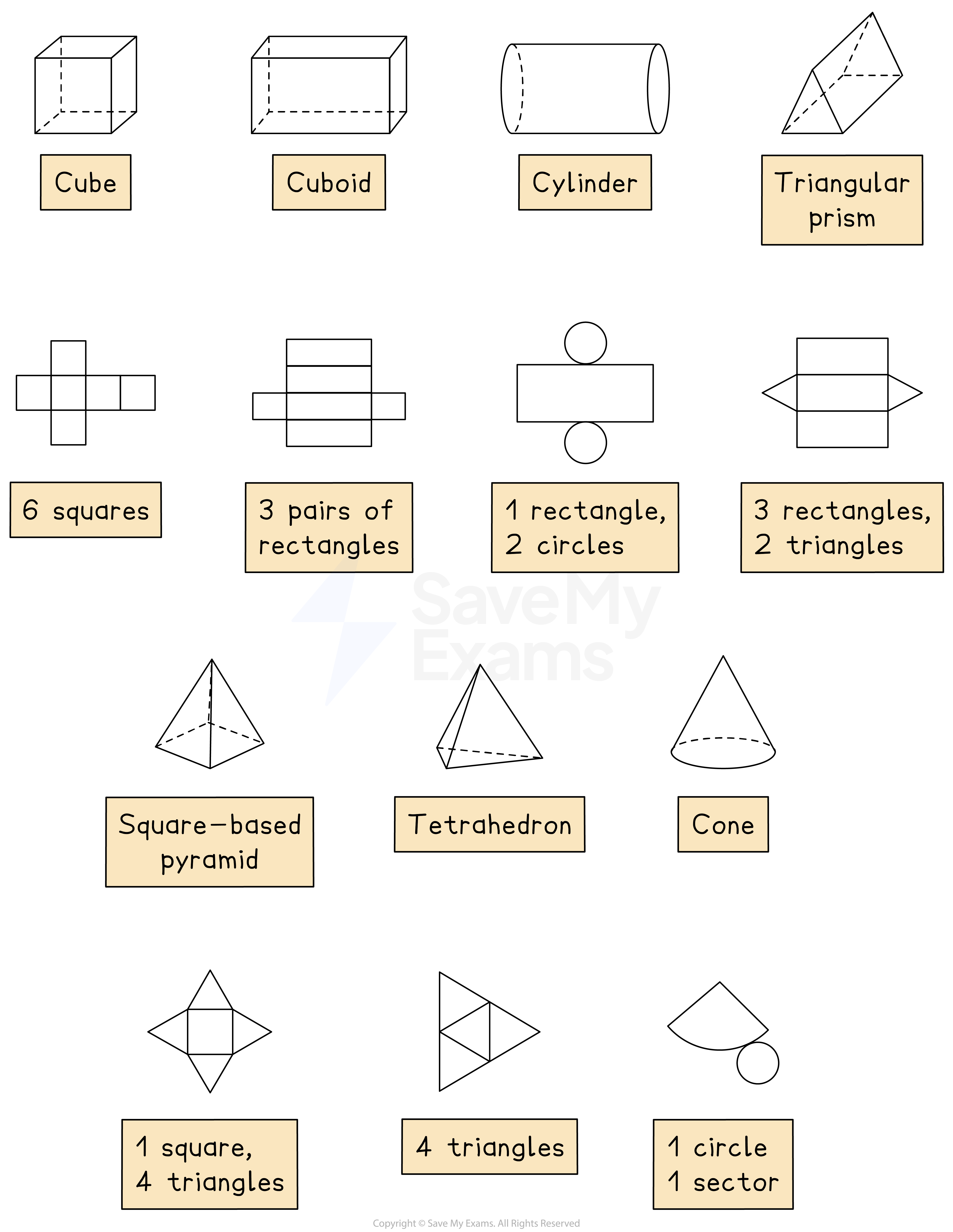
Recognising nets
Before imagining a fold, count the required faces:
| Solid | Required faces |
|---|---|
| Cube | 6 congruent squares |
| Cuboid | 3 pairs of congruent rectangles |
| Triangular prism | 2 triangles and 3 rectangles |
| Square-based pyramid | 1 square and 4 triangles |
| Cylinder | 2 circles and 1 rectangle |
| Cone | 1 circle and 1 sector |
For a cube net, a practical test is to identify a strip of four squares. These can wrap around to form the four lateral faces. The remaining two squares must close the top and bottom without landing on the same face.
Two common traps are:
- Counting is necessary but not sufficient. Six squares do not always fold into a cube; their arrangement can overlap.
- A net cannot stretch. Faces may rotate around shared edges, but a rectangle cannot become a square and a triangle cannot become a curved surface.
Visualising a view of a solid
In an “as viewed from the arrow” question, the answer is a projection, not the original three-dimensional sketch.
Use this sequence:
- Face the object from the arrow’s direction.
- Ignore depth: features directly behind others may be hidden.
- Draw the outside silhouette first.
- Add only edges or boundaries visible from that direction.
For example, when a trapezoidal block sits on a rectangular block, a side view may show the rectangle as the base and the trapezium above it. A sloping face visible in a perspective sketch does not automatically appear in every view.
Cross-sections and rotation into solids
A cross-section is the shape made where a plane cuts a solid. For a cube:
- a cut parallel to a face gives a square;
- a vertical cut through opposite edges can give a rectangle;
- a cut that removes one corner gives a triangle.
A two-dimensional region can also generate a solid by rotation. If a right triangle is revolved about one perpendicular side, that side becomes the cone’s height and the other perpendicular side becomes the radius. The hypotenuse becomes the slant height.
4. Mensuration: choose the geometric model before applying a formula
Mensuration questions are usually simple once the object has been identified correctly. The difficult step is deciding what each stated length represents: radius, diameter, height, slant height, circumference, surface area, or volume.
Keep units visible:
- Length uses units such as .
- Area uses .
- Volume uses .
Essential formulas
| Object | Volume | Surface area |
|---|---|---|
| Cube, side | ||
| Cuboid, dimensions | ||
| Any prism | Add the areas of all faces | |
| Cylinder | Curved: ; closed: | |
| Cone | Curved: ; closed: | |
| Sphere |
Here is the area of the base, is the radius, is the perpendicular height, and is a cone’s slant height.
For a cuboid, the longest internal diagonal is
For a cube of side , this simplifies to
Example: a square cut and revolved into a cone
Take a square of side , cut it along a diagonal, and use one resulting right isosceles triangle. Revolve the triangle about one of its perpendicular sides.
The axis of rotation is the cone’s height:
The other perpendicular side sweeps out the circular base:
Therefore,
The key reasoning is not the formula itself. It is identifying the axis of rotation as the height and the perpendicular distance from that axis as the radius.
Example: rolling a rectangular sheet into a cylinder
Suppose a by rectangle is rolled by joining its short edges. The two short edges meet, so the longer dimension wraps around the circular base.
Thus,
and hence
The cylinder’s height is . Its volume is therefore
The wording “which edges are joined?” is decisive. If the long edges were joined instead, the circumference and height would be interchanged, producing a different cylinder.
GATE Spatial Aptitude Questions Solved Problems with Detailed Solutions [Free PDF]
Read the cone-from-a-square example in this Testbook collection after working through the model above. It is useful because it connects a two-dimensional cut, a rotation in three-dimensional space, and a volume calculation in one GATE-style problem.
In the section containing GATE Questions 6–10, locate Question 7, beginning with “Consider a square sheet of side 1 unit.” Read the square-to-cone solution. Focus on why the two perpendicular sides of the triangle become the cone’s radius and height; do not memorize the numerical answer without that geometric identification.
5. A compact strategy for the exam
Spatial questions reward short, accurate externalisation. Use rough diagrams; no artistic drawing is needed.
For transformations and symmetry
- Mark the mirror line or rotation centre first.
- Track one asymmetric feature before considering the whole figure.
- Check both its new position and its orientation.
- For symmetry completion, create reflected partners systematically.
For folding and punching
- Identify the crease of every fold.
- Write the folds in order.
- Unfold in the reverse order.
- Reflect every hole, notch, or pattern across the crease currently being opened.
- Treat cuts on creases and edges as special cases.
For solids and mensuration
- Name the solid before selecting a formula.
- Label known dimensions directly on a sketch.
- Distinguish radius from diameter, and perpendicular height from slant height.
- For sheets rolled into cylinders, explicitly mark which dimension becomes circumference.
- Verify whether the question asks for area, surface area, perimeter, or volume.
In your error log, use specific labels such as reflection-direction error, unfold-order error, net-overlap error, radius-diameter error, wrong-solid model, or unit error. These diagnoses will make later revision much more efficient than recording only “spatial aptitude mistake.”
Key takeaways
- Transformations preserve shape and size, but reflections reverse orientation.
- A symmetry question is solved by pairing each part with its reflection across the stated line.
- Paper folding is reflection across creases; paper cutting is solved by undoing folds in reverse order.
- Nets must have the right faces and a non-overlapping arrangement when folded.
- In three-dimensional views, first determine the visible silhouette from the indicated direction.
- Mensuration depends on modelling: identify the solid and the meaning of each dimension before using a formula.
You have now completed the General Aptitude and Test Diagnosis module. The next module begins Discrete Mathematics for Computer Science with set operations and the classification of functions as injective, surjective, bijective, or invertible.
Can't find a good explanation? Sign up and we'll make it for you
Sign up