
Welcome back. In the previous lesson, you translated everyday situations into numerical models using ratios, percentages, averages, rates, and work. This lesson gives you a complementary toolkit: algebraic notation lets you express an unknown quantity precisely, constrain it, and solve for it quickly.
For GATE General Aptitude, equations, inequalities, exponents, logarithms, and sequences usually appear in short questions where the main challenge is recognizing the structure—not doing lengthy calculations. By the end of this lesson, you should be able to choose a reliable method, maintain domain restrictions, and reject tempting but invalid algebraic shortcuts.
Equations: preserve equality while isolating the unknown
An equation asserts that two expressions have the same value. Solving it means finding every value of the unknown for which the equality is true.
The central principle is simple:
Perform the same valid operation on both sides of an equation.
For example, solve:
First expand both sides:
Collect variable terms on one side and constants on the other:
A quick substitution check is worthwhile when fractions or several operations are involved. It catches sign errors before you commit to an answer.
Treat the equation as a statement, not as a collection of symbols
In aptitude questions, an equation often comes from a condition such as:
- “A number increased by 8 is twice the number decreased by 1.”
- “The sum of two consecutive integers is 41.”
- “The cost after a discount is 720.”
For “a number increased by 8 is twice the number decreased by 1,” let the number be :
The algebra is routine once the sentence has been modelled accurately.
Equations can have one, none, or infinitely many solutions
After simplifying an equation, notice what remains.
| Simplified result | Meaning |
|---|---|
| One solution | |
| No solution | |
| Every permissible value is a solution |
For instance:
Expanding gives:
This is always true, so the equation has infinitely many solutions.
Factor before using complicated methods
Some GATE questions conceal a product that can be factored immediately:
A product is zero when at least one factor is zero. Hence:
Do not divide both sides by an expression containing without checking whether that expression could be zero. Doing so can accidentally discard a valid solution.
Inequalities: equality rules with one crucial difference
An inequality describes a range of values rather than usually one exact value. Its symbols are:
| Symbol | Meaning |
|---|---|
| greater than | |
| less than | |
| greater than or equal to | |
| less than or equal to |
You can add or subtract the same quantity from both sides without changing the inequality direction. You can multiply or divide by a positive quantity without changing it as well.
However, multiplying or dividing by a negative quantity reverses the inequality:
Dividing by gives:
The reversal is essential. On a number line, multiplying values by a negative number reflects their order around zero: a larger number becomes a smaller negative number.
Compound inequalities
A condition with “and” requires both parts to be true:
Subtracting throughout gives:
A condition with “or” accepts values satisfying either part. For example:
represents two separate regions.
Rational inequalities: use signs, not unsafe cross multiplication
For an inequality involving a variable in a denominator, do not multiply by the denominator unless you know whether it is positive or negative. A sign chart is more reliable.
Consider:
First find the critical points:
- Numerator is zero at and .
- Denominator is zero at , where the expression is undefined.
These three values divide the number line into intervals. Test one value from each interval.
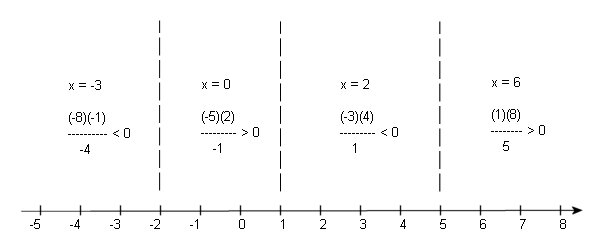
For the expression above:
| Interval | Test value | Sign of expression |
|---|---|---|
| negative | ||
| positive | ||
| negative | ||
| positive |
We need values less than or equal to zero. The zeros at and are included because they make the numerator zero, but is excluded because it makes the denominator zero:
The image’s test-point method is particularly useful under exam pressure: identify where the expression is zero or undefined, test the intervals, then decide endpoint inclusion from the original inequality.
#17 | Algebra | Equality& Inequality| General Aptitude | COMPLETE COURSE GATE 2024 |Christy Varghese
Watch “Algebra | Equality & Inequality” by Christy’s Classes for a worked GATE-style linear inequality and its number-line interpretation.
Watch the GATE inequality. Focus on the moment when the inequality is simplified and then translated into an interval on the number line; compare its endpoint logic with the rational-inequality method above.
Exponents: simplify by matching bases
Exponents describe repeated multiplication:
For nonzero , the core laws are:
The condition matters for negative and zero exponents.
Two common traps
The first trap is confusing addition with multiplication:
For example:
whereas:
The second trap is distributing powers over a sum:
In fact:
Exponent rules apply directly to products, quotients, and powers—not to arbitrary sums.
Reduce to a common base
Consider:
Write both bases as powers of :
Since equal powers of the same base have equal exponents:
This “common-base” strategy is usually faster and cleaner than using logarithms when the bases are related.
Logarithms: exponents written in reverse
A logarithm answers an exponent question:
means exactly:
Here, is the base, is the argument, and is the exponent.
For real-number logarithms:
For example:
because:
The most useful properties are:
Also:
Remember what is not a valid rule:
There is no simple “logarithm of a sum” rule.
Solve logarithmic equations with a domain check
Solve:
The arguments must be positive:
Thus:
Now combine the logarithms:
Convert to exponential form:
The algebraic candidates are and . But the domain requires , so only:
is valid. This final domain check is non-negotiable in logarithm questions.
GATE 2025 General Aptitude | Exponents & Logarithm | General Aptitude Practice #gate2025
Watch “GATE 2025 General Aptitude | Exponents & Logarithm” by OHM INSTITUTE Hyderabad for a compact GATE-oriented review of the exponent–logarithm connection, log laws, and their use in questions.
Begin with the inverse idea to reinforce what a logarithm means. Then watch the log properties, writing the product, quotient, and power rules once yourself. Finish with worked applications; pause before each solution step and identify which property is being used.
Numerical sequences: identify the rule before extending it
A numerical sequence is an ordered list. In GATE aptitude, the question may ask for the next term, a missing term, or an inconsistent term. The important word is ordered: position matters.
Start by asking what changes from one term to the next.
Arithmetic sequences: constant differences
In an arithmetic sequence, consecutive terms differ by a fixed value .
For:
the common difference is . Therefore:
Geometric sequences: constant ratios
In a geometric sequence, consecutive nonzero terms have a fixed ratio .
For:
the ratio is . Thus the next term is .
When neither pattern is immediate
If neither a constant difference nor ratio works, check these common structures:
-
Second differences
For:the first differences are:
The next difference is , so the next term is .
-
Alternating patterns
In:the odd-position terms double:
and the even-position terms also double:
-
Recurrence from earlier terms
In:each term after the first two is the sum of the previous two.
In principle, a finite list can fit many invented rules. In an exam, prefer the simplest rule that explains every displayed term, and use the answer choices as a reasonableness check. Do not guess from only one pair of terms when later terms contradict your pattern.
A fast decision routine for GATE questions
When you see one of these topics, use this order:
-
Classify the structure.
Is it an equality, a range, a power relation, a logarithmic statement, or a list pattern? -
Write restrictions first.
Denominators cannot be zero; logarithm arguments must be positive; square roots in real-number contexts require nonnegative radicands. -
Simplify structurally.
Expand brackets in equations, identify sign-changing points in rational inequalities, rewrite powers in a common base, and compute differences or ratios in sequences. -
Check the result in the original statement.
This is especially important after squaring, clearing denominators, or combining logarithms.
For your error log, distinguish a wrong algebraic rule from an omitted domain condition. The first is a conceptual issue; the second is usually an interpretation or checking issue. They need different revision.
Key takeaways
- Equations preserve equality when the same valid operation is applied to both sides.
- Inequalities reverse direction when multiplied or divided by a negative quantity.
- For rational inequalities, find zeros and undefined points, then use a sign chart across the resulting intervals.
- Exponent laws apply to multiplication, division, and powers; they do not turn sums into products.
- A logarithm is an exponent in reverse, and its argument must be positive.
- For sequences, test constant differences, constant ratios, second differences, alternating subsequences, and recurrence relations before choosing a rule.
The next lesson moves from symbolic quantities to data interpretation: reading tables, charts, and graphs accurately, estimating quantities, and making justified comparisons under time pressure.
Can't find a good explanation? Sign up and we'll make it for you
Sign up