
Welcome back.
In the previous lesson, you practised extracting exactly what a passage supports. General Aptitude now shifts from verbal evidence to numerical modelling: turning a short story about prices, workers, travel, or marks into a small set of quantities and relationships.
For GATE, these questions are rarely difficult because of advanced mathematics. They become difficult when the base quantity, unit, or relationship is chosen incorrectly. This lesson builds a common framework for ratios, proportions, percentages, averages, profit and loss, speed–time–distance, and time–work problems.
Start with the structure, not the arithmetic
Every arithmetic word problem has three ingredients:
- Quantities: money, distance, people, marks, hours, articles, or work.
- A relationship: a ratio, percentage, average, rate, or change.
- A requested quantity: the unknown you must calculate.
Before calculating, write a compact mathematical model. For example:
- “The ratio of boys to girls is ” means boys and girls can be written as and .
- “A price rises by ” means the new price is times the old price.
- “A can finish work in days” means A completes of the work per day.
- “A car travels at km/h” means , if is measured in hours.
The calculation should follow the model. If you begin manipulating numbers before deciding what they represent, you are likely to apply the correct formula to the wrong base.
A useful GATE habit is to annotate the quantities with units:
If units do not agree, pause. For instance, do not combine minutes with kilometres per hour without converting minutes to hours.
GENERAL APTITUDE GENERAL APTITUDE
Read the selected General Aptitude handbook pages from GATE Wallah for a compact formula-and-example reference. The pages establish the definitions and common calculation patterns; use this lesson to focus on choosing the right model and avoiding typical GATE traps.
Read Section “1 PERCENTAGES” on pages 11.1–11.5, from percentage basics. Focus on the reference value in a percentage calculation and on representing increases and decreases as multipliers. Then read Section “2 AVERAGES & AGES” on page 11.6, especially the equal distribution explanation. Continue with Section “3 PROFIT AND LOSS” on pages 11.7–11.10, from the definitions and bases. Finally, read the start of Section “4 RATIOS AND PROPORTIONS” on page 11.10, beginning at the ratio model. Skip the long sets of examples for now if time is limited.
Ratios and proportions: represent quantities using common parts
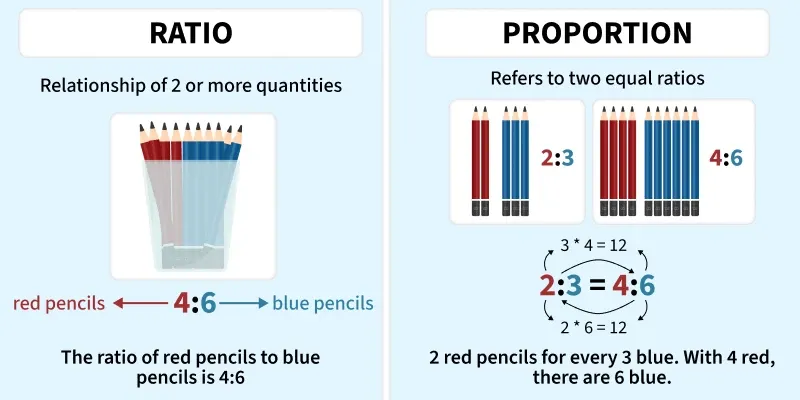
A ratio compares quantities in a specified order. Thus,
means
and can be represented as
for some common multiplier .
Dividing a total in a ratio
Suppose a fund of is divided between A and B in the ratio .
The total number of parts is
One part is
Therefore,
The important idea is that a ratio is not itself an absolute quantity. It specifies only the relative number of equal parts.
Using a difference instead of a total
If two numbers are in the ratio and their difference is , write them as and . Their difference is:
So,
The numbers are and .
Here, the difference in ratio parts, not their sum, is the relevant quantity.
Proportions
A proportion says that two ratios are equal:
Cross multiplication gives:
Use this only after preserving the order of quantities. For example, if machines make components in a fixed time, and all machines have equal productivity, then machines make components in the same time:
The correspondence must stay consistent: machines with machines, components with components.
Percentages: identify the base before applying the percent
The word “percent” means “per hundred.” Therefore:
The central relationship is:
The base is the quantity of which the percentage is taken.
For example, of is:
But if is what percent of , then:
These are inverse forms of the same relationship.
Percentage changes use the original value as the base
If a quantity changes from to , its percentage change is:
The denominator is the original quantity .
If a salary rises from to , the increase is . Therefore:
When wording says “ is more than ,” use as the base. “Than” usually identifies the comparison base.
Multipliers are faster than repeated percentage calculations
| Change | Multiplier |
|---|---|
| Increase by | |
| Decrease by | |
| Increase by | |
| Decrease by |
If a price first increases by and then decreases by , the final multiplier is:
So the final price is of the original price: an overall decrease of .
This is a classic trap. Equal percentage increases and decreases do not cancel because they use different bases.
Averages: work with totals, not intuition
An average is equal distribution of a total:
Equivalently:
Suppose five test scores have an average of . Their total is:
If a sixth score of is added, the new total becomes:
The new average is:
Adding, removing, or replacing an observation
For these questions, first recover the old total. Then modify that total.
- Adding a member: add the new value and increase the count.
- Removing a member: subtract the removed value and reduce the count.
- Replacing a value: subtract the old value, add the new one; the count stays unchanged.
Do not average two averages directly unless the two groups have equal sizes. If one group has students and another has , the second group must contribute four times as much to the combined average.
Profit, loss, discount, and the correct reference price
Use these terms precisely:
- Cost Price, : purchase price or investment.
- Selling Price, : price received on selling.
- Marked Price, : displayed or list price.
- Discount: reduction from marked price.
The core relationships are:
Profit or loss percentage is calculated on cost price. A discount percentage is calculated on marked price.
A layered price problem
An article has cost price . It is marked above cost price, and then a discount of is offered.
First calculate marked price:
Now apply the discount to :
Profit is:
Therefore profit percentage is:
A frequent error is to subtract the discount percentage directly from the markup percentage and conclude a profit. That does not work because the two percentages have different bases.
Rates and travel: distance, speed, and time
The fundamental identity is:
where is distance, is speed, and is time.
Its rearrangements are:
Keep units consistent
The standard conversion is:
For example:
Average speed is not usually an arithmetic mean
Average speed always means:
Suppose a car covers km at km/h and another km at km/h.
Time for the first part:
Time for the second part:
Thus:
It is not km/h. An arithmetic mean of speeds is valid only when the durations at those speeds are equal.
Relative speed
For objects moving in opposite directions, their separation changes at the sum of their speeds.
For objects moving in the same direction, their separation changes at the difference of their speeds.
If two trains travel towards each other at km/h and km/h, their relative speed is:
If they are km apart, meeting time is:
General Aptitude | Time and Distance in One Shot | GATE 2023
Watch “General Aptitude | Time and Distance in One Shot | GATE 2023” from GATE Wallah (English) for a concise visual review of the distance, speed, and time model and unit conversion.
Watch the foundation. Focus on setting up d = st with compatible units before attempting the example. The later parts of the video cover extensions such as trains and boats; leave those for focused practice after the basic model is automatic.
Time and work: convert completion times into daily rates
Time-and-work questions are rate questions. Instead of kilometres per hour, the rate is “fraction of the whole task per day.”
If A completes a task in days, A’s one-day work is:
If B completes the same task in days, B’s one-day work is:
Working together, their daily work is:
So the time required for one whole task is:
The central rule is:
Add workers’ rates, not their completion times.
Workers joining or leaving
When a worker leaves, split the problem into periods:
- Calculate the work completed in the first period.
- Subtract it from the whole work.
- Use the rate of the remaining workers for the unfinished part.
The same model handles pipes and cisterns. A filling pipe has a positive rate; a leak or outlet has a negative rate.
If one pipe fills a tank in hours and a leak empties it in hours, their combined rate is:
Thus, with the leak present, the tank fills in hours.
Direct and inverse relationships
With constant worker efficiency and daily hours:
- More workers means less time for the same work.
- More work means more time for the same workforce.
- More working hours per day means fewer days for the same work.
These are useful checks, but rate equations remain safer when the wording includes workers joining, leaving, working at different efficiencies, or changing schedules.
General Aptitude | Time and Work in One Shot | GATE 2023
Watch the selected portion of “General Aptitude | Time and Work in One Shot | GATE 2023” from GATE Wallah (English). It explains why direct and inverse proportion alone can become confusing, and why per-day work is the more reliable representation.
Begin with variable relationships to distinguish the roles of workers, work, and time. Then watch per day work, focusing on converting a completion time into a rate such as \frac{1}{n} task per day and combining rates.
A compact method for GATE arithmetic questions
Under time pressure, use this sequence:
-
Name the requested quantity.
Is the question asking for a share, a percentage, a price, a time, or a rate? -
Write the governing relation.
Examples include , , or . -
Identify the base.
For percentage, profit, loss, and discounts, explicitly write what quantity receives the percentage. -
Check units and direction.
If speed decreases for a fixed distance, time must increase. If a discount is applied, selling price must be lower than marked price. -
Estimate before finalising.
A discount should not produce a selling price greater than the marked price. Two workers together should not take longer than the faster worker working alone.
When reviewing a mistake, classify it accurately:
- A wrong formula or relation is a conceptual error.
- Choosing the wrong percentage base is an interpretation error.
- A fraction, sign, or arithmetic slip is a calculation error.
- Spending too long on routine arithmetic is a time-management error.
That classification will make later revision much more targeted than simply re-solving every question.
Key takeaways
Most GATE arithmetic problems reduce to a few stable models:
- A ratio can be represented as and .
- A proportion equates two consistently ordered ratios.
- Percentages require a clearly identified base; successive changes are handled with multipliers.
- Average is total divided by count, so adding or removing values should be handled through totals.
- Profit and loss percentages use ; discounts use .
- Travel problems rely on , with average speed calculated from total distance divided by total time.
- Work problems rely on rates: a task finished in days corresponds to a daily rate of .
In the next lesson, you will extend this numerical foundation to equations, inequalities, exponents, logarithms, and numerical sequences—tools that make more compact GATE aptitude questions manageable.
Can't find a good explanation? Sign up and we'll make it for you
Sign up