
Good to see you again. Last round focused on Earth’s reference lines: latitude, longitude, hemispheres, and the Equator. Now shift from where places are to the major physical features shown on a world map: continents, oceans, a past supercontinent, a polar desert, and an unusually large lake.
For tomorrow’s test, watch for what “largest” means. Asia is the largest continent; the Pacific is the largest ocean; Antarctica is the largest desert by area; and Lake Baikal is the largest freshwater lake by volume.
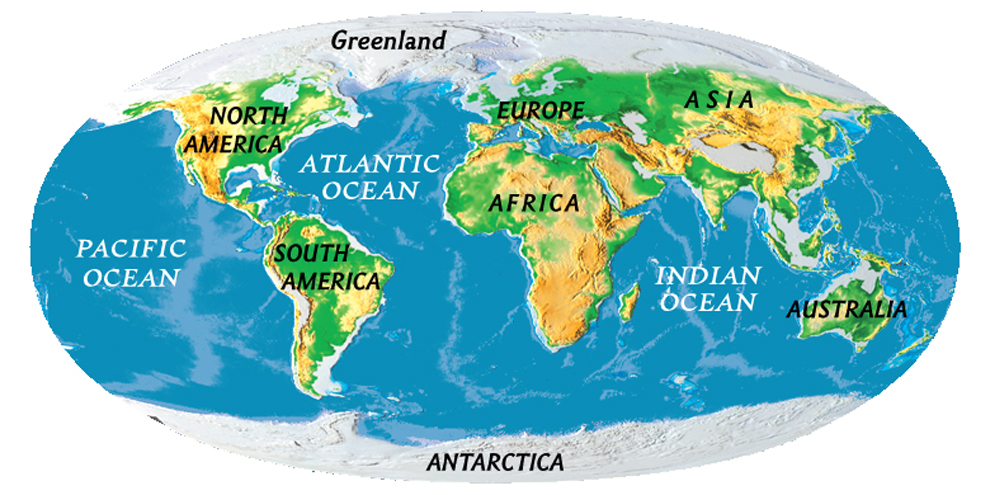
See the present-day world
A continent is one of Earth’s major land divisions. In the seven-continent model used in most U.S. classrooms, they are:
- Asia
- Africa
- North America
- South America
- Antarctica
- Europe
- Australia
The ranking above goes from largest to smallest. Therefore, the largest continent is ASIA.
Read National Geographic’s short introduction to confirm the seven-continent model and the size ranking you need for the test.
In the opening paragraph of the article, read the continent ranking. Then skim the following paragraph beginning “When geographers identify a continent” to reinforce that continents include associated islands. Focus on the first item in the ranking: Asia.
The Pacific Ocean is the largest ocean on Earth. It is also the deepest ocean basin. On a world map, it appears on both the left and right sides because flat maps cut the round Earth at a chosen point.
Use this NOAA Ocean Exploration fact page for a direct confirmation of the largest-ocean answer.
Read the opening statement and the next paragraph, from the Pacific’s size comparison. The test-level fact to retain is simply: Pacific equals largest ocean.
Fast map anchors
- ASIA: largest continent
- PACIFIC OCEAN: largest ocean
- ANTARCTICA: continent around the South Pole
- AUSTRALIA: smallest continent in this seven-continent model
Before today’s continents: Pangaea
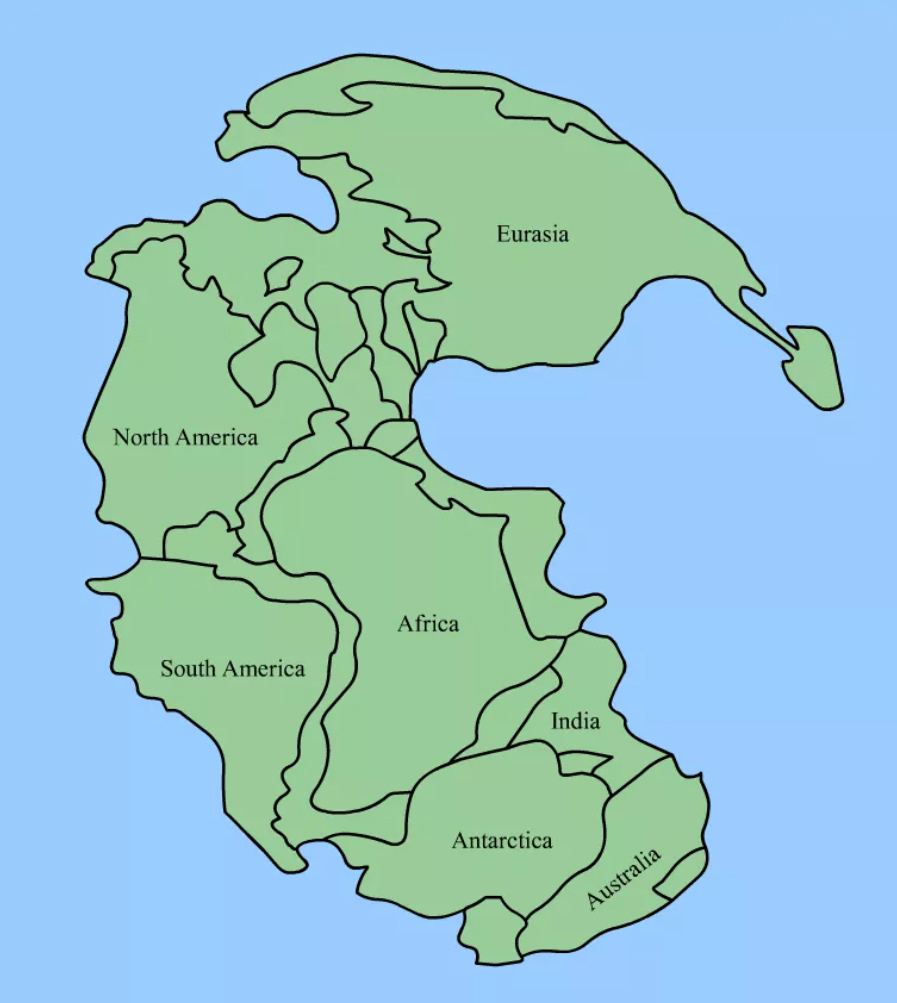
Earth’s continents have not always been in their current positions. More than 240 million years ago, most of Earth’s land was joined into one enormous supercontinent called PANGAEA. The name is often spelled Pangea as well; either spelling refers to the same supercontinent.
Over a very long time, tectonic plates moved, the supercontinent split apart, and its pieces gradually became the continents we recognize today. The map below helps make the idea visible: the shapes of South America and Africa fit together especially clearly.
What Is Pangaea & Plate Tectonic? | CONTINENTAL DRIFT | The Dr Binocs Show | Peekaboo Kidz
Watch the opening of “What Is Pangaea & Plate Tectonic?” by Peekaboo Kidz for a quick visual explanation of the supercontinent and why scientists concluded that continents were once joined.
Watch Pangaea’s introduction to lock in the definition and time period. If you have another minute, continue with the evidence, focusing on matching fossils and rock formations on continents now separated by the Atlantic Ocean.
A useful test association is:
| Clue in the question | Answer |
|---|---|
| “single huge supercontinent” | PANGAEA |
| “continents moving over time” | Continental drift |
| “largest continent today” | ASIA |
Two “largest” questions that need careful wording
Lake Baikal: largest by volume
Your original Question 18 seems to have a wording mistake: it asks what country the lake is “located in,” but its supplied answer is the name of a lake. The corrected test fact is:
Lake Baikal, in Siberia, Russia, is the world’s largest freshwater lake by volume.
This phrase by volume matters. Lake Baikal holds more freshwater than any other lake because it is extremely deep. If a question instead asks for the largest freshwater lake by surface area, the answer is Lake Superior. For your supplied study question, choose LAKE BAIKAL.
Antarctica: a cold desert
A desert is defined by receiving very little precipitation, not by being hot or sandy. Antarctica gets so little precipitation that it is a polar desert. Because it covers such a huge area, it is the world’s largest desert by area.
Antarctica | Destination World | Nat Geo Kids
Watch this brief segment from “Antarctica | Destination World” by Nat Geo Kids to correct the common misconception that every desert must be hot and sandy.
Watch Antarctica’s overview for its place among the seven continents. Then watch why it is a desert; focus on the low-precipitation definition of a desert and the comparison with the Sahara.
Do not let the word desert automatically make you think Sahara. The Sahara is the largest hot desert, but ANTARCTICA is the largest desert overall.
Blooket-style review: Questions 8, 9, 11, 18, 20, and 36
Answer in your head first, then check the all-capital reveal.
8. How many continents are in the standard school geography model?
A. 5
B. 6
C. 7
D. 8
ANSWER: 7
The seven are Asia, Africa, North America, South America, Antarctica, Europe, and Australia.
9. What was the giant supercontinent called?
A. Gondwana
B. Pangaea
C. Panthalassa
D. Laurasia
ANSWER: PANGAEA
Pangaea was the enormous joined landmass that later broke apart into today’s continents.
11. Which ocean is the largest?
A. Atlantic Ocean
B. Indian Ocean
C. Arctic Ocean
D. Pacific Ocean
ANSWER: PACIFIC OCEAN
The Pacific is the largest and deepest ocean basin.
18. Which lake is the largest freshwater lake in the world by volume?
A. Lake Superior
B. Lake Victoria
C. Lake Baikal
D. Great Salt Lake
ANSWER: LAKE BAIKAL
Lake Baikal is in Siberia, Russia. The words by volume make this answer accurate.
20. What is the largest continent?
A. Africa
B. Asia
C. North America
D. Antarctica
ANSWER: ASIA
Asia is larger in area than every other continent.
36. What is the largest desert in the world by area?
A. Sahara
B. Gobi
C. Arabian Desert
D. Antarctica
ANSWER: ANTARCTICA
Antarctica is a cold, polar desert because it receives very little precipitation.
Last-minute memory set
Memorize these six answers as a group:
| Question clue | Correct answer |
|---|---|
| Number of continents | 7 |
| Old supercontinent | PANGAEA |
| Largest ocean | PACIFIC OCEAN |
| Largest freshwater lake by volume | LAKE BAIKAL |
| Largest continent | ASIA |
| Largest desert by area | ANTARCTICA |
The big test skill here is reading the qualifier: continent, ocean, by volume, and by area lead to different answers. Next, you will review Earth’s layers and processes: lithosphere, magma and lava, relief, atmosphere, weathering, and erosion.
Can't find a good explanation? Sign up and we'll make it for you
Sign up