
Welcome back. Last lesson used careful wording to separate facts such as largest continent and largest desert by area. This round has a similar goal: a few of the supplied answers need correction. In particular, magma is underground, a glacier causes ice (glacial) erosion, and the solid outer rock layer is the lithosphere.
By the end, you should be able to identify Earth’s rocky and gaseous layers, distinguish magma from lava, define relief, and separate weathering from erosion before doing a fast Blooket-style review.
Earth’s systems: rock below, gases above
Earth can be described in connected “spheres.” For this test, concentrate on two:
- The lithosphere is the rigid, rocky outer layer of Earth. It includes the crust and the uppermost rigid part of the mantle.
- The atmosphere is the layer of gases surrounding Earth.

The diagram also shows the hydrosphere (water) and biosphere (living things), but do not mix them up with the two test answers above. A lake belongs to the hydrosphere; plants and animals belong to the biosphere; the air belongs to the atmosphere.
Inside the Earth [This Dynamic Earth, USGS]
Read the U.S. Geological Survey explanation because it gives the exact scientific meaning of lithosphere, beyond the test’s shorter clue, “solid rock portion of Earth.”
On the “Inside the Earth” page, read the paragraph beginning with the lithosphere explanation. Focus on the sentence explaining that the crust and upper mantle together form a rigid layer of rock. You only need to remember LITHOSPHERE for the question, but understanding its parts makes the word easier to recognize.
Test anchors
| Clue | Correct answer |
|---|---|
| Rigid, rocky outer layer | LITHOSPHERE |
| Layer of gases around Earth | ATMOSPHERE |
| Water on, under, or above Earth’s surface | Hydrosphere |
| Living things | Biosphere |
Magma becomes lava only at the surface
The words magma and lava name the same kind of material—molten rock—but its location determines the word.
- Magma is molten rock beneath Earth’s surface.
- Lava is magma that has erupted or flowed onto Earth’s surface.
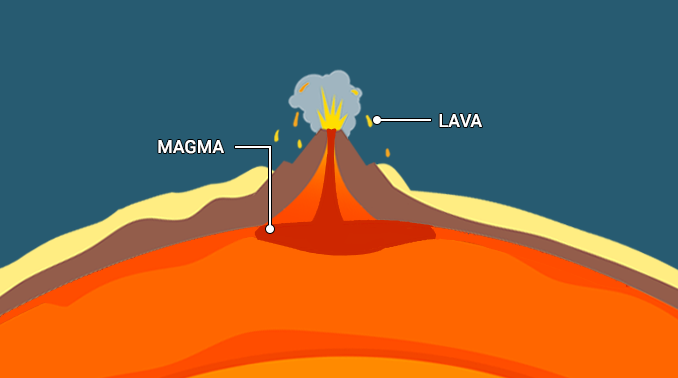
What is the difference between "magma" and "lava"? | U.S. Geological Survey
Read this short U.S. Geological Survey FAQ for the cleanest possible definition pair: the difference is location, not temperature or color.
Directly below the page title, read the central sentence. Say the contrast aloud once: “Magma is underground; lava is at the surface.”
Question 13 in the supplied list originally gives lava as the answer to “molten rock that can form in the mantle and rise through the crust.” That description is actually MAGMA. Once it reaches Earth’s surface, it becomes lava.
Question 19 is correct: “Magma that reaches Earth’s surface is lava” is TRUE.
Land shape: relief, weathering, and erosion
Relief is the difference in elevation between the highest and lowest points of a landform or area. A steep mountain has high relief because its summit is far above its base. A broad, nearly flat plain has low relief.
The spelling on the test should be RELIEF, not “releif.”
Weathering and erosion often happen together, but they are not the same process:
- Weathering breaks rock down into smaller pieces or changes the rock’s minerals.
- Erosion moves those broken pieces from one place to another.
- Sediment may eventually settle; that later process is called deposition.
For Question 32, acid rain is an example of chemical weathering. The acidic water reacts with minerals in rock and can slowly dissolve or change them. This is different from mechanical weathering, which breaks rock apart without changing what the rock is made of.
A glacier is a huge moving mass of ice. It scrapes rock, carries sediment, and reshapes land. Therefore, it is an example of ice erosion, also called glacial erosion. Gravity helps glaciers move downhill, but gravity is not the best answer when the question asks what type of erosion a glacier represents.
Weathering and Erosion | What Is the Difference between Weathering and Erosion?
Watch “Weathering and Erosion | What Is the Difference between Weathering and Erosion?” from Learn Bright for a quick visual distinction between breaking rock and moving sediment.
Watch the core difference to see weathering defined as breaking or changing rock and erosion as transport. Then watch weathering types, focusing on why a chemical reaction is chemical weathering. Finish with erosion agents, especially the explanation that glaciers are moving ice and that gravity can also move material in events such as rockfalls.
Do not mix up these pairs
| If the question says… | Choose… |
|---|---|
| Rock is broken down or chemically changed | Weathering |
| Sediment is carried away | Erosion |
| Acid reacts with rock minerals | Chemical weathering |
| Moving glacier wears away land | Ice (glacial) erosion |
| Difference between high and low elevations | Relief |
Blooket-style review: Questions 12, 13, 16, 17, 19, 32, and 37
Answer each in your head first. Then check the all-capital reveal immediately below it.
12. What is Earth’s rigid, rocky outer layer called?
A. Atmosphere
B. Hydrosphere
C. Lithosphere
D. Biosphere
ANSWER: LITHOSPHERE
The lithosphere includes Earth’s crust and the rigid uppermost mantle.
13. What is molten rock called while it is beneath Earth’s surface?
A. Lava
B. Magma
C. Sediment
D. Crust
ANSWER: MAGMA
Magma can form deep within Earth and rise through the crust. It is called lava only after it reaches the surface.
16. What is the difference in elevation between the highest and lowest parts of a landform?
A. Latitude
B. Relief
C. Weathering
D. Climate
ANSWER: RELIEF
High relief means a large elevation difference, such as from a mountain base to its summit.
17. What layer of gases surrounds Earth?
A. Biosphere
B. Lithosphere
C. Hydrosphere
D. Atmosphere
ANSWER: ATMOSPHERE
The atmosphere is the air surrounding Earth.
19. Magma that reaches Earth’s surface is called lava.
A. True
B. False
C. Both true and false
D. Neither true nor false
ANSWER: TRUE
The location change is what changes the name from magma to lava.
32. Acid rain is an example of which type of weathering?
A. Mechanical weathering
B. Chemical weathering
C. Biological weathering
D. Glacial erosion
ANSWER: CHEMICAL WEATHERING
Acidic water reacts with and changes minerals in rock.
37. A glacier is an example of which type of erosion?
A. Wind erosion
B. Water erosion
C. Ice (glacial) erosion
D. Gravity-driven mass movement
ANSWER: ICE (GLACIAL) EROSION
A glacier is moving ice that wears away rock and carries sediment.
Last-minute memory set
Memorize these corrected answers together:
- LITHOSPHERE: rigid rocky outer layer
- MAGMA: molten rock underground
- LAVA: molten rock at the surface
- RELIEF: difference in elevation
- ATMOSPHERE: layer of gases
- CHEMICAL WEATHERING: acid rain changes rock minerals
- ICE (GLACIAL) EROSION: glaciers wear away and move material
The major trap is to remember that weathering breaks or changes rock, while erosion moves it. Next, you will use these ideas with volcanoes, earthquakes, faults, geysers, and tsunamis.
Can't find a good explanation? Sign up and we'll make it for you
Sign up