
Welcome back. Last time, you separated magma from lava and learned that Earth’s surface is shaped by processes such as weathering and erosion. Now use that foundation for the geology-and-hazards part of the test: volcanoes, earthquakes, faults, geysers, and tsunamis.
This is a high-value correction round. Your original list has one major ranking error: the United States has many active volcanoes, especially in Alaska, but Indonesia has the most active volcanoes of any country. By the end, you should have nine fast answers ready for Blooket-style questions.
The location anchors: Indonesia, Alaska, Chile, New Madrid, and the Pacific
Start by locking in five place-answer pairs:
| Test clue | Correct answer |
|---|---|
| Most active volcanoes of any country | INDONESIA |
| Most U.S. earthquakes and active volcanoes | ALASKA |
| Largest earthquake ever recorded | CHILE |
| Seismic zone closest to Mt. Vernon, Illinois | NEW MADRID |
| Pacific zone with many volcanoes and earthquakes | RING OF FIRE |
30 Years Saving Lives from Volcanoes | U.S. Geological Survey
Read this short U.S. Geological Survey article to correct the volcano-ranking question. It explains why the United States is near the top but is not first.
In the section “Mutual Benefit to America,” read the ranking comparison. Then, under “Reflecting on the Past 30 Years,” find the subsection “Indonesia” and read the Indonesia description. Your test takeaway is that the United States is second to Indonesia in this comparison.
Indonesia versus Alaska
For Question 1, choose INDONESIA, not the United States. Indonesia sits along active plate boundaries and has many active volcanoes.
For Question 10, the intended answer is ALASKA. Alaska has the most earthquakes in the United States and contains most of the country’s active volcanoes. This makes sense geographically: southern Alaska and the Aleutian Islands lie on the edge of the Pacific Ocean, where tectonic plates interact intensely.
The wording “the vast majority” is a little too broad for a precise science statement, but for this test’s state-answer question, ALASKA is the answer to memorize.
Chile: the largest recorded earthquake
The largest earthquake measured by seismic instruments occurred in Chile on May 22, 1960. Its magnitude was . On the test, you only need the country: CHILE.
Earthquake Facts & Earthquake Fantasy
This U.S. Geological Survey page gives the most reliable evidence for the earthquake facts in this lesson: what an earthquake is, where the record earthquake happened, why the Pacific is especially active, and why New Madrid matters.
First, under “FACT: Earthquakes are sudden rolling or shaking events caused by movement under the Earth’s surface,” read the earthquake explanation. Next, in the paragraph immediately before the Ring of Fire image, read the Chile record. Under “FICTION: Earthquakes only occur on the West Coast in the United States,” read the New Madrid example. Finally, under “PARTIALLY FACT: California has the most earthquakes in the United States,” read the Alaska comparison.
New Madrid: the local Illinois connection
Mt. Vernon, Illinois, is closest to the New Madrid Seismic Zone. It is named for New Madrid, Missouri, but the zone affects a broader area around the central Mississippi River Valley, including parts of Missouri, Arkansas, Tennessee, Kentucky, and southern Illinois.
An earthquake does not have to happen on the West Coast. New Madrid is an important reminder that earthquakes can occur within a tectonic plate, not only at the edges of plates.

Why the Pacific Ring of Fire is so active
The Pacific Ring of Fire is a broad, horseshoe-shaped zone around much of the Pacific Ocean. It contains many volcanic chains, deep ocean trenches, faults, and earthquake zones. Alaska, Japan, Indonesia, New Zealand, and the west coasts of North and South America are all part of it.
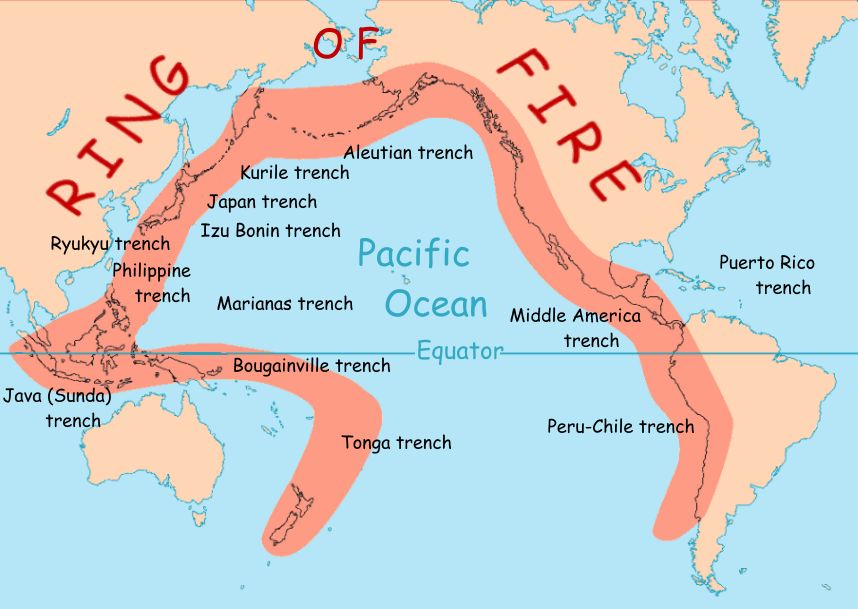
The key idea is plate movement. In many places around the Pacific, one tectonic plate is forced beneath another. This is called subduction. The plates may stick because of friction, allowing stress to build. When the rocks suddenly slip, an earthquake occurs. Subduction also helps produce magma, which can feed volcanoes.
Why 90% of Earthquakes Happen Here: The Ring of Fire Explained
Watch “Why 90% of Earthquakes Happen Here: The Ring of Fire Explained” from Beneath the Depths for a quick visual explanation of where the Ring of Fire is and why plate boundaries there produce hazards.
Watch the opening map to place the Ring of Fire around the Pacific basin. Then watch the plate explanation. Focus on the definition of subduction and on how a deep trench, earthquakes, and volcanoes can be connected.
For Question 21, do not choose “Pacific Ocean” by itself. The question asks for the area within and around the Pacific where many volcanoes are found. The specific name is RING OF FIRE.
Three hazard terms that must stay separate
These terms are connected, but they name different things.
| Term | What it is | Test clue |
|---|---|---|
| Earthquake | Ground shaking caused by sudden movement on a fault | Plates collide or slide; ground shakes |
| Volcano | An opening or vent in Earth’s crust where molten rock, gas, and ash may erupt | Magma or lava erupts from Earth |
| Tsunami | A series of large ocean waves caused by sudden displacement of seawater | Giant ocean wave after an undersea disturbance |
Earthquake
An earthquake is the shaking of the ground caused by a sudden slip along a fault, which is a break in Earth’s crust. Moving tectonic plates create stress. When the rocks can no longer hold that stress, they slip and release energy.
For Question 43, choose EARTHQUAKE.
Volcano
A volcano is an opening in Earth’s crust, often building into a mountain, through which molten rock, gases, ash, and other materials can erupt. Recall the key fact from the previous lesson:
- Underground molten rock is magma.
- Once it reaches the surface, it is lava.
Your original question’s wording is not perfectly scientific because it describes erupting material rather than the landform or vent itself. But if the choices include volcano, earthquake, tsunami, and tornado, choose VOLCANO.
Tsunami
A tsunami is not simply one unusually large wave. It is a series of powerful ocean waves caused when a large amount of water is suddenly displaced. Underwater earthquakes are a common cause, especially near subduction zones. Underwater landslides and volcanic eruptions can also cause tsunamis.
A tsunami can cross an entire ocean. The 1960 Chile earthquake, for example, generated waves that affected places across the Pacific. For Question 45, choose TSUNAMI.
Geyser
A geyser is different from a volcano. It is a hot spring that periodically erupts hot water and steam because underground water is heated and pressurized. The famous U.S. example is Old Faithful, located in Yellowstone National Park in Wyoming.
For Question 22, choose OLD FAITHFUL.
Blooket-style review: Questions 1, 10, 14, 15, 21, 22, and 43–45
Answer in your head first, then check the reveal immediately below.
1. Which country has the most active volcanoes?
A. United States
B. Indonesia
C. Japan
D. Chile
ANSWER: INDONESIA
Indonesia is the world’s most volcanically active nation. The United States is second in the USGS comparison.
10. Which U.S. state has the most earthquakes and most active volcanoes?
A. California
B. Hawaii
C. Alaska
D. Washington
ANSWER: ALASKA
Alaska’s location along the Pacific Ring of Fire explains its high earthquake and volcano activity.
14. What major seismic zone is closest to Mt. Vernon, Illinois?
A. San Andreas
B. New Madrid
C. Cascadia
D. Aleutian
ANSWER: NEW MADRID
The New Madrid Seismic Zone is centered near the central Mississippi River Valley.
15. In which country did the largest earthquake ever recorded occur?
A. Japan
B. Indonesia
C. United States
D. Chile
ANSWER: CHILE
The 1960 Chile earthquake had a magnitude of , the largest measured by seismic instruments.
21. What Pacific region has many volcanoes and earthquakes?
A. Tornado Alley
B. Ring of Fire
C. Great Rift Valley
D. Sahara Desert
ANSWER: RING OF FIRE
The Ring of Fire follows active plate boundaries around much of the Pacific Ocean.
22. Which is a famous geyser in the United States?
A. Mount St. Helens
B. Old Faithful
C. Death Valley
D. Niagara Falls
ANSWER: OLD FAITHFUL
Old Faithful is a geyser in Yellowstone National Park.
43. What is a violent shaking of Earth caused by sudden movement along a fault?
A. Volcano
B. Tsunami
C. Earthquake
D. Hurricane
ANSWER: EARTHQUAKE
Earthquakes release energy when rocks suddenly slip along a fault.
44. What is an opening in Earth’s crust through which magma, gases, and ash may erupt?
A. Volcano
B. Earthquake
C. Glacier
D. Geyser
ANSWER: VOLCANO
Magma is underground; once it erupts onto the surface, it is called lava.
45. What is a series of large ocean waves caused by sudden movement of seawater?
A. Tornado
B. Tsunami
C. Blizzard
D. Drought
ANSWER: TSUNAMI
Underwater earthquakes are a common cause of tsunamis.
Last-minute memory set
Memorize this geographic sequence:
- INDONESIA: most active volcanoes by country
- ALASKA: most U.S. earthquakes and active volcanoes
- NEW MADRID: nearby seismic zone for southern Illinois
- CHILE: largest recorded earthquake
- RING OF FIRE: Pacific zone of volcanoes and earthquakes
- OLD FAITHFUL: famous U.S. geyser
- EARTHQUAKE: sudden fault movement shakes the ground
- VOLCANO: a vent where magma, gases, and ash can erupt
- TSUNAMI: a series of large ocean waves caused by displaced water
The biggest correction to remember is INDONESIA, not the United States, for the world’s most active volcanoes. Next, you will shift from geologic hazards to atmosphere-related questions: hurricane warnings, weather, and global warming.
Can't find a good explanation? Sign up and we'll make it for you
Sign up