
Good to see you again. In the last lesson, you reviewed hazards produced by Earth’s internal activity: earthquakes, volcanoes, and tsunamis. This lesson moves to the atmosphere: how hurricanes are warned about, what weather means, and what causes modern global warming.
These three questions are easy to mix up because they all involve the atmosphere, but each has one precise test answer. Your goal is to recognize the clue words quickly and select the matching term.
29. Can hurricanes occur with no warning?
The test statement is:
“Hurricanes can occur with no warning.”
The correct answer is FALSE.
Hurricanes are tracked by meteorologists using satellites, aircraft, ocean observations, radar, and computer forecasts. While weather forecasts are never perfect and a storm can strengthen quickly, coastal areas are normally given watches and warnings before hurricane conditions arrive.
The most important distinction:
| Alert | Meaning | Timing |
|---|---|---|
| Hurricane Watch | Hurricane conditions are possible. | Usually issued about 48 hours before tropical-storm-force winds may begin. |
| Hurricane Warning | Hurricane conditions are expected. | Usually issued about 36 hours before tropical-storm-force winds may begin. |
Get Weather Ready - During a Hurricane
Watch “Get Weather Ready – During a Hurricane” from usoceangov. It gives a quick, practical explanation of the difference between a hurricane watch and a hurricane warning.
Watch watch and warning. Focus on the timing: a watch means possible impacts within two days, while a warning means dangerous conditions are expected within about a day and a half.
For the test, do not overthink unusual situations. The statement says hurricanes happen with no warning, which is too absolute. Hurricane watches and warnings exist precisely because forecasts give people time to prepare.
Blooket-style question 29
Can hurricanes occur with no warning?
A. True
B. False
C. Only in winter
D. Only over land
ANSWER: FALSE
34. Weather: conditions now, at a particular place
Weather is the condition, or state, of the atmosphere at a certain time and place. It includes conditions such as temperature, precipitation, wind, humidity, cloud cover, and air pressure.
For example:
- “It is 72 degrees, cloudy, and windy in Mt. Vernon this afternoon” describes weather.
- “Southern Illinois usually has warm summers and cold winters” describes climate.
A useful test clue is the time scale:
| If the question mentions... | Think... |
|---|---|
| Today, tomorrow, this afternoon, current conditions | WEATHER |
| Usual conditions over many years or decades | CLIMATE |
Read the National Weather Service’s short definition to lock in the exact wording your test is asking for.
Near the beginning of the page, just below the Mark Twain quotation, find the bold word “Weather.” Read the definition. Notice the two anchors: a given time and place.
Weather changes from hour to hour because atmospheric conditions keep shifting. Climate is the larger pattern found by looking at weather records over a long period. Therefore, one cold day does not disprove a long-term warming trend, just as one hot day does not by itself prove one.
Blooket-style question 34
What is the condition of the atmosphere at a particular location and time?
A. Climate
B. Weather
C. Erosion
D. Latitude
ANSWER: WEATHER
35. Global warming and the greenhouse effect
Your original question asks:
“What do most scientists think is the cause of global warming?”
For this test, the expected answer is GREENHOUSE EFFECT. More precisely, scientists identify the human-enhanced greenhouse effect as the main cause of current global warming.
The natural greenhouse effect is necessary for life. Certain gases in the atmosphere, including water vapor, carbon dioxide, and methane, absorb and re-emit some of the infrared energy Earth gives off after being warmed by the Sun. This helps keep the planet warmer than it would otherwise be.
The problem is that people have increased the amount of some greenhouse gases, especially carbon dioxide, mainly by burning fossil fuels such as coal, oil, and natural gas. More greenhouse gases strengthen the heat-trapping effect. That is why the accurate full idea is:
Human activities increase greenhouse gases, strengthening the greenhouse effect and causing modern global warming.
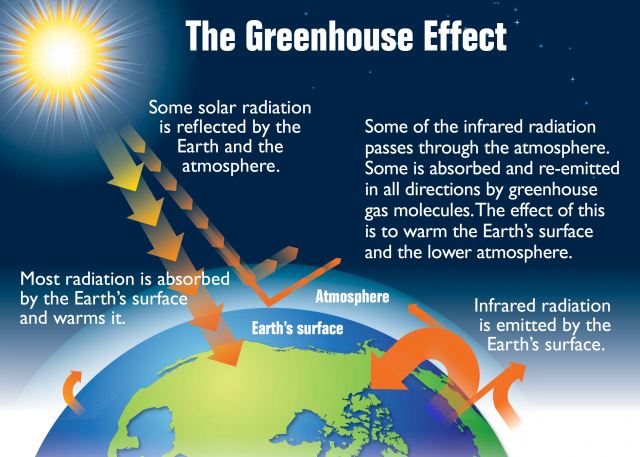
The diagram does not mean that all heat is trapped permanently. Some infrared radiation continues outward into space. The warming occurs because increased greenhouse gases change Earth’s energy balance, so more energy is retained in the climate system.
Weather Versus Climate Change | Cosmos: A Spacetime Odyssey
Watch the selected clips from National Geographic’s “Weather Versus Climate Change | Cosmos: A Spacetime Odyssey.” They separate short-term weather from long-term climate, then identify the major driver of current climate change.
First, watch weather and climate for the short-term versus long-term distinction. Then watch carbon dioxide, which connects rising carbon dioxide from fossil-fuel use to the extra retention of warmth.
Blooket-style question 35
What is the main cause of current global warming?
A. The greenhouse effect strengthened by human greenhouse-gas emissions
B. One unusually hot summer
C. Earth moving closer to the Sun every year
D. Hurricanes forming over warm water
ANSWER: GREENHOUSE EFFECT
For a short classroom question, select GREENHOUSE EFFECT. If a written-response question asks you to explain, use the more complete phrase: the enhanced greenhouse effect caused by increased greenhouse gases, especially carbon dioxide from burning fossil fuels.
Three-question speed review
29. Hurricanes can occur with no warning.
A. True
B. False
C. Only in the Pacific
D. Only at night
ANSWER: FALSE
34. The condition of the atmosphere at a particular time and place is called:
A. Climate
B. Weather
C. Relief
D. Region
ANSWER: WEATHER
35. What is the test-answer cause of global warming?
A. Chemical weathering
B. The greenhouse effect
C. Plate tectonics
D. Ocean tides
ANSWER: GREENHOUSE EFFECT
Last-minute memory set
-
HURRICANES CAN OCCUR WITH NO WARNING: FALSE
Hurricane watches and warnings provide advance notice. -
ATMOSPHERE AT A PARTICULAR TIME AND PLACE: WEATHER
-
CAUSE OF CURRENT GLOBAL WARMING: GREENHOUSE EFFECT
More accurately: the enhanced greenhouse effect from human-added greenhouse gases.
Next, you will review the remaining severe-weather vocabulary: tornadoes, hurricanes, typhoons, blizzards, and droughts.
Can't find a good explanation? Sign up and we'll make it for you
Sign up