
Introduction
Welcome back. In our previous lesson, we established the central problem of Immanuel Kant's philosophy: How are synthetic a priori judgments possible? We saw that for Kant, the fundamental principles of mathematics and natural science (like "7 + 5 = 12" and "Every event has a cause") were both informative about the world (synthetic) and known with necessity and universality (a priori). He argued that David Hume's empiricism, which denied the possibility of such knowledge, would lead to a corrosive skepticism that undermines science itself.
The solution, we briefly noted, was Kant's "Copernican Revolution": the idea that our mind doesn't just passively receive information, but actively structures it. In this lesson, we will explore the details of this solution. You will learn the crucial concepts that form the architecture of Kant's system.
Our learning outcome is to explain the distinction between phenomena and noumena, and the role of the 'categories of understanding' in structuring experience. By the end of this lesson, you will understand how Kant solves his own problem by arguing that synthetic a priori knowledge is possible for the world as we experience it, precisely because our minds are the source of its fundamental structure.
1. The Two Worlds: Phenomena and Noumena
Kant's Copernican Revolution leads to a profound conclusion: we must distinguish between the world as it appears to us and the world as it is in itself, independent of our minds.
A helpful way to grasp this is through the "spectacles" metaphor. Imagine everyone is born wearing a pair of irremovable green spectacles. Everything you see appears green. You might assume "greenness" is a property of the world itself, but it's actually contributed by your spectacles. You can know with a priori certainty that any object you experience will be green, not because you've seen all objects, but because you know the nature of the "instrument" through which you see them.
This first video introduces this metaphor and uses it to explain Kant's core distinction.
Introduction to Kant's Incredible Critique of Pure Reason (see text box for recommended readings)
This clip from the teachphilosophy channel provides an excellent introduction to Kant's famous distinction between the 'phenomenal' world (what we see through our 'spectacles') and the 'noumenal' world (the world as it is in itself, which we can never access).
Watch from the beginning to 03:18. Focus on understanding the spectacles metaphor and how it illustrates the difference between the phenomenal and noumenal realms.
Let's formalize these terms:
- Phenomena: (singular: phenomenon) This is the world of appearances; the world as we experience it, already structured by the faculties of our mind (our "spectacles"). This is the world of science, of space, time, and causality. Kant argues we can have objective, certain knowledge of this world.
- Noumena: (singular: noumenon) This is the world of "things-in-themselves" (Dinge an sich); reality as it exists independently of our minds. According to Kant, we can think about this realm, but we can never know anything about it, because to know it, we would have to take our "spectacles" off, which is impossible.
This distinction is the core of Kant's philosophy, known as Transcendental Idealism. It's "idealist" because the fundamental structure of our experienced world (space, time, causality) is mind-dependent. However, it's also a form of Empirical Realism because, within that mind-structured phenomenal world, we can have real, objective knowledge of objects that exist outside of us.
This next reading provides a good summary and importantly distinguishes Kant's view from Berkeley's more radical idealism.
Immanuel Kant: Metaphysics - Internet Encyclopedia of Philosophy
The Internet Encyclopedia of Philosophy provides a clear overview of Transcendental Idealism. Reading these sections will help solidify your understanding of the phenomena/noumena split and clarify how Kant can be both an idealist and a realist.
Please read sections 4 ('Kant’s Transcendental Idealism') and the final two paragraphs of section 3 ('Kant's Copernican Revolution: Mind Making Nature'). Focus on these points: How the mind's receptive capacity (sensibility) and conceptual capacity (understanding) act as sources of constraints on knowledge. Why space and time are considered a priori 'forms of sensibility.' The difference between Kant's 'Transcendental Idealism' and Berkeley's idealism. Kant's status as an 'empirical realist.'
2. The Mind's Toolkit: Sensibility and Understanding
So, what exactly are these "spectacles"? Kant divides the mind's structuring apparatus into two main faculties:
- Sensibility: The passive, receptive faculty that receives raw sensory data ("intuitions"). But it's not purely passive; it imposes the a priori forms of space and time on all incoming data. We can't experience anything except in space and time.
- Understanding: The active, conceptual faculty that takes the spatiotemporal data from sensibility and organizes it into a coherent experience of objects, properties, and relations. It does this using a set of innate concepts called the Categories.
Kant famously summarized the relationship between these two faculties: "Thoughts without content are empty; intuitions without concepts are blind."
- Thoughts without content are empty: The understanding, with its categories, has nothing to think about without raw data from the senses.
- Intuitions without concepts are blind: Raw sensory data, without being organized by the categories, would be a meaningless "blooming, buzzing confusion" (to borrow a phrase from William James), not an experience of distinct objects.
The video you watched earlier explains this point well, noting how the mind synthesizes raw sensations like 'green,' 'rough,' and 'brown' into the unified concept of a 'tree.' This act of synthesis is the work of the understanding and its categories.
3. The Categories of Understanding
The categories are the fundamental rules for thinking, the pure concepts of the understanding that we apply to all experience. They are the specific "lenses" within our spectacles. Kant derived his list of categories from the logical forms of judgment, believing he had found the complete and necessary set of rules for all rational thought.
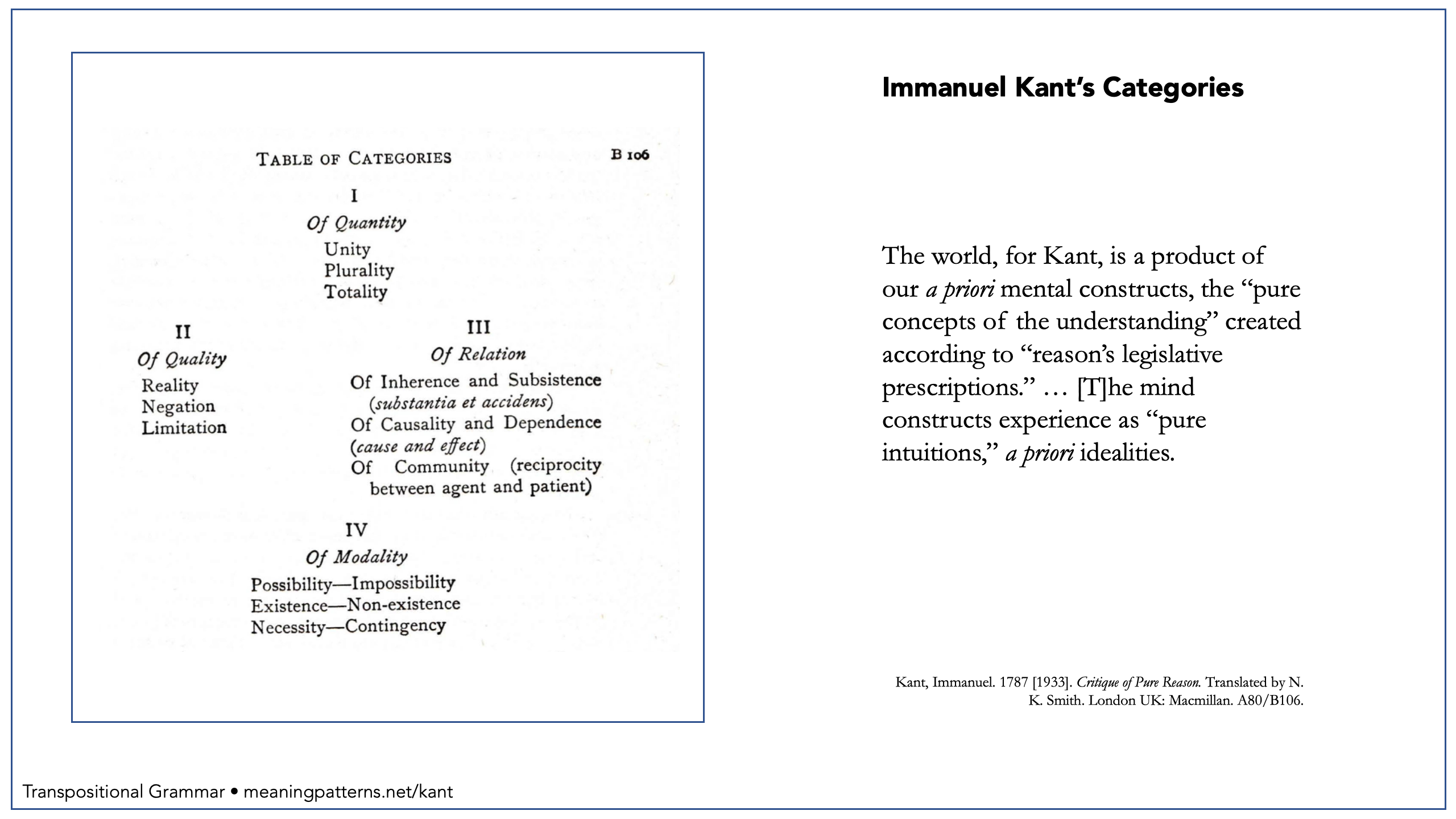
Let's focus on the most important ones to see how they work:
- Substance (from Relation): The mind organizes sensations so that some aspects are perceived as qualities inhering in an underlying, persisting substance. This is how we perceive a 'ball' that 'is red' and 'is round', rather than just a free-floating jumble of redness and roundness.
- Causality (from Relation): The mind connects events in time according to a rule, where one event (the cause) is understood to necessitate another (the effect).
- Unity/Plurality/Totality (from Quantity): The mind groups intuitions into single objects (unity), multiple objects (plurality), or complete sets of objects (totality).
This next video provides a clear and systematic explanation of the categories and how they apply only to the phenomenal realm.
Professor Daniel Bonevac provides a more detailed walkthrough of Kant's categories. This will clarify how these innate concepts are derived from the logical functions of judgment and give concrete examples.
Please watch the following two segments: The Four Families of Categories (07:15 - 17:10): Listen for the explanation of the four main groups: Quantity, Quality, Relation, and Modality. You don't need to memorize every sub-category, but aim to understand how concepts like 'substance' and 'causality' fit into this scheme as a priori mental structures. Application to Phenomena (19:05 - 25:28): This is a crucial part. Focus on Bonevac's explanation that these categories and the principles derived from them (like 'every event has a cause') apply only to phenomena (objects of experience) and tell us nothing about noumena (things-in-themselves).
The example of causality is particularly powerful. As we saw in the previous lesson, Hume argued we never experience a necessary connection between events, only constant conjunction. Kant agrees, but turns the tables. The necessity doesn't come from the world to us; it is imposed by our minds on the sequence of appearances to make them intelligible as an objective series of events. Without the category of causality, we couldn't distinguish between our subjective sequence of perceptions (looking around a house) and an objective, irreversible sequence of events (a ship sailing downstream).
4. How Can Pure Concepts Apply to Sensible Data? The Schematism
You might be asking: how can a pure, abstract concept like 'causality' or 'substance' (from the understanding) apply to concrete sensory data like colors and sounds (from sensibility)? There seems to be a gap between them.
Kant addresses this in one of the most difficult but ingenious parts of his Critique, the chapter on "Schematism." His solution is that there must be a mediating representation, something that is both pure/intellectual and sensible. That "third thing" is time.
Each category has a corresponding transcendental schema, which is a rule for applying the category in time.
- The schema for substance is the persistence of the real in time.
- The schema for causality is rule-governed succession in time.
- The schema for community is rule-governed coexistence (simultaneity) in time.
The schema is not an image; it is a rule for producing images and ordering perceptions. This is your most challenging reading for this lesson, but it gets to the heart of how the mind actively constructs experience.
Critique of Pure Reason - The Schematism
We now turn to the primary text. This section from the 'Critique of Pure Reason' is where Kant explains how the pure categories of the understanding are applied to appearances through the mediating role of time. The translation and commentary from Jonathan Bennett are designed to make this difficult text more accessible.
Please read Chapter 1, 'The schematism of the pure concepts of the understanding' (pages 90-95 in the PDF). Focus on understanding: Why a 'mediating representation' (a 'transcendental schema') is needed to connect pure concepts to appearances. Why this schema must be related to time. The distinction between a schema (a rule) and an image (a particular product). Kant's example of the concept 'dog' is helpful here. Look at the descriptions of the schemas for categories like substance and cause. Notice how they are all defined in terms of time (persistence, succession, etc.).
By showing that the categories are applied via temporal rules, Kant has finally completed his answer. Synthetic a priori knowledge is possible because space and time (forms of sensibility) and the categories (forms of understanding, applied via schemata) are the necessary preconditions for having any objective experience at all. We can know a priori that every event we experience will have a cause, because "rule-governed succession in time" is the very rule our mind uses to construct the experience of events.
Conclusion
In this lesson, we have unpacked the core of Kant's "Copernican Revolution." We have moved from identifying his central problem to understanding his complex and powerful solution.
Key Takeaways:
- Kant distinguishes between phenomena (the world as it appears to us, structured by our minds) and noumena (the unknowable world of things-in-themselves).
- Our mind structures experience using two faculties: sensibility, which provides the a priori forms of space and time, and the understanding, which provides the a priori categories.
- The categories are pure concepts like substance and causality that organize sensory data into an intelligible, objective reality. Kant's key slogan is "intuitions without concepts are blind."
- The schematism explains how abstract categories are applied to sensory intuitions via rules that are based in time.
- This entire framework explains how synthetic a priori knowledge is possible: we can know necessary truths about the phenomenal world because our minds are the source of its fundamental structure.
Preview of the Next Lesson:
This framework has radical implications. If the categories of understanding (like causality, substance, and necessity) are only validly applied to the phenomenal world of experience, what happens when philosophers try to use them to prove things about the noumenal realm? In our next lesson, we will analyze Kant's critique of traditional rationalist metaphysics, using his refutation of the ontological argument for God's existence as a prime example. You will see how Kant uses his own system to diagnose the errors of his predecessors and to set strict limits on the legitimate use of pure reason.
Can't find a good explanation? Sign up and we'll make it for you
Sign up