
Introduction
Welcome back. In our last lesson, we explored the core of Kant's "Copernican Revolution"—his argument that our mind actively structures our experience of the world. The crucial takeaway was the distinction between phenomena (the world as we experience it, shaped by our mental faculties) and noumena (the unknowable world of things-in-themselves). You learned that the "categories of the understanding"—pure concepts like causality, substance, and necessity—are only validly applied to the phenomenal realm. As Kant put it, "concepts without intuitions are empty."
This lesson examines the profound consequences of that idea. What happens when philosophers misuse reason and apply these concepts to the noumenal realm, to things we can never experience? According to Kant, the result is traditional rationalist metaphysics, a field filled with insoluble disputes and logical fallacies.
Today's learning outcome is to analyze Kant's critique of traditional rationalist metaphysics, using his refutation of the ontological argument as an example. We will enter the part of the Critique of Pure Reason known as the "Transcendental Dialectic," where Kant systematically dismantles the arguments of his rationalist predecessors concerning the soul, the world as a totality, and God.
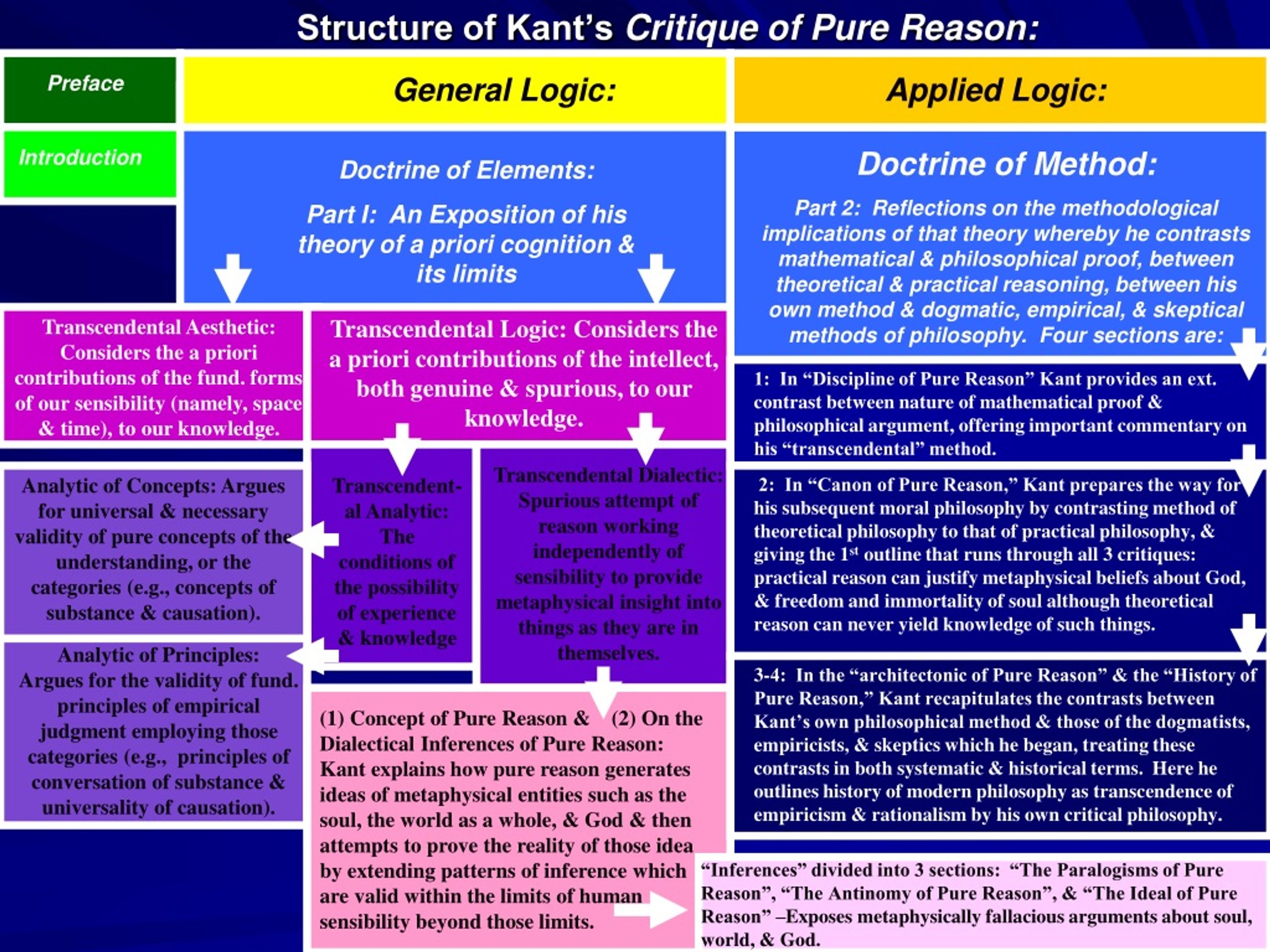
By the end of this lesson, you will understand why Kant believed that metaphysics, as a speculative science aiming for knowledge of ultimate reality, is impossible.
1. The Source of Metaphysical Error: Reason's Demand for the Unconditioned
If applying concepts beyond experience is an error, why do we do it? Kant's answer is that it's not a simple mistake but a natural and unavoidable tendency of human reason itself.
To understand this, we must distinguish between two faculties:
- The Understanding (Verstand): As we saw, this faculty applies categories to sensory data to organize experience. It always works with conditioned things (e.g., event A is caused by event B, which is conditioned by event C, and so on).
- Reason (Vernunft): This is a higher faculty that seeks unity and completeness. It is not satisfied with endless chains of conditions. Reason's defining characteristic is its demand for the unconditioned—the ultimate cause, the final ground, the absolute totality that would bring our knowledge to completion.
This demand leads reason to form three "Transcendental Ideas":
- The Soul: The unconditioned unity of all our thoughts (the thinking subject).
- The World: The unconditioned totality of all appearances (the complete series of causes and effects).
- God: The unconditioned ground of all possibility (the ultimate being that grounds everything else).
The problem, which Kant calls transcendental illusion, is that reason naturally mistakes these necessary ideas for knowable objects. It hypostatizes them, treating them as if they were real entities we could have knowledge about. Kant's project in the Dialectic is to expose this illusion.
The following reading from the Stanford Encyclopedia of Philosophy explains this process in detail.
Kant's critique of metaphysics - Stanford Encyclopedia of Philosophy
This article, 'Kant's Critique of Metaphysics,' provides an excellent scholarly overview of the Transcendental Dialectic. This first section will explain the theoretical foundation of Kant's critique.
Please read Section 2.1, 'The Theory of Reason and Transcendental Illusion.' Focus on: The distinction between the logical function of reason (seeking principles) and its real use. The central role of the 'unconditioned.' The definition of 'transcendental illusion' as taking a subjective necessity of thought for an objective reality. How reason's demand for the unconditioned leads to the three main ideas: Soul, World, and God.
2. The Critique of Rational Theology
Kant argues that all of traditional "rational theology"—the attempt to prove God's existence through pure reason—is a product of this transcendental illusion. Reason posits the idea of a supremely perfect and necessary being (ens realissimum) as the unconditioned ground of all reality. It then mistakenly believes it can prove this idea corresponds to an actual object.
Before we dive into the complex arguments, this short video gives a clear, high-level summary of why, according to Kant's framework, God must be considered noumenal and therefore unknowable.
This video from the channel 'dead theologians' provides a very accessible application of the phenomena/noumena distinction to the question of God's existence.
Watch the segment from 03:24 to 07:26. Pay attention to how the speaker uses the analogy of a radio wave to explain the concept of a noumenal reality and why this makes it impossible for us to describe or have knowledge of God.
Kant identifies three main types of speculative arguments for God's existence:
- The Ontological Argument: Argues from the very concept of God to his necessary existence.
- The Cosmological Argument: Argues from the existence of a contingent thing to the existence of a necessary being.
- The Physico-Theological Argument (Argument from Design): Argues from the observed order and purpose in the universe to the existence of an intelligent designer.
Kant's strategy is to show that the cosmological and physico-theological arguments ultimately depend on the ontological argument. Therefore, if he can demolish the ontological argument, the entire edifice of rational theology collapses with it.
3. Case Study: The Demolition of the Ontological Argument
The ontological argument, most famously formulated by Anselm and Descartes, claims that existence is a perfection and is therefore part of the very concept or essence of God. To deny God's existence would be a contradiction, like denying that a triangle has three sides.
Kant's refutation is one of the most famous critiques in the history of philosophy. His central claim is that "being is obviously not a real predicate."
A "real predicate" is a property that adds to our concept of a thing, helping to determine or describe it. For example, in "the ball is red," the predicate "red" adds to my concept of the ball. Kant argues that "exists" does not function this way. It does not add a new property to the concept; it merely posits the object itself, with all its properties, as existing in reality.
Let's engage directly with Kant's own words on this.
[PDF] “Existence Is Not a Predicate” by Immanuel Kant
We will now read the crucial section from the Critique of Pure Reason where Kant explains his refutation. This is the heart of today's lesson.
Please read the two pages titled '[Existence Is Not a Property]' and the section with the image of the Thalers. Focus on these two key points: The synthetic nature of existential propositions: Kant argues that any statement about existence (e.g., 'X exists') must be synthetic, meaning it adds new information not contained in the concept of X. Why can't the denial of an existential proposition be a contradiction? The 'hundred real dollars' (Thalers) example: How does this famous analogy illustrate that 'existence' does not add anything to the concept of a thing?
To summarize Kant's reasoning:
- The concept of "one hundred possible dollars" and the concept of "one hundred real dollars" are identical. They contain the same number of dollars with the same properties.
- The difference is not in the concept, but in the fact that the real dollars are instantiated in the world of experience—they relate to my perception.
- The ontological argument treats "existence" as if it were just another property on a checklist of perfections. But you cannot add "existence" to a concept to make it real. To know if something exists, you must go outside the concept and find it in experience.
- Since God is, by definition, a noumenal being who cannot be an object of experience, no existential proposition about God can ever be proven.
This next video provides a helpful lecture-style explanation of Kant's entire critique of rational theology, starting with the ontological argument.
A History of Philosophy | 54 Kant on Metaphysics
In this video from his 'A History of Philosophy' series, Dr. Arthur Holmes walks through Kant's critique of all three major theistic proofs.
Watch the segment on Rational Theology from 34:11 to 44:07. Dr. Holmes will explain: Kant's refutation of the ontological argument, reinforcing what you just read. How the cosmological argument illicitly jumps from the phenomenal to the noumenal and secretly relies on the ontological argument. How the physico-theological (design) argument, at best, proves an 'architect' and also must fall back on the ontological argument to prove the God of theology.
By showing that all three paths of speculative reason lead to failure, Kant concludes that we can have no theoretical knowledge of God's existence.
Conclusion: "Doing Away with Knowledge to Make Room for Belief"
Today we have seen how Kant uses the framework established in his theory of knowledge to systematically critique the ambitions of traditional metaphysics. He argues that trying to prove the existence of the soul, the ultimate nature of the world, or the existence of God through pure reason is a "transcendental illusion."
Key Takeaways:
- Kant's critique of metaphysics stems from a natural tendency of Reason to seek the unconditioned, leading it to form ideas (Soul, World, God) that it mistakenly treats as knowable objects.
- This error, transcendental illusion, involves the illegitimate application of the categories of the understanding beyond the bounds of possible experience (phenomena) to the realm of things-in-themselves (noumena).
- Kant's refutation of the ontological argument serves as a prime example. His central point is that "existence is not a real predicate"; it adds nothing to the concept of a thing but merely posits it.
- Since other proofs like the cosmological and design arguments ultimately rely on the ontological argument to reach their conclusion, the entire project of rational theology fails.
This might seem like a purely negative project, but Kant's famous statement was that he "found it necessary to deny knowledge, in order to make room for faith [or belief]." By showing the limits of what theoretical reason can prove, he believes he has protected religion and morality from the attacks of skeptics. If you can't prove God exists, you also can't disprove it. Reason is simply silent on the matter.
Preview of the Next Lesson:
Having closed the door on theoretical reason's claims to know God, Kant will open another door: practical reason. In our next lesson, we will turn to Kant's ethics. We will explore his distinction between hypothetical and categorical imperatives and begin to see how morality provides a completely different, non-theoretical basis for thinking about concepts like freedom, immortality, and God.
Can't find a good explanation? Sign up and we'll make it for you
Sign up