
Introduction
Welcome back. In our last lesson, we explored Immanuel Kant's "Copernican Revolution"—his groundbreaking idea that to have objective knowledge, our minds don't passively conform to objects, but rather objects must conform to the active, structuring faculties of our minds. This was his answer to the impasse between the dogmatic claims of rationalism and the corrosive skepticism of empiricism.
We concluded by noting that this revolution was designed to answer a very specific and profound question. Today, we will unpack that question. To do so, we need to learn Kant's specialized vocabulary for classifying judgments. This lesson is foundational for understanding the rest of Kant's project.
Our learning outcome is to distinguish between analytic/synthetic and a priori/a posteriori judgments to frame the problem of synthetic a priori knowledge. By mastering these distinctions, you will grasp the central problem that Kant believed all of modern philosophy had to solve: "How is synthetic a priori knowledge possible?"
1. Two Fundamental Distinctions
Kant organized all possible judgments along two independent axes. One distinction is epistemological (about how we know something), and the other is semantic (about the meaning of the statement itself).
Let's break them down. This first video provides a very clear introduction to both distinctions with helpful examples.
Epistemology: A Priori vs. A Posterior; Analytic vs. Synthetic; Necessary vs. Contingent
This video from the teachphilosophy channel clearly defines and illustrates the two key pairs of terms we need: a priori/a posteriori and analytic/synthetic. It provides a solid foundation for everything that follows.
Please watch from the beginning until 08:54. First part (00:14 - 05:13): Focus on the distinction between a priori (justified without experience) and a posteriori (justified through experience). Pay attention to the important clarification that this is about the method of proof, not how you first learned the concept. Second part (05:13 - 08:54): Focus on the distinction between analytic (predicate contained in the subject) and synthetic (predicate adds new information).
Let's formalize those definitions.
The A Priori / A Posteriori Distinction (How We Justify)
This distinction concerns the justification for a judgment.
- A Priori: A judgment is known a priori if its justification does not depend on any particular experience. We can know it "prior to" looking at the world. These judgments possess necessity (they couldn't be otherwise) and strict universality (they apply everywhere, without exception).
- Example: "All bachelors are unmarried." You don't need to survey bachelors to know this is true.
- A Posteriori: A judgment is known a posteriori if its justification does depend on experience. We know it "after" or through sensory evidence. These judgments are contingent (they could have been otherwise) and empirical.
- Example: "My desk is made of wood." You must observe the desk to know this.
The Analytic / Synthetic Distinction (What We Mean)
This distinction concerns the relationship between the concepts in a judgment, specifically between the subject and the predicate.
- Analytic: A judgment is analytic if the predicate concept is already "contained within" the subject concept. These judgments are explicative—they don't add new knowledge but merely clarify or analyze the subject concept. They are essentially true by definition.
- Example: "A triangle has three angles." The concept 'three angles' is part of the definition of 'triangle'.
- Synthetic: A judgment is synthetic if the predicate concept is not contained within the subject concept. These judgments are ampliative—they synthesize (combine) distinct concepts to add new information and expand our knowledge.
- Example: "The triangle on the board is green." The concept 'green' is not part of the definition of 'triangle'.
2. Combining the Distinctions: Hume's Fork
Before Kant, empiricist philosophers like David Hume effectively recognized only two categories of meaningful statements. This view is often called Hume's Fork.
- Analytic a priori: These are Hume's "relations of ideas." They are necessary truths known by reason alone, but they are purely definitional and tell us nothing new about the world (e.g., all geometry, basic logic).
- Synthetic a posteriori: These are Hume's "matters of fact." They tell us about the world, but they are learned from experience and can never be known with necessity or universality. All scientific observations fall into this category.
For Hume, any statement that didn't fit into one of these two categories was not genuine knowledge. This created a massive problem, as this next video explains.
Immanuel Kant's Philosophy - Bryan Magee & Geoffrey Warnock (1987)
In this classic discussion, Geoffrey Warnock explains to Bryan Magee how Hume's dichotomy created a 'serious predicament' for both philosophy and science. This sets the stage for Kant's revolutionary insight.
Watch the segment from 08:44 to 10:56. Focus on why, if analytic a priori and synthetic a posteriori are the only types of propositions, then fundamental scientific laws and metaphysical claims seem impossible to justify.
As you just saw, Hume's Fork leaves no room for propositions that are both informative about the world (synthetic) and known with necessity and universality (a priori). Yet, the fundamental laws of science ("Every event has a cause") and the truths of mathematics ("7 + 5 = 12") seem to be exactly this kind of proposition. They aren't just definitions, but we also don't believe they are merely probable generalizations from experience.
3. Kant's Innovation: The Synthetic A Priori
This is where Kant makes his crucial move. He argues that Hume's Fork is a false dichotomy. There is a third, vital category of judgment.
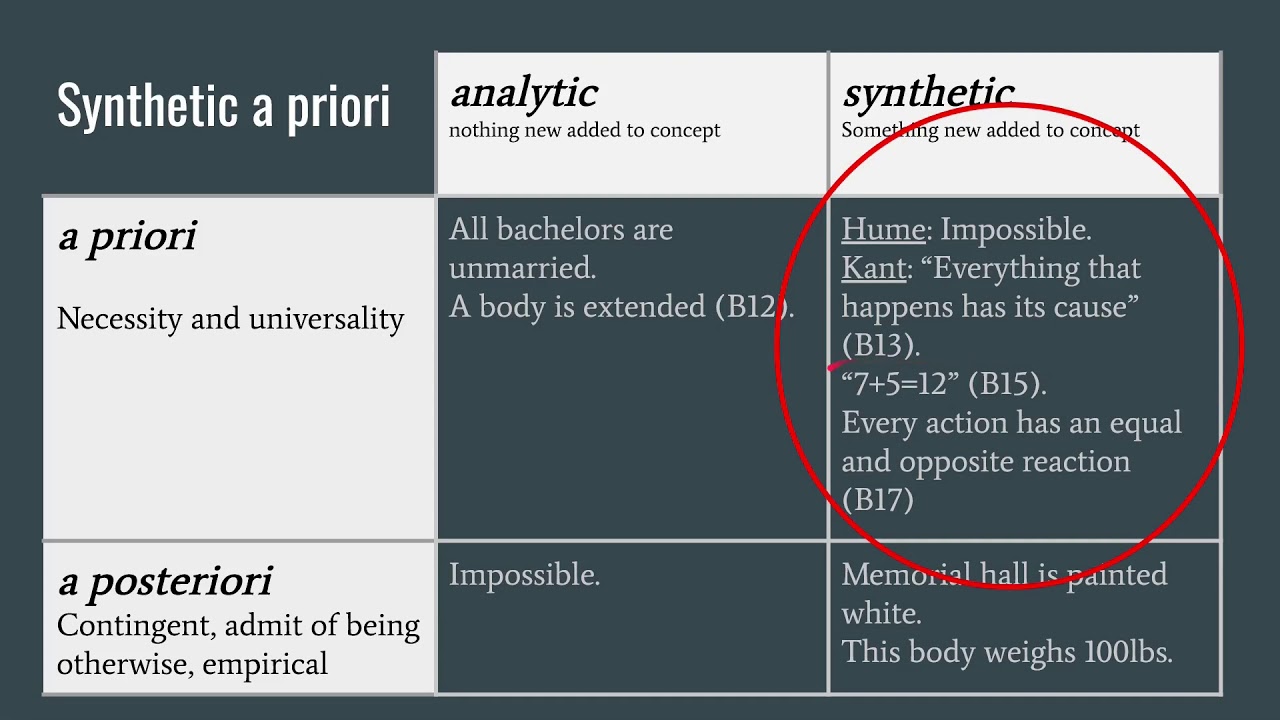
Synthetic a priori judgments are propositions that are:
- Synthetic: They are ampliative; the predicate adds new information not contained in the subject. They tell us something about reality.
- A Priori: They are known with necessity and universality, independent of any specific experience.
For Kant, these judgments form the bedrock of genuine knowledge. His central task in the Critique of Pure Reason is to demonstrate that they exist and to explain how they are possible.
Let's examine Kant's primary examples.
Kant on the Synthetic A Priori
This text, 'Kant on the Synthetic A Priori,' provides a more detailed, academic look at Kant's arguments. It will walk you through his reasoning for why judgments in mathematics and metaphysics must be synthetic a priori.
Please read two sections from this page: Start at the heading 'The Synthetic A Priori' and read to the end of that section. Focus on Kant's argument about the proposition, 'Everything that happens has its cause.' Why does he think the concept of 'cause' is not contained in the concept of 'something that happens'? Continue to the next section, 'Mathematics and the Synthetic A Priori,' and read it completely. Pay close attention to Kant's analysis of '7 + 5 = 12.' Why isn't the concept '12' simply part of your concept of 'the sum of 7 and 5'?
To summarize the key arguments from the reading:
- Causality ("Every alteration must have a cause"): Kant agrees with Hume that the concept of 'cause' is not analytically contained in the concept of 'an alteration'. However, unlike Hume, who concluded it must be a habit of mind derived from experience, Kant insists we cognize this connection with necessity. Since experience can never provide necessity, this judgment must be a priori. Therefore, it is synthetic a priori.
- Mathematics ("7 + 5 = 12"): Kant argues that the concept of "the sum of 7 and 5" only contains the idea of uniting two numbers. The specific result, 12, is not found by simply analyzing that concept. You must perform an act of synthesis—in this case, an act of "construction in intuition" (like counting on your fingers or visualizing units)—to arrive at 12. Because this result is necessary and universal, not an empirical observation, mathematical judgments are also synthetic a priori.
4. Framing the Central Question
Kant's entire critical project is structured around answering one main question, which he breaks down into smaller ones: How are synthetic a priori judgments possible?
- How is pure mathematics possible?
- How is pure natural science possible?
- How is metaphysics, as a science, possible?
The "Copernican Revolution" we discussed last lesson is his answer. Synthetic a priori judgments are possible because our mind actively imposes a structure on reality. We can know a priori that every event will have a cause because "causality" is one of the "categories" our mind uses to organize sensory data into intelligible experience. We can know mathematical truths a priori because space and time are the "forms of intuition" through which we perceive anything at all.
Kant himself saw this question as the key that could unlock—or doom—all of metaphysics. He stresses its importance in his Prolegomena to Any Future Metaphysics.
Prolegomena to any Future Metaphysic
In this excerpt from his own work, Kant directly addresses his critics, emphasizing that they have missed the entire point of his philosophy by ignoring his central problem.
Please read the two short paragraphs indicated: Find the paragraph beginning 'But my suspicion that they didn’t is not unfounded...'. Here, Kant explicitly states that the possibility of synthetic a priori knowledge is 'the real problem on the solution of which the fate of metaphysics wholly rests'. Find the paragraph beginning 'If anyone thinks himself wronged in this, he can easily refute my charge...'. Notice how he challenges any opponent to produce just one synthetic metaphysical proposition proven a priori, highlighting how difficult this is without his new framework.
This direct engagement with Kant's own text shows how central this problem was. He wasn't just classifying sentences; he was trying to establish the very possibility of knowledge that goes beyond mere definitions or contingent observations.
Conclusion
In this lesson, we have assembled the conceptual toolkit necessary to understand Kant's main project. By breaking down judgments into these four categories, Kant was able to precisely diagnose the failure of past philosophy and frame the question he needed to answer.
Key Takeaways:
- Judgments can be classified along two axes: a priori / a posteriori (based on their justification) and analytic / synthetic (based on their meaning).
- Hume's Fork recognized only two valid categories: analytic a priori ("relations of ideas") and synthetic a posteriori ("matters of fact").
- Kant's key innovation was to identify a third, crucial category: synthetic a priori judgments. These are propositions that expand our knowledge (synthetic) but are known with necessity and universality (a priori).
- He argued that the core principles of mathematics and natural science are synthetic a priori.
- Kant's central philosophical question is: "How are synthetic a priori judgments possible?" His "Copernican Revolution" is the answer.
Preview of the Next Lesson:
Now that we have defined Kant's problem, we can explore his solution in more detail. In the next lesson, we will delve deeper into the consequences of the Copernican Revolution by analyzing the crucial distinction between phenomena (the world as we experience it) and noumena (things-in-themselves), and we'll see how the mind's "categories of understanding" are the tools that make synthetic a priori knowledge of the phenomenal world possible.
Can't find a good explanation? Sign up and we'll make it for you
Sign up