
Hello! Welcome to the next lesson in our module on "Building a High-Performance Marketing Organization."
In our last lesson, we focused on the human side of data-driven transformation, exploring how to identify and mitigate organizational resistance. You learned that fostering a receptive culture is the essential first step. However, a great culture is not enough; your team also needs the right tools to succeed. Making the wrong technology investment can be costly, drain resources, and undermine the very data-driven culture you're trying to build.
Today's learning outcome is to develop a scorecard for evaluating and selecting analytics vendors or marketing technology. We will move from the art of managing people to the science of making objective, defensible technology decisions. This lesson will provide you with a structured framework to evaluate complex options, justify investments to stakeholders, and ensure the tools you choose directly support your strategic business goals.
1. The High Cost of a Bad Decision
In the martech landscape, which boasts over 10,000 solutions, it's easy to be swayed by a polished sales pitch or a competitor's success story. However, an unstructured approach is risky. One industry analysis suggests that over 60% of martech implementations fail to deliver the expected ROI, often due to poor vendor selection.
As a leader, your role is to replace this guesswork with a rigorous, data-driven process. The vendor scorecard is your primary instrument for achieving this. It transforms a subjective choice into an objective comparison, allowing you to make a decision based on evidence and strategic fit.
2. A Four-Step Framework for Vendor Evaluation
A robust evaluation process provides structure and clarity. We'll use a proven four-step framework as our guide for this lesson.
To begin, please read this short article from Gartner, a leading technology research firm. It outlines a systematic approach that we will build upon.
How to Evaluate Technology Vendors Properly
This article, 'How to Evaluate Technology Vendors Properly,' provides a high-level strategic framework. It introduces the four key steps that will structure our discussion.
Read the entire article, focusing on understanding the four main steps: 1) Put the right team in place, 2) Set the criteria, 3) Score the vendors, and 4) Finalize your shortlist. Don't worry about the specific details of Gartner's products; focus on the process.
As the article outlines, the four key steps are:
- Assemble the Buying Team: Before you even look at vendors, bring together a cross-functional team (Marketing, IT, Finance, etc.). This relates directly to our previous lesson on breaking down silos and ensures all perspectives are considered from the start.
- Set the Evaluation Criteria: Define what "good" looks like before you see any demos. This is the core of your scorecard.
- Score the Vendors: Systematically assess each potential partner against your predefined criteria.
- Finalize and Decide: Use the scores and qualitative data to create a shortlist and make a final, evidence-backed decision.
We will now dive deep into steps 2 and 3: building and using the scorecard.
3. Building Your Scorecard: From Business Goals to Criteria
A scorecard is only as good as the criteria it contains. A common mistake is to focus too heavily on features. A strategic evaluation requires a more holistic view. Gartner's five categories provide an excellent starting point, which we will enrich with marketing-specific examples.
To see how these categories apply directly to martech, please review the following resource.
Martech Vendor Evaluation Framework: 15-Point Checklist
This 'Martech Vendor Evaluation Framework' provides a detailed, 15-point checklist that we can map to our five main categories. It offers concrete examples relevant to your role.
Read the sections 'Pre-Evaluation Preparation' and 'The 15-Point Martech Vendor Evaluation Framework.' As you read, notice how the 15 points can be grouped into the five broader categories we're about to discuss.
Let's integrate these ideas into a comprehensive set of criteria for your scorecard.
Category 1: Functional Fit
- What it is: Does the tool do what you need it to do? This goes beyond a simple feature list.
- Key Questions for Your Scorecard:
- Alignment with Objectives: How well does the platform support your North Star Metric and primary business goals (e.g., customer acquisition, LTV optimization)?
- Feature Completeness: Does it have the core capabilities your team needs to execute their jobs? (e.g., Does the attribution tool model both online and offline touchpoints?)
- Usability & User Experience (UX): Is the interface intuitive for different user types (analysts, campaign managers)? A powerful tool with poor UX will suffer from low adoption.
Category 2: Technical Fit
- What it is: How well does the tool fit into your existing technology ecosystem? Your computer science background gives you an edge here, allowing you to ask deeper, more strategic questions of your IT counterparts.
- Key Questions for Your Scorecard:
- Integration Capabilities: Does it have native integrations with your critical systems (e.g., CRM, data warehouse)? Does it have a well-documented API for custom connections?
- Scalability and Performance: Can the platform handle your expected data volume and user load, especially during peak seasons? Ask for performance benchmarks.
- Data Security & Compliance: Does it comply with relevant regulations (e.g., GDPR, CCPA)? Where is the data stored? What are the data encryption and backup policies?
Category 3: Support & Services
- What it is: A great tool is useless without great support during and after implementation.
- Key Questions for Your Scorecard:
- Implementation & Onboarding: What does the implementation process look like? Is it self-serve, partner-led, or fully supported by the vendor? What is the timeline and what internal resources are required?
- Training & Change Management: What training resources are available (e.g., documentation, live sessions, localized materials)? How do they support team adoption?
- Ongoing Support: What are the Service Level Agreements (SLAs) for support tickets? Is there a dedicated customer success manager?
Category 4: Vendor Health & Vision
- What it is: You are not just buying a product; you are entering a long-term partnership.
- Key Questions for Your Scorecard:
- Company Stability: Is the vendor financially stable? Are they a startup or an established player?
- Product Roadmap: Is there a clear, innovative vision for the product's future? A stagnant roadmap is a major red flag.
- Customer References: Can they provide references from companies similar to yours in size and industry?
Category 5: Pricing & Commercials
- What it is: Understanding the true cost and contractual obligations.
- Key Questions for Your Scorecard:
- Total Cost of Ownership (TCO): Look beyond the license fee. What are the costs for implementation, training, additional user seats, or API calls? Calculate the TCO over a 3-year horizon.
- Contract Flexibility: Scrutinize lock-in clauses, renewal terms, and upgrade paths. Are there termination clauses if the tool doesn't meet expectations?
- Exit Strategy: If you decide to switch vendors in the future, how easy is it to get your data out? This is a critical but often overlooked point.
4. Weighting and Scoring: Making the Scorecard Work
Once you have your criteria, the next step is to assign weights and scores. This is what makes the scorecard a powerful decision-making tool.
1. Weighting: Reflect Your Priorities
Not all criteria are created equal. You must assign a weight to each criterion or category based on its importance to your business. For example, if integrating with your proprietary CRM is a must-have, the "Integration Capabilities" criterion might get a weight of 25%, while "Vendor social media presence" might get 1%.
2. Scoring: Keep it Simple and Consistent
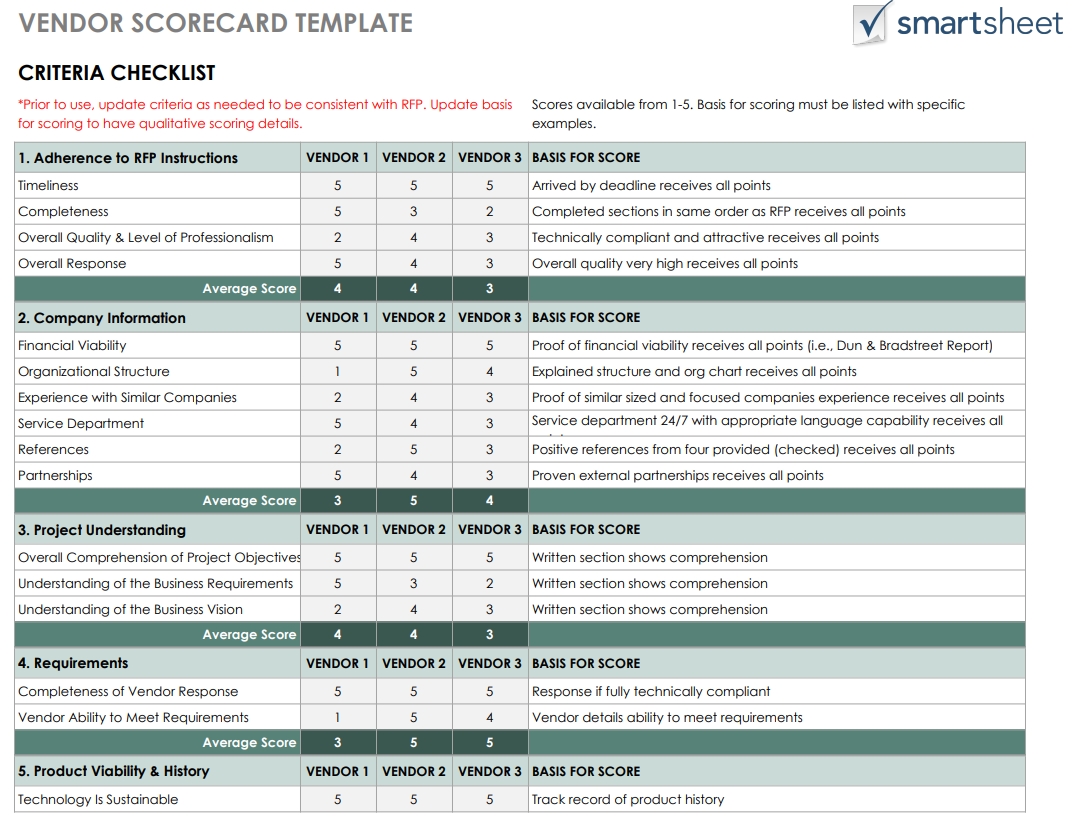
Use a simple scale, such as 1 (Poor) to 5 (Excellent), to rate each vendor against each criterion. The key is to apply the same standard to every vendor to ensure a fair comparison.
Here is an example of what a simple scorecard might look like.
For a more advanced view that incorporates weighting, consider this example.
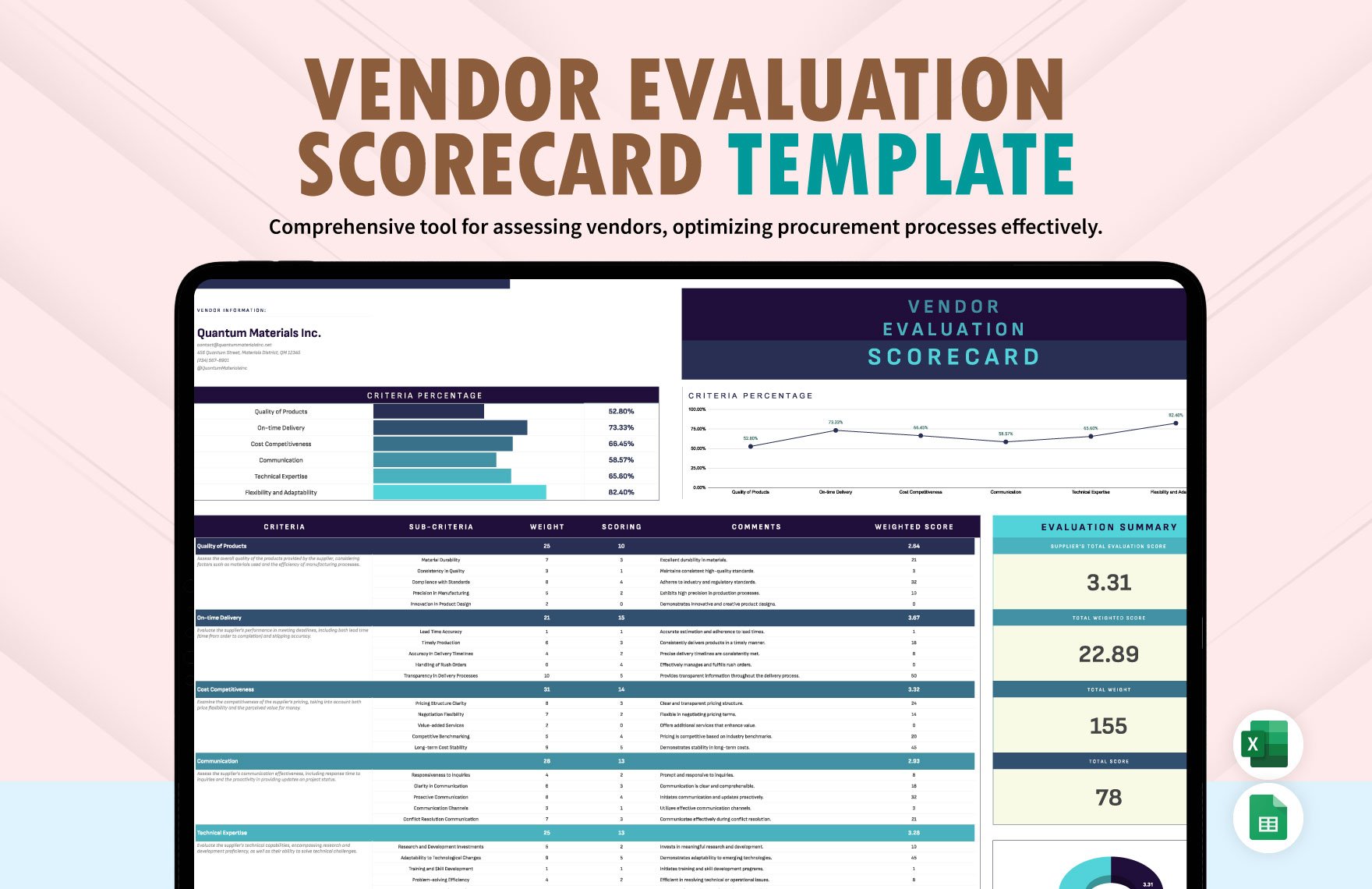
The final score for each vendor is a weighted average, calculated by multiplying each criterion's score by its weight and summing the results. This gives you a single number for comparison, grounded in your strategic priorities.
5. Beyond the Score: Qualitative Due Diligence
The scorecard provides the quantitative foundation for your decision, but it's not the whole story. You must supplement it with qualitative research.
- Run a Proof-of-Concept (POC): This is perhaps the most critical step. Ask your top 1-2 shortlisted vendors to run a POC with your actual data and a real business use case. This moves beyond a canned demo to a real-world test of the tool's capabilities and your team's ability to use it.
- Check References: Don't just accept the glowing case studies from the vendor's website. Ask to speak with current customers who are similar to you. Ask them pointed questions: "What was the biggest surprise during implementation? What do you wish the tool did better? How responsive is their support team?"
- Consult Third-Party Research: Leverage independent reviews from firms like Gartner or Forrester, and user review sites like G2 or Capterra, to validate vendor claims and get an unbiased perspective.
Test your understanding!
Imagine your company is looking to invest in a new Marketing Mix Modeling (MMM) platform. Your primary business objective is to optimize budget allocation across channels to maximize incremental revenue, but your team has limited data science resources.
Based on this scenario, identify three critical evaluation criteria for your scorecard. For each criterion, assign a hypothetical weight (as a percentage) and briefly justify your weighting.
Show answer
Here is a sample answer:
-
Criterion: Model Usability & Interpretation
- Weight: 40%
- Justification: Given the limited data science resources, the platform must be highly usable for marketing strategists and analysts, not just data scientists. The ability to easily interpret outputs like response curves and contribution charts is paramount for the tool to be adopted and used for budget decisions. This functional requirement is the most critical factor for success.
-
Criterion: Implementation Support & Training
- Weight: 35%
- Justification: MMM implementation is complex. Since the internal team lacks deep expertise, the vendor's ability to provide robust onboarding, training, and ongoing strategic support is almost as important as the tool itself. A great tool with poor support will likely fail.
-
Criterion: Integration with Financial Data Systems
- Weight: 25%
- Justification: To prove the model's value and directly link marketing spend to revenue, the platform must seamlessly integrate with our financial data systems to pull spend data and push back ROI forecasts. While important, this is a technical requirement that can potentially be solved with some IT effort, making it slightly less critical than the direct usability and support needed by the marketing team itself.
Conclusion
Choosing the right technology is a strategic leadership function. By replacing gut feelings with a structured evaluation process centered on a weighted scorecard, you can de-risk major investments, ensure alignment with business goals, and build a defensible case for your decisions.
Key Takeaways:
- Structure is paramount: A systematic process is essential for making sound technology decisions and avoiding costly mistakes.
- The scorecard is your central tool: It allows for objective, evidence-based comparison of vendors.
- Criteria must be holistic: Your scorecard should cover functional fit, technical compatibility, vendor support, vendor health, and commercial terms.
- Weighting reflects strategy: Assigning weights to criteria ensures your final decision is aligned with what matters most to your business.
- Don't skip due diligence: The scorecard is a guide, not a final answer. Always supplement it with qualitative research like reference checks and a proof-of-concept.
Preview of Your Next Lesson:
You've learned how to foster a data-driven culture and how to select the right tools. The final piece of the puzzle is the people. In our next lesson, you will learn to "Define the core roles, responsibilities, and skillsets for a modern marketing analytics function." We will explore how to structure your team to get the most value out of the culture you've built and the tools you've chosen.