
Hello! Welcome to the first lesson of our final module, "Building a High-Performance Marketing Organization."
In our last lesson, you mastered one of the most important skills for a marketing leader: presenting a complex analytical finding in a simple, persuasive manner using the Situation-Complication-Resolution framework. You learned how to build a compelling, data-backed case for strategic change.
However, even the most logical and well-presented argument can be met with skepticism, inertia, or outright opposition. This is where leadership truly begins. Your ability to drive change depends not just on the quality of your insights, but on your ability to navigate the human and organizational dynamics that resist it.
Today, your learning outcome is to identify common sources of organizational resistance to data-driven marketing and develop mitigation strategies. This lesson will equip you with the frameworks to understand why resistance happens and the practical strategies to overcome it, transforming you from an analyst into a change agent.
1. Understanding the Landscape of Resistance
It’s tempting to think of resistance as individuals being difficult, but the reality is more complex. Resistance is often a systemic response to change. The sources can be structural, psychological, or practical.
This diagram provides a useful high-level overview of the challenges you'll face. We'll focus primarily on the "Change Management and Resistance" bubble, but you'll see how it's deeply connected to data silos and security concerns.
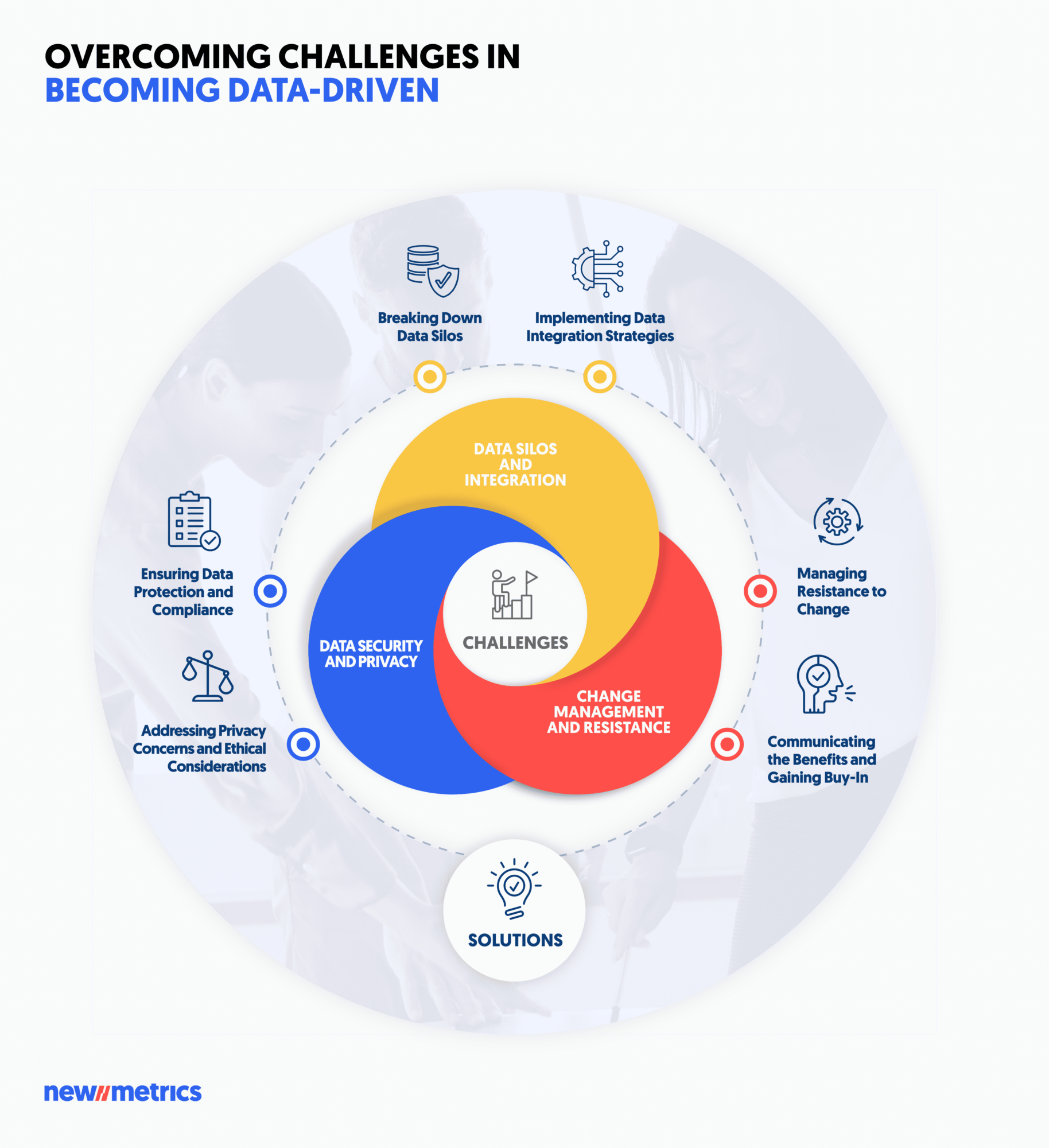
Let's break down these sources of resistance into more specific categories that you will encounter in a marketing context.
To begin, please watch this video which outlines five common reasons why data-driven initiatives fail to take hold in an organization's culture.
5 Pieces Of Advice On How To Create A Data Driven Culture
This video from Lights On Data provides an excellent overview of the foundational barriers that create resistance. As you watch, think about which of these you've personally experienced in your career.
Watch from 01:20 to 10:18. Pay close attention to the five key pieces of advice, as they highlight five corresponding problems: data inaccessibility, lack of top-down support, poor data literacy, undefined terms (metadata), and siloed analytics teams.
Based on the video and other common scenarios, the key sources of resistance you'll face as a marketing leader include:
- Fear and Skepticism: People fear what they don't understand. A new data-driven approach can feel like a threat to job security, established expertise, or familiar workflows. Team members may be skeptical of the "black box" and doubt the validity of the data or models.
- Lack of C-Suite Buy-in: If senior leadership doesn't champion a data-driven culture, any bottom-up efforts will hit a ceiling. Without top-down support, securing resources and enforcing new decision-making processes is nearly impossible.
- Organizational Silos: As your experience with Google Ads, Meta Ads, and SEO has likely shown, marketing departments are often structured in channel-specific silos. A data-driven approach that recommends shifting budget from one channel to another can ignite turf wars and political battles. The
Think with Googleguide on attribution highlights "Internal politics" and "silo structure" as primary blockers. - Poor Data Literacy & Accessibility: If your team can't access the data or doesn't know how to interpret it, they can't use it. Resistance can be a symptom of feeling ill-equipped. This is often coupled with a lack of clear definitions—if "customer," "conversion," or "ROI" mean different things to different teams, trust in the data erodes.
- Inertia (The "We've always done it this way" syndrome): Organizations, like people, are creatures of habit. The comfort of the status quo is a powerful force. Sticking with last-click attribution, for example, is often easier than embracing a more complex but more accurate model.
2. A Framework for Change: The Law of Diffusion
Now that we've identified the sources of resistance, how do we begin to tackle them? The biggest mistake is trying to convince everyone at once. A much more effective approach is to understand how populations adopt new ideas.
Simon Sinek's explanation of the "Law of Diffusion of Innovations" provides a powerful mental model for any leader driving change.
Simon Sinek: How to start a cultural change?
This clip from a Simon Sinek talk is perhaps the single most important strategic concept for managing organizational change. It will change how you think about rolling out any new initiative.
Watch from 00:53 to 03:38. Focus on understanding the five segments of the population (Innovators, Early Adopters, etc.) and the critical insight about where to focus your energy to create a 'tipping point'.
The key takeaway is that you cannot win over the majority directly. The "Early Majority" and "Late Majority" are practical and cynical; they will not try something new until someone else has proven it works.
Your strategy, therefore, is to ignore the skeptics and laggards at the beginning. Instead, focus all your energy on the Early Adopters. These are the people who are naturally enthusiastic and willing to try new things because they believe in the potential.
By empowering this small group (you only need to win over about 15-18% of the organization), their success will create the social proof and demand that pulls the rest of the organization across the "chasm."
3. Practical Mitigation Strategies for Marketing Leaders
With the Law of Diffusion as our strategic compass, let's outline a toolkit of mitigation tactics.
Navigating Leadership with Data: Five Traps and How to Avoid Them
This article from Ivey Business School provides a concise summary of common traps and how to avoid them. It will reinforce some of the strategies we're about to discuss.
Read the section 'Five Common Traps to Avoid'. Pay particular attention to the advice under 'Resistance to Change,' 'Overlooking the Human Element,' and 'Underestimating the Importance of Training.'
Here are five key strategies to mitigate resistance and build a data-driven culture:
Strategy 1: Start with a Pilot Project
Instead of proposing a massive, company-wide overhaul, identify a single, high-impact area for a pilot project. This minimizes risk and creates a controlled environment to prove the value of your approach.
- Who to involve: Your Early Adopters. Give them the tools and support to succeed.
- Example: Instead of changing the entire company's attribution model, run an incrementality test on one channel (like you learned about previously) and use the results to optimize its budget. The success of this small-scale test becomes your best marketing tool for winning over others.
Strategy 2: Lead by Example and Communicate the "Why"
As a leader, you must visibly use data in your own decision-making. More importantly, you must translate data insights into a compelling business narrative.
- Connect to business goals: Don't talk about p-values and R-squared with the C-suite. Talk about revenue, profit, and market share. Use the SCR framework you practiced to frame your proposals.
- Communicate benefits, not features: The benefit is "increased profit by 15%." The feature is "implementing a new marketing mix model." Always lead with the benefit.
Strategy 3: Overlook the Human Element
This is a trap many analytical leaders fall into. Data doesn't replace human experience; it enhances it. Resistance often softens when people feel their expertise is valued, not threatened.
- Frame data as a tool: Present data as a way to "confirm our hunches" or "spot things we might be missing."
- Ask for input: After presenting a data-driven finding, ask your team: "This is what the data suggests. Does this align with what you're seeing on the ground? What context might we be missing?" This fosters a partnership between data and intuition. The
Think with Googleguide notes this well, advising marketers to stay critical of results and use their "expertise, experience, and branding study outcome...to come up with your own, nuanced interpretation."
Strategy 4: Invest in Data Literacy and Clear Definitions
You must actively work to demystify data for your organization.
- Create a shared vocabulary: Work with finance and sales to establish a single, agreed-upon definition for critical KPIs like "customer," "conversion," and "LTV." A business glossary or data dictionary is a vital tool.
- Provide accessible tools & training: Invest in user-friendly dashboards (like you'll learn to design later in this course) and hold regular, informal sessions to help your team understand and use them. As the Ivey article notes, you must avoid "underestimating the importance of training."
Strategy 5: Break Down Silos by Building Bridges
Since resistance is often structural, your mitigation must be too. Actively build relationships with leaders in other departments (Finance, Sales, IT).
- Form cross-functional "tiger teams": For any significant data initiative, create a project team with members from different departments. This ensures buy-in from the start and prevents the "not invented here" syndrome.
- Align KPIs: Work to establish shared, business-objective-driven KPIs instead of conflicting, channel-specific ones. For example, shift the focus from "clicks" or "impressions" to a shared goal like "incremental Return on Ad Spend (iROAS)."
4. A Framework for Action
These strategies are not isolated tactics; they fit into a structured change management process. This framework provides a great visual summary of how to put everything together.
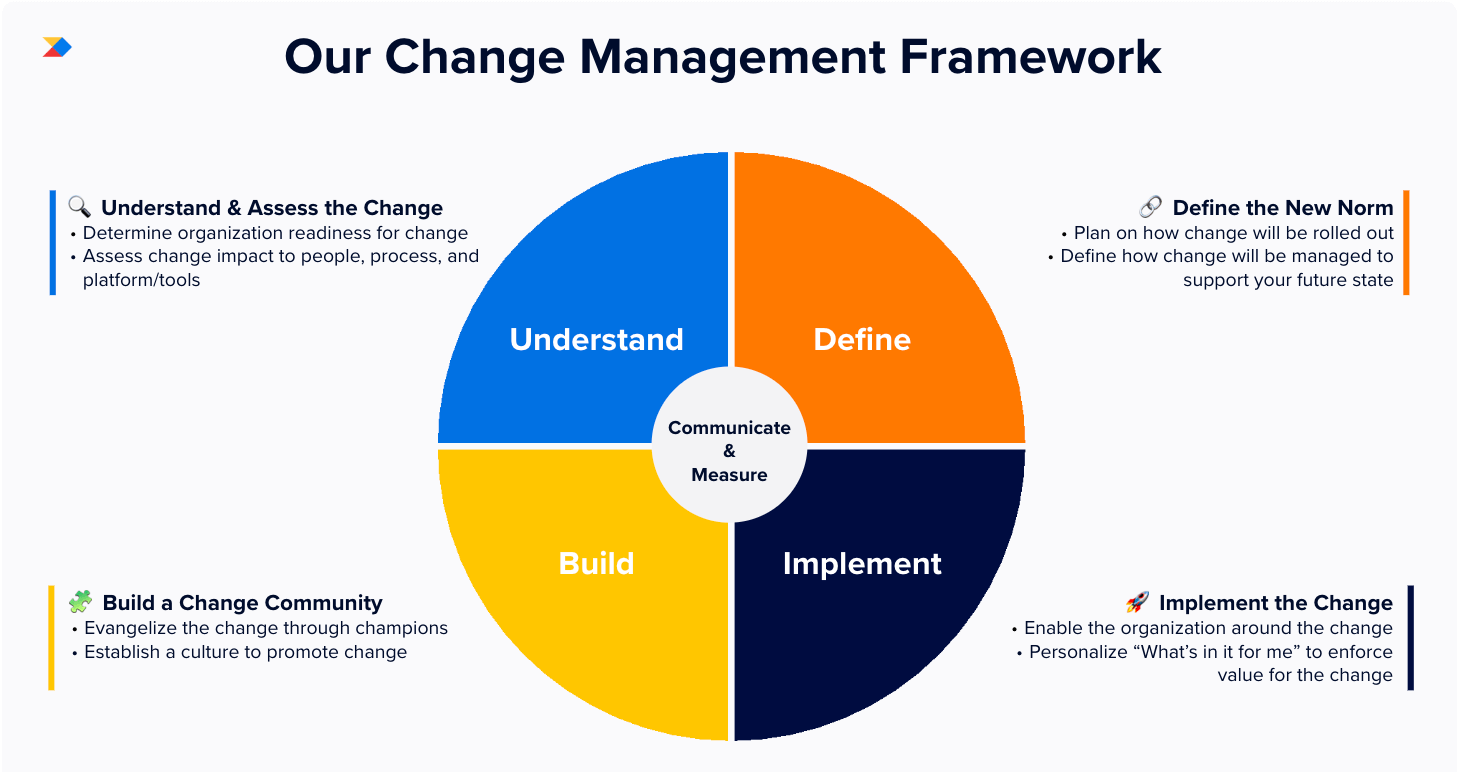
Think of how our strategies map to this:
- Understand: Identify your stakeholders and where they fall on the Law of Diffusion curve.
- Define: Clarify the business objectives of your data initiative (the "why").
- Build: Design your pilot project, recruit your Early Adopters, and create your persuasive SCR narrative.
- Implement: Launch your pilot, measure its success, and then use those results to communicate the benefits to the wider organization, building momentum for a broader rollout.
Test your understanding!
Imagine you've just presented your findings from an incrementality test showing that a popular, high-budget display ad campaign has zero incremental impact on sales. The Head of Brand Marketing, who owns that campaign, is highly skeptical and defensive. The agency that runs the campaign also pushes back, citing high click-through rates.
Based on the mitigation strategies discussed, list three concrete steps you would take next.
Show answer
Here are three effective steps based on the lesson:
-
Acknowledge the Human Element & Value Their Expertise: Instead of doubling down on the data, start by validating their perspective. You could say, "I understand your skepticism. This campaign is driving significant engagement, and the data-driven model might not be capturing the full long-term brand value. Your team has done excellent work building awareness." This defuses the tension and shows you respect their expertise.
-
Reframe the Goal & Propose a Collaborative Next Step: Position this not as an attack, but as a shared learning opportunity. Say something like, "My goal isn't to cut the budget, but to ensure we can prove the full value of your work to leadership. How can we work together to measure the impact this campaign has on brand metrics, which the incrementality model might miss?" This turns an adversary into a partner.
-
Start Small with a Joint Test: Rather than arguing about the past test, propose a new, smaller pilot project that you design together. For example, "What if we run a small, controlled test in one region where we also measure brand-lift survey results alongside the sales lift? This would give us a more holistic picture and help us build a stronger case for the campaign's total value." This applies the "start small" principle and fosters collaboration.
Conclusion
Leading a shift to a data-driven culture is one of the most challenging but rewarding aspects of modern marketing leadership. Resistance is not a sign of failure; it is a normal and predictable part of the process.
Key Takeaways:
- Organizational resistance stems from predictable sources: fear, skepticism, structural silos, and simple inertia.
- Don't try to convince everyone at once. Use the Law of Diffusion to strategically focus on winning over your Early Adopters first.
- Your mitigation toolkit includes: starting with pilot projects, communicating the business "why," valuing the human element, investing in data literacy, and actively breaking down silos.
- Success requires you to be both an analyst and an anthropologist, understanding both the data and the people who must act on it.
Preview of Your Next Lesson:
Now that you understand how to foster a culture that's receptive to data, the next logical step is to equip that culture with the right tools. In our next lesson, you will learn how to "Develop a scorecard for evaluating and selecting analytics vendors or marketing technology." This will give you a structured process for making critical technology decisions that support your organization's journey toward data maturity.