Hello! Welcome back to our module on managing and scaling your Amazon business.
In our last lesson, we focused on "defense"—the crucial discipline of monitoring your Account Health dashboard to protect your selling privileges. With that foundation in place, we can now switch back to "offense" and focus on a powerful strategy for increasing sales and profitability.
Today's lesson addresses the learning outcome: to set up an automated repricing tool to compete for the Amazon Buy Box. Mastering automated pricing is a key step in scaling your business. Manually adjusting prices for multiple products to stay competitive is not feasible, especially as you grow. An automated tool works for you 24/7, making strategic adjustments to help you win sales while you focus on other parts of your business.
1. Why Automated Pricing is Essential for Winning the Buy Box
On most Amazon product pages, you'll see a prominent "Add to Cart" or "Buy Now" button. This is the Amazon Buy Box. The vast majority of sales—over 80%—happen through this button. When multiple sellers offer the same product, they compete to "win" the Buy Box. The seller who has won it gets the sale when a customer clicks that button.
While Amazon's algorithm for awarding the Buy Box is secret, price is one of the most significant factors. An automated repricing tool is software that automatically adjusts your product prices based on a set of rules you define. Its primary goal is to keep your price competitive enough to win a share of the Buy Box.
Let's start by reading about the core benefits and mechanics of this strategy.
Amazon Automated Pricing 2025: Setup & Win More Sales
This article, 'Amazon Automated Pricing 2025', provides a clear overview of what automated pricing is, how it works, and why it's so critical for winning the Buy Box.
Please read the following three sections: 'Why Use Amazon Automated Pricing?': Focus on the benefits of saving time, staying competitive, and increasing Buy Box wins. 'How Does Amazon Automated Pricing Work?': Understand the key elements: pricing rules, price boundaries (min/max), and SKU selection. 'The Role of the Buy Box in Automated Pricing': This reinforces the connection between competitive pricing and winning the sale.
As the article highlights, the benefits are clear: you save time, remain competitive around the clock, and increase your chances of winning the Buy Box. However, poorly configured repricing can lead to a "race to the bottom," where sellers continuously undercut each other, destroying profit margins for everyone. The key is to use smart rules that protect your profitability.
2. Your Options: Amazon's Free Tool vs. Third-Party Repricers
There are two main paths for implementing automated pricing: using Amazon's free, built-in tool or subscribing to a more powerful third-party service.
Option A: Amazon's "Automate Pricing" Tool
Amazon provides a free repricer for all professional sellers directly within Seller Central. It's a good starting point to understand the basics.
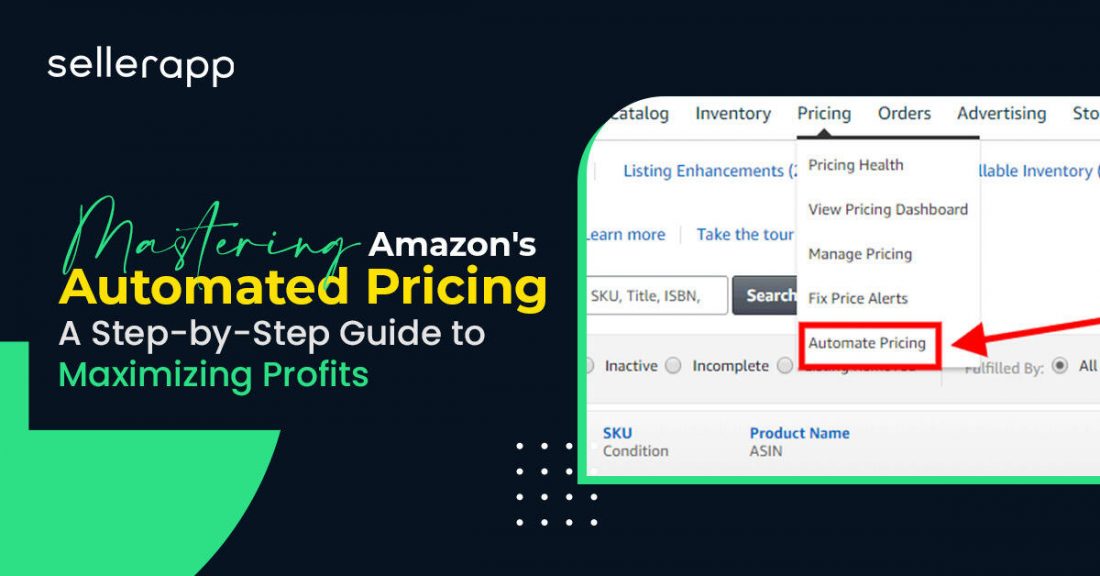
To see how it works and understand its limitations, let's watch a short overview.
Automate Pricing - The Pros and Cons of Amazon's Free Repricer Tool
This video, 'The Pros and Cons of Amazon's Free Repricer Tool', gives a balanced walkthrough of setting up the tool and discusses its major drawbacks.
Watch from 0:51 to 9:35. Pay close attention to: How to create a rule (0:51 - 5:08). The Pros (free, simple) (5:08 - 6:33). The Cons, which are very important (limited rules, doesn't raise prices, only works on active SKUs) (6:33 - 9:35).
Key Takeaway: Amazon's free tool is great for getting started, but its biggest flaw is that it primarily lowers prices to get the Buy Box and does not effectively raise them when a competitor sells out. This leaves potential profit on the table.
Option B: Third-Party Repricing Tools (e.g., BQool)
For more serious sellers, third-party repricers offer far more power and flexibility. These are paid services (typically with monthly subscriptions) like BQool, Aura, or Repricer.com.
Their main advantages include:
- Advanced Rule-Making: Create highly specific rules based on competitor type, feedback rating, fulfillment method, etc.
- Pricing Up: They can automatically raise your price to match the next competitor or go to your maximum price when you are the only seller, maximizing your profit.
- AI and Analytics: Many use AI to optimize for profit and sales velocity, and provide detailed analytics on performance.
3. Hands-On: Setting Up Smart Repricing Rules
To give you a practical, hands-on understanding of how a professional repricer works, we'll watch a detailed walkthrough using BQool, a popular choice among Amazon sellers. The principles shown here apply to most third-party repricers.
How to Use BQool Repricer for Amazon FBA | Step-by-Step
This step-by-step video, 'How to Use BQool Repricer', is a masterclass in setting up smart rules. It covers the entire process from setting price limits to creating advanced strategies.
We will watch this video in a few key segments. Setting Min/Max Prices (16:58 - 18:54): First, watch this part to see how to use Keepa charts to determine your profitable price floor (minimum) and a realistic ceiling (maximum). This is the most important step in protecting your margin. Creating the Main Rule (1:59 - 5:27): Now, go back and watch this segment. It explains how to create a rule to compete for the Buy Box. Focus on the advice to match the Buy Box price, not undercut it by a penny. This is the crucial strategy to avoid a race to the bottom. Advanced Profit Strategies (8:19 - 10:06): This section introduces two pro-level tactics: how to set up your repricer to counter 'penny-undercutters' and the strategy of raising prices at night to increase profitability across the entire listing.
Let's break down the key strategies from the video:
-
Set Your Min/Max Manually: Before you automate anything, you must define your boundaries.
- Minimum Price: Your absolute floor. Calculate this by taking your selling price and subtracting your product cost, all FBA fees, shipping, and a desired minimum profit. The FBA Revenue Calculator we used in Module 5 is perfect for this.
- Maximum Price: A realistic high price that the product has historically sold for. Use the Keepa chart for this analysis.
-
Match, Don't Undercut by a Penny: When competing with other FBA sellers, the Buy Box often rotates between sellers at the same price. Undercutting by $0.01 just invites your competitors' repricers to follow you down, eroding profits for everyone. The best starting strategy is to simply match the current Buy Box price.
-
Raise Prices at Night: During off-peak hours (e.g., 2 AM - 4 AM), there are fewer buyers. By setting a rule to raise your prices by a certain percentage during this time, you can often pull your competitors' repricers up with you. When prices are reset in the morning, the new "floor" is higher for everyone, leading to more profit.
Test your understanding!
You are selling a product via FBA.
- Your product cost is $10.
- Total FBA fees are $6.50.
- You want a minimum profit of $3 per sale.
- The current Buy Box price is $22, held by another FBA seller.
- A merchant-fulfilled seller has the lowest price at $20.50 + $3 shipping.
Based on the strategies discussed, what would you set as your minimum price? What would your initial repricing rule be?
Show answer
-
Minimum Price: Your breakeven price is
$10 (cost) + $6.50 (fees) = $16.50. To ensure a $3 profit, your minimum price should be$16.50 + $3 = $19.50. -
Repricing Rule: A smart initial rule would be: "Match the FBA Buy Box price, as long as it is above my minimum price of $19.50. Compete only with other FBA offers and ignore merchant-fulfilled offers." This would set your price to $22 to compete directly for the Buy Box, as the merchant-fulfilled offer is less competitive for Prime customers.
4. Best Practices for Automated Repricing
Setting up a repricer is not a "set it and forget it" task. To use it effectively, you need to follow some best practices.
Complete Guide To Amazon Dynamic Pricing Strategy in ...
This article, 'Complete Guide To Amazon Dynamic Pricing Strategy', offers an excellent list of best practices for using these tools effectively.
Please read the section titled '10 Best Practices in Implementing Amazon Dynamic Pricing'. This is a fantastic checklist to guide your strategy.
Here are the most critical points to remember:
- Always Monitor Competitor Pricing: See what your main competitors are doing. Are they aggressive? Are they holding a stable price?
- Don't Leave Prices Static: Review your min/max prices and rules regularly, especially if your costs or the market changes.
- Balance Price with Advertising: Your pricing and PPC ad strategy must work together. A competitive price is needed to convert the traffic your ads generate.
- Don't Be Afraid to Reverse a Bad Test: If a new rule hurts your sales or profit, change it back. Test, learn, and iterate.
Conclusion
You now have a comprehensive understanding of how to use automated repricers to strategically compete for the Amazon Buy Box. This tool is fundamental to scaling your Amazon operations, saving you countless hours while working to maximize your sales and profits.
Key Takeaways:
- Winning the Buy Box is Key: Automated repricers are essential tools for winning your share of the Buy Box, where most sales occur.
- Third-Party Tools Offer More Power: While Amazon's free tool is a good start, paid third-party tools provide the advanced features needed to maximize profitability, such as "pricing up."
- Strategy is Everything: A successful repricing strategy is not about being the cheapest. It's about setting smart rules—like matching the Buy Box and raising prices at night—to protect your margins while staying competitive.
- Set Boundaries and Monitor: The most crucial step is to calculate and set a minimum price that guarantees your profitability. Always monitor your performance and adjust your rules as the market changes.
Next Up:
We've covered monitoring your account health and now competing on price. The final lesson in this module will address another critical aspect of managing your business: outlining the tax and compliance requirements for selling in the US market, specifically focusing on sales tax.