Hello! Welcome back.
In our last lesson, we introduced Real Options Theory, framing strategic flexibility not just as a good idea, but as a tangible asset. We saw how choices like leasing equipment or buying versatile machinery create valuable "options" to pivot, expand, or even abandon your venture, giving you resilience against market uncertainty.
Today, we'll learn how to get the information you need to make those choices. An option is only valuable if you can wisely decide when to exercise it. This lesson directly tackles the learning outcome: Apply an experimentation framework (e.g., pilot programs) to test a new product or market before committing.
We'll move from the theory of flexibility to the practice of learning. For your new woodworking business, this means finding answers to critical questions like, "Will architects actually pay a premium for my CNC-machined doors?" or "Is there a real market for bespoke cabinets before I invest $100,000 in machinery?"
1. The Innovator's Core Problem: Building the Wrong Thing
The single biggest risk for any new venture isn't technical failure—it's market failure. You can build the most perfectly engineered cabinet, but if nobody wants to buy it, the business will fail. As an engineer, your instinct might be to perfect the product first. The entrepreneurial mindset, however, flips this around.
Pretotyping - Pretending to Prototype. - Blender
The article 'Pretotyping - Pretending to Prototype' introduces a powerful concept developed at Google. It focuses on one simple but crucial idea, summarized by its creator, Alberto Savoia.
Please read the first two sections, 'What is pretotyping?' and 'What are the benefits of prototyping?'. Pay special attention to the core slogan: 'Make sure you are building the right ‘it’ before you build ‘it’ right.' The examples of the Palm-Pilot and IBM's speech-to-text experiment are key.
The concept of pretotyping (pretend-prototyping) is about testing the core hypothesis of your product with the minimum possible investment of time and money. The story of Jeff Hawkins carrying a block of wood to simulate the Palm-Pilot is legendary. He wasn't testing the electronics or the software; he was testing desirability and ergonomics. He was figuring out the right 'it' before his team built 'it' right.
This is your first mental model: before you even think about a full prototype, how can you pretend to have a product to see if people want it?
2. A Framework for Learning: Build-Measure-Learn
The pretotyping mindset is part of a broader, systematic approach to reducing risk called the Lean Startup methodology. Its central engine is a feedback loop designed to help you learn as fast as possible.
THE LEAN STARTUP SUMMARY (BY ERIC RIES)
This video from The Swedish Investor provides an excellent summary of Eric Ries's 'The Lean Startup' and its core feedback loop.
Watch the first two takeaways, from 00:59 to 05:25. Focus on understanding the 'Build-Measure-Learn' feedback loop and the idea that 'Everything is a grand experiment.'
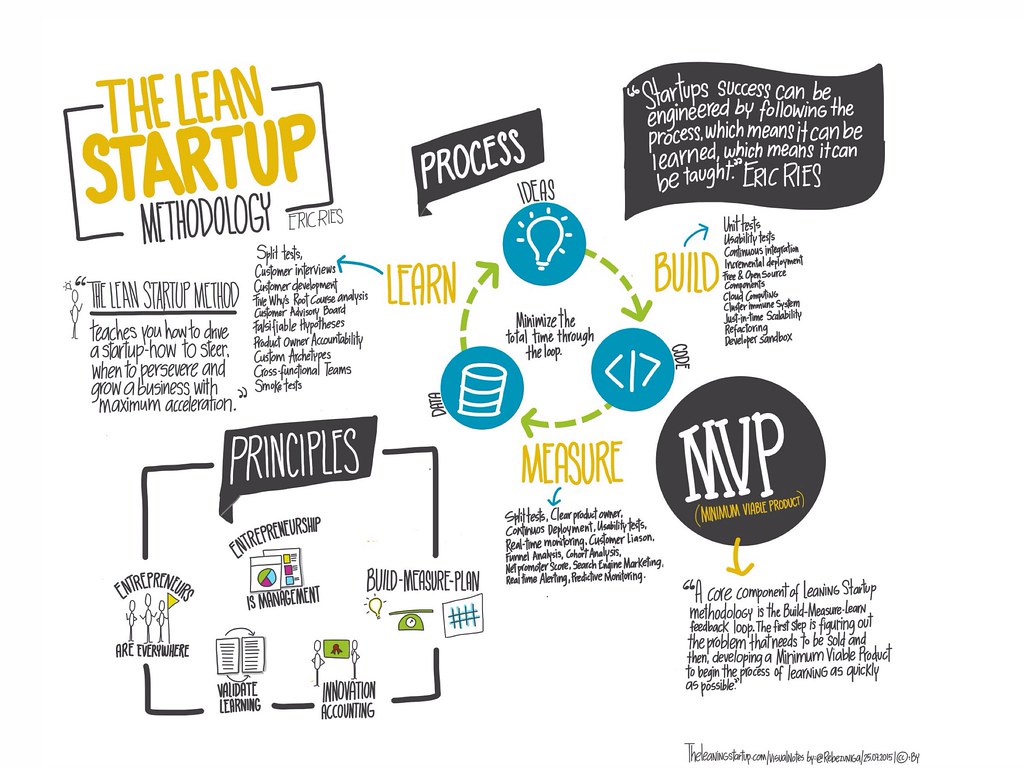
Let's break this down for your business:
- Ideas/Hypotheses: You start with a belief. For example: "High-end interior designers in my area are frustrated with the limited options and long lead times of current custom cabinet makers."
- Build: You create a Minimum Viable Product (MVP) to test this hypothesis. This is not your final, perfect product. It is the simplest possible version that allows you to start learning.
- Measure: You get the MVP in front of real customers (the designers) and collect data. Are they interested? What are their objections? Do they place an order?
- Learn: You analyze the data to get validated learning. This isn't just opinion; it's evidence. Based on this, you decide whether to persevere with your current idea or pivot to a new one.
The entire point is to avoid spending months and thousands of dollars building a full suite of kitchen cabinets, only to find out designers wanted something different.
3. Your First Experiment: Minimum Viable Products (MVPs)
So what could an MVP look like for a premium woodworking business? It's not a fully functional kitchen. The key is to find the cheapest, fastest way to test your core assumptions.
The THE LEAN STARTUP SUMMARY video you just watched and the Pretotyping article mention several types of MVPs that are directly applicable.
THE LEAN STARTUP SUMMARY (BY ERIC RIES)
Let's revisit the 'Lean Startup' summary to explore specific types of MVPs.
Watch the segment on 'Different types of MVPs' from 05:25 to 07:22. Think about how you could adapt these ideas for your business.
Here are those MVP types, adapted for your woodworking venture:
- Video / 3D Render MVP: Instead of building a physical product, you could use your design skills to create photorealistic 3D renders or even an animated video showcasing a line of unique cabinet doors. You can then show this "digital catalog" to architects and designers to gauge interest and get feedback on styles. This tests aesthetic appeal and market fit before a single piece of wood is cut.
- Concierge MVP: Focus on just one customer. Offer to design and deliver a single, bespoke piece of furniture (e.g., a bathroom vanity or a statement cabinet). You would handle everything manually, potentially even outsourcing the CNC work or renting time on a machine. The goal isn't profit; it's an immersive learning experience. You'll learn about the client's pain points, the design process, installation challenges, and pricing sensitivity.
- Wizard of Oz MVP: This involves creating the illusion of a full-service operation. For example, you could set up a professional website with a "custom door configurator." To the user, it looks like a sophisticated piece of software. In reality, when they submit their design, it just sends you an email with their selections. You then manually create the technical drawing and quote. This tests demand for customization without the immense cost of software development.
Test your understanding!
You have a hypothesis that local restaurants would pay for unique, custom-milled wooden menus and check presenters. You want to test this idea quickly. Which MVP type would be most effective and why?
Show answer
A Concierge MVP would be highly effective. You could approach one or two trendy local restaurants and offer to create a small batch of menus for them at a pilot price. By working closely with a single client, you would learn about durability requirements (how do they stand up to spills?), aesthetic preferences (does your style match their brand?), and a price point that makes sense for them. A 3D render isn't enough here, because the tactile feel of the wood is part of the product's value proposition.
4. How to Design a Good Business Experiment
Having a great MVP idea is one thing; running a rigorous experiment that yields clear results is another. A poorly designed test can be worse than no test at all because it gives you misleading information.
Here’s a two-step process to bring structure to your experiments.
Step 1: Formulate a Falsifiable Hypothesis
An idea like "people will like my cabinets" is not a testable hypothesis. It's a vague opinion. We need to make it specific, measurable, and falsifiable.
Alberto Savoia | How I Tested Pretotyping
Alberto Savoia, the creator of pretotyping, developed a simple but brilliant template for this. In this interview, he explains his 'XYZ Hypothesis' format.
Read the sections where Savoia explains the 'XYZ hypothesis' (starting around 18:53) and 'hypothesis zooming' (starting around 23:00). The format is 'At least X% of Y will do Z'. This is a tool you can use immediately.
The XYZ Hypothesis format is: At least X% of Y will do Z.
- X% = The percentage of people who take the key action. This sets your minimum success threshold.
- Y = Your target market segment, zoomed in to a testable group.
- Z = The specific, observable action they take that shows real interest or commitment (i.e., "skin in the game").
Here's an example for your business:
At least 20% (X) of the high-end residential architects I present my portfolio to (Y) will sign a letter of intent to use my doors on a future project (Z).
This hypothesis is powerful because it's no longer a matter of opinion. Either you hit the 20% mark or you don't. It gives you a clear pass/fail for your experiment.
Step 2: Run a Professional Pilot Program
Once you have your hypothesis, you need to design the pilot test. This is not about giving away free samples; it's about professionally qualifying real customers.
5 Rules for Successful Startup Pilots, POCs, Trials | Dose 045
The venture capital firm Dreamit put together a fantastic video on how to run pilots that lead to actual sales. These are hard-won lessons from the startup world.
Watch the sections covering the terminology (00:35), success criteria (01:32), the importance of charging (04:27), and qualifying customers (05:26). These rules will transform your experiments from casual chats into serious business validation.
Here are the key rules for your pilot program:
- Define Clear, Quantitative Success Criteria: Your "Z" action must be unambiguous. "Liking the design" is not a success metric. "Paying a $500 deposit for a pilot project" is.
- Charge for the Pilot: This is the most crucial rule. Asking for money, even a small amount, is the ultimate test of desirability. It filters out people who are just being polite and confirms you're solving a problem they are willing to pay for. It's a powerful signal.
- Qualify Your Customer: Before you even start a pilot, discuss your estimated production pricing. If a potential client balks at your target price range, they aren't a real customer for your premium business, and running a pilot with them is a waste of your most valuable resource: time.
Conclusion
Today we've laid out a practical, low-risk framework for testing your business ideas before making major financial commitments. This process of systematic experimentation is what allows a startup to learn and adapt faster than established competitors.
Key Takeaways:
- Your first job is not to build a product, but to test if you're building the right product ("the right it").
- Use the Build-Measure-Learn feedback loop to structure your learning process.
- Start with low-cost Pretotypes and MVPs (like 3D renders or a Concierge service) to test your riskiest assumptions.
- Formulate a specific, measurable XYZ Hypothesis before every experiment (e.g., "At least X% of Y will do Z").
- Run professional pilots by defining quantitative success criteria and, most importantly, charging money to confirm real customer commitment.
Preview of the Next Lesson:
This experimentation framework gives you the data to make informed decisions. But what happens when that data tells you to pivot? A pivot isn't just a change in product; it's a strategic move in a competitive landscape. In our next lesson, we will model a potential business pivot as a sequential game to anticipate competitor responses, connecting your internal learning back to the external world of game theory.