Hello! Welcome back to the course.
In our last lesson, we focused on how to test your business ideas before making big commitments. You learned to use the Build-Measure-Learn loop, create Minimum Viable Products (MVPs), and run professional pilot programs to gather real-world data. This process gives you validated learning to decide whether to persevere with your current strategy or pivot to a new one.
But what happens when the data suggests a pivot is necessary? For example, your pilot program with architects might reveal that while they're lukewarm on your custom doors, they're desperate for high-quality, unique cabinet fronts. A pivot isn't just a change in plans; it's a strategic move in a competitive market. Your competitors will watch, and they will react.
Today's lesson directly addresses this challenge and fulfills the learning outcome: Model a potential business pivot as a sequential game to anticipate competitor responses. We will bridge the gap between your internal decision to pivot and the external competitive reality, using the tools of game theory to think several moves ahead.
1. A Pivot is the First Move in a New Game
A pivot is a change in strategy, not just tactics. It could mean changing your target customer (e.g., from architects to direct-to-consumer), your core product (e.g., from doors to cabinets), or your business model.
Because a pivot involves a public change, it's best understood as a sequential game. You make the first move, and your competitors observe it and then decide on their counter-move. Thinking about it this way prevents you from making a move that looks good in isolation but leads to a disastrous competitive reaction.
Game Theory in Competitive Product Positioning
This article, 'Game Theory in Competitive Product Positioning', provides a great high-level overview of this concept. It frames strategic decisions as a game and gives a famous real-world example of a successful pivot.
Please read section 4, 'Sequential Games,' and the 'Netflix's Streaming Pivot' example. Notice how Netflix's pivot is framed as making the first move in a sequential game, forcing others to react.
As the article highlights, the key is to "always think several moves ahead." Today, we'll learn the formal method for doing just that.
2. Visualizing the Game: The Game Tree
To analyze a sequential game, we first need to map it out. The standard tool for this is the game tree, also known as the extensive form of a game. It's a diagram that shows who moves when, what their options are, and what the outcomes are for every possible sequence of choices.
Your mechanical engineering background has likely given you experience with flowcharts and decision diagrams; a game tree operates on a similar principle.
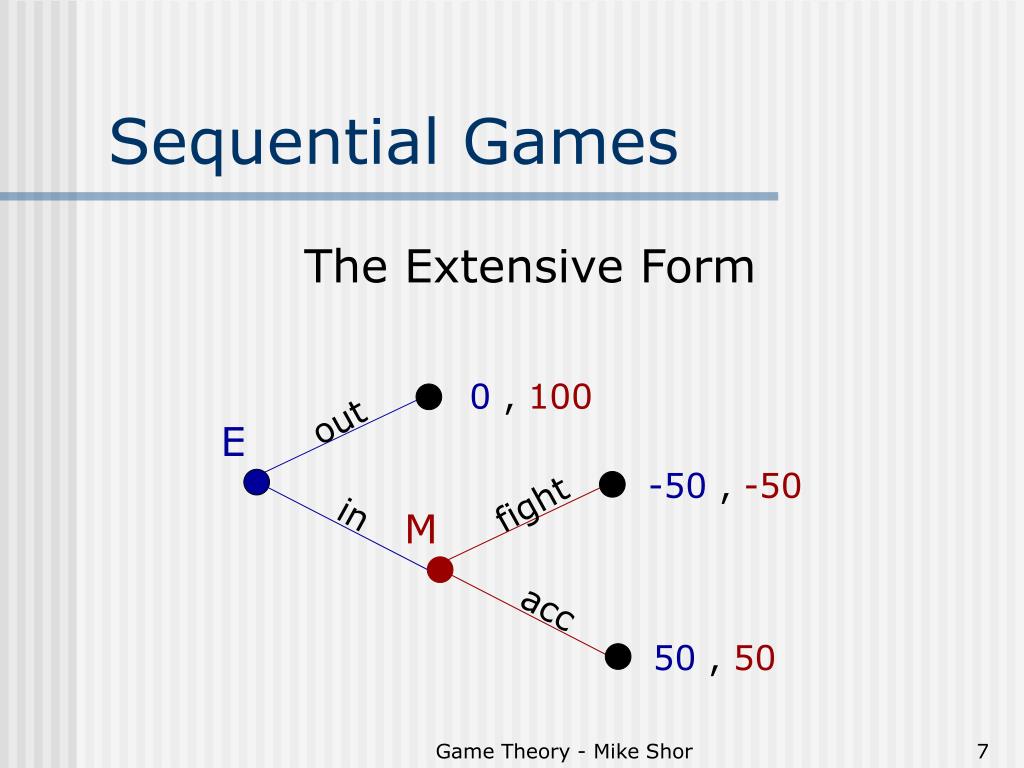
Let's apply this to your woodworking business. Imagine your pilot programs show a strong demand for custom CNC-milled cabinet fronts, a market currently served by one main local competitor. You are considering pivoting your focus from general-purpose doors to specializing in these cabinet fronts.
Your game tree would look like this:
- Players: You ("Entrant") and the Local Competitor ("Incumbent").
- Your Move (Node 1): You decide first. Your actions are to
Stay(continue with your original plan) orPivot(enter the cabinet front market). - Competitor's Move (Node 2): The Competitor only moves if you
Pivot. Their actions could be toAccommodate(do nothing, letting you have a piece of the market) orFight(start a price war, or copy your designs and market them aggressively). - Payoffs: At the end of each branch, we assign payoffs (e.g., estimated profit) for both you and the competitor.
This structure forces you to explicitly consider how your competitor might react.
3. Solving the Game: Backward Induction
Once you've mapped out the game tree, how do you find the most likely outcome? You can't just look at the payoffs and hope for the one you want. You must analyze the game from your competitor's perspective.
The method for this is called backward induction. You start at the end of the game and work your way back to the beginning.
This video from Ashley Hodgson provides a clear, step-by-step demonstration of how to apply backward induction to a game tree.
Watch the main demonstration from 01:13 to 05:44. Focus on the logic of starting at the last player's decision and 'pruning' the branches that they would never rationally choose.
The logic is simple but powerful:
- Go to the final decision nodes in the game.
- For each node, identify the rational choice for the player whose turn it is to move. A rational player will always choose the action that leads to their own highest payoff.
- "Prune" the branches representing the actions that the player will not take.
- Treat the payoffs from that rational choice as the outcome for that node.
- Move backward to the next-to-last set of decision nodes and repeat the process, knowing what the player(s) after you will do.
- Continue until you reach the first move of the game. The path of remaining branches is the predicted outcome.
4. Uncovering Non-Credible Threats
The real genius of backward induction is that it automatically filters out non-credible threats. A competitor might threaten to "crush you" if you enter their market, but if carrying out that threat would hurt them more than accommodating you, it's just a bluff. A rational player will not act against their own self-interest.
17 Sequential Games - Profit Analytics for Entrepreneurs
This text from 'Profit Analytics for Entrepreneurs' explains the concept of non-credible threats and how backward induction is the tool to systematically identify and dismiss them.
Please read sections 17.2 'Non-Credible Threats' and 17.4 'Constructing Sequential Games in Extensive Form'. This will connect the game tree diagram to the strategic goal of finding a credible outcome.
The outcome you find using backward induction is called a Subgame Perfect Equilibrium. It's "perfect" because it ensures that every player's strategy is rational at every stage of the game.
Let's apply this to our woodworking pivot scenario.
Scenario:
- If you
Staywith your original plan, you expect a modest profit of $20k. The Competitor is unaffected, keeping their cabinet profit of $100k. Payoff:(You: 20, Competitor: 100) - If you
Pivot, the Competitor must react:- If they
Accommodate, you split the market. You both make a good profit. Payoff:(You: 60, Competitor: 70) - If they
Fight(e.g., a price war), profits are destroyed for everyone. Payoff:(You: -10, Competitor: -10)
- If they
Analysis using Backward Induction:
- Start at the end: Look at the Competitor's decision. They are choosing between
Accommodate(which gives them a payoff of 70) andFight(which gives them a payoff of -10). - Find the rational choice: A rational competitor will choose 70 over -10. Therefore, they will
Accommodate. We can prune theFightbranch. The threat of a price war is non-credible. - Work backward: Now, analyze your decision at the start. You are choosing between:
Stay: Payoff of 20.Pivot: Knowing the competitor will accommodate, this path leads to a payoff of 60.
- Make your decision: You will choose
Pivotbecause 60 is greater than 20.
The Subgame Perfect Equilibrium is: (You Pivot, Competitor Accommodates). By modeling the situation as a sequential game, you can confidently make the pivot, anticipating that your competitor's most rational response is to share the market, despite any aggressive talk.
Test your understanding!
Let's change the payoffs. Imagine your competitor is a large, family-run business that is known to be extremely prideful and irrational about competition. You estimate that if you pivot, they would get so much personal satisfaction from driving you out of business that it would be worth the financial loss.
New Fight payoff: (You: -10, Competitor: 75) (They lose money but gain immense satisfaction, which they value more).
The other payoffs remain the same.
Using backward induction, what is the predicted outcome now? Is the pivot still a good idea?
Show answer
- Start at the end: Look at the Competitor's decision. They are choosing between
Accommodate(payoff of 70) andFight(payoff of 75). - Find the rational choice: In this new scenario, the competitor's rational choice is to
Fight, because 75 is greater than 70. The threat is now credible. - Work backward: Now, analyze your choice. You are choosing between:
Stay: Payoff of 20.Pivot: Knowing the competitor will fight, this path leads to a payoff of -10.
- Make your decision: You will choose
Stay, because 20 is greater than -10.
In this scenario, the pivot is a bad idea. This illustrates how crucial it is to have realistic estimates of your competitors' payoffs, which can include non-financial factors like pride or reputation.
Conclusion
Today, we've equipped you with a powerful framework for making one of the most difficult decisions an entrepreneur faces: whether to pivot. By moving beyond a simple "pros and cons" list and modeling the decision as a sequential game, you can more rigorously analyze the strategic landscape.
Key Takeaways:
- A business pivot is not a decision made in a vacuum; it's the opening move in a sequential game with your competitors.
- A game tree is a visual tool to map out the players, actions, and potential outcomes of a sequential decision.
- Backward induction is the method for solving the game. By starting at the end and working backward, you can predict the rational response of your competitors.
- This process allows you to identify and ignore non-credible threats, leading to a more realistic prediction of the outcome, known as the Subgame Perfect Equilibrium.
Preview of the Next Lesson:
We now have a tool to analyze the consequences of a pivot if we decide to make it. But this raises another question: is now the right time? A pivot made too early might be based on insufficient data, while one made too late might miss the market window. In our next lesson, we will explore this by learning how to use a decision framework to evaluate the optimal timing of a pivot based on market signals.