Hello! Welcome back.
In our last lesson, we looked inward, focusing on the psychological traps like the sunk cost fallacy that can prevent you from making a necessary change in your business. You learned how to use frameworks like Zero-Based Thinking to rationally evaluate whether to pivot or persevere.
Today, we shift our focus outward. A decision to pivot doesn't happen in a vacuum; it's a response to external events. This lesson addresses your learning outcome: to identify key market signals that might trigger a pivot (e.g., competitor actions, demand shifts). We'll explore the specific triggers in the marketplace that should prompt you to use the evaluation tools we discussed last time. For your new woodworking business, being able to read these signals early is the difference between proactively adapting and reactively scrambling.
1. What is a Market Signal?
Think of a market signal as an indicator on a dashboard. Just as you monitor speed, fuel, and engine temperature while driving, a business owner must monitor signals from the market to know if their current strategy is sound or if a change of course is needed. A signal is any piece of information that suggests a potential shift in customer needs, the competitive environment, or the broader economy.
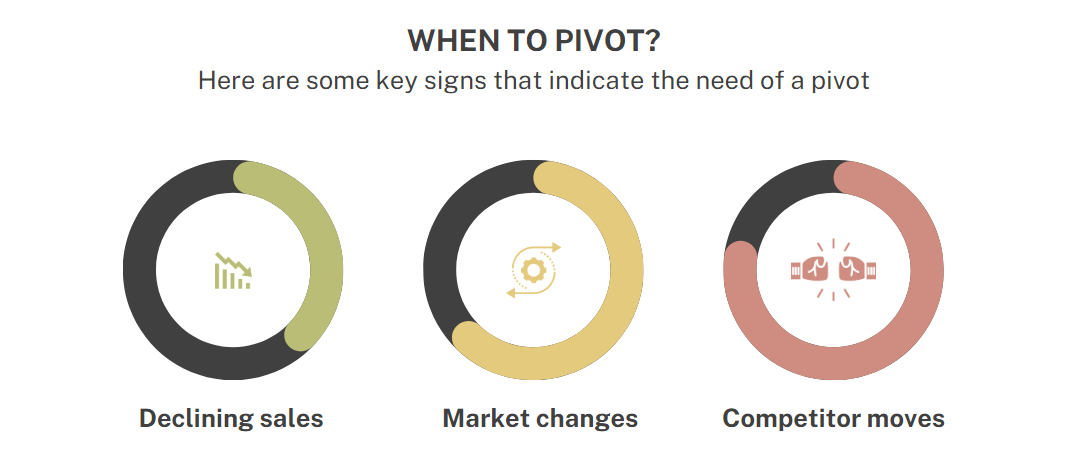
We can group these signals into three main categories, as shown in this simple visual.
2. Signal Type 1: Internal Performance Metrics
The most immediate and undeniable signals come from your own business performance. These are the direct results of your strategy meeting reality. Key indicators for your woodworking business include:
- Sales and Lead Quality: Are you getting fewer quote requests? Are the requests for work that doesn't fit your "premium door" focus (e.g., handyman repairs)?
- Conversion Rate: If you send out ten quotes but only one is accepted, this is a strong signal. It might point to a mismatch in pricing, product-market fit, or perceived value.
- Customer Feedback: Are potential clients explicitly telling you your prices are too high? Are they asking for kitchen cabinets when you're trying to sell doors? This qualitative data is pure gold.
A pivot is often necessary when your business is not gaining traction and you're running out of time or money to keep experimenting.
When & How To Pivot Your Startup | Dose 053
The video 'When & How To Pivot Your Startup' by Dreamit offers a practical test for when to pivot and explores the various parts of a business where signals might appear.
Please watch these two segments: The Two-Part Test (0:34 - 1:08): Pay attention to the simple test of evaluating traction vs. your remaining 'runway' (time and money). Specific Pivot Areas (3:02 - 6:40): This section details signals related to the problem you're solving, your customer base, and your pricing model. Think about how each of these could manifest as an 'internal' signal in your business.
If your internal metrics are weak (e.g., poor traction), it's a clear trigger to investigate whether the cause is your execution or a fundamental flaw in your strategy, which might require a pivot.
3. Signal Type 2: Competitor Actions
Your business does not operate in isolation. The moves your competitors make are direct signals about the structure of the game you're playing. A savvy entrepreneur watches competitors not to copy them, but to understand their strategy and anticipate the changing landscape.
Game Theory in Competitor Analysis
The article 'Game Theory in Competitor Analysis' from RivalSense provides a list of concrete competitive actions that you can track as market signals.
Please read the sections titled 'Applying Game Theory with RivalSense' and 'Real-World RivalSense Insights: Game Theory in Action'. Ignore the promotional aspects of the tool and focus on the types of signals discussed, such as: Product launches and updates Pricing changes New partnerships or alliances Hiring of key executives
For your woodworking business, a competitor signal could be:
- A large cabinet shop suddenly launching a "premium, artisan door" line.
- A local competitor investing in the same high-end CNC machine you have, signaling their intent to compete on quality.
- Two smaller millwork shops merging to gain scale and efficiency.
- An established furniture maker suddenly offering deep discounts, potentially starting a price war.
Each of these actions is a move in the game that might require you to re-evaluate your own position and strategy.
4. Signal Type 3: Broader Market Changes
Some of the most powerful signals are not from your direct competitors but from shifts in the wider world. These are macroeconomic, social, or technological trends that can fundamentally alter customer demand.
A demand shift occurs when people's willingness to buy a product changes, even if the price stays the same.
4 Strategies to Prepare for Demand Shifts
The article '4 Strategies to Prepare for Demand Shifts' from Retalon explains what a demand shift is and what causes it.
Please read the first three sections of the article: 'What is a shift in demand?', the 'Example: Staycation vs. Vacation', and 'Powerful factors influencing shifts in demand'. Focus on understanding the list of factors that can cause demand to change, such as the economy, culture, and consumer preferences.
For your business, these broader signals could include:
- Economic: Rising interest rates make mortgages more expensive, slowing down home construction and high-end renovations.
- Cultural/Taste: A popular design show promotes minimalist, sleek cabinet designs, reducing demand for the ornate, traditional doors you planned to make.
- Technological: A new, more durable and eco-friendly wood finishing product becomes available, making your current finishing process obsolete.
- Demographic: The neighborhood you operate in sees an influx of young families, who may prioritize durable, affordable cabinets over luxury statement doors.
Ignoring these larger currents is a common reason why businesses fail.
Test your understanding!
You specialize in high-end, custom-carved wood doors. You notice three things over the past quarter:
- A leading local real estate blog publishes an article titled "Homeowners Cut Back: Renovations Shift from Luxury to Longevity."
- Your main competitor, previously also a high-end shop, just launched a new, heavily marketed service for refacing existing kitchen cabinets with durable, simple laminate fronts.
- You've sent out five quotes for custom doors, but received feedback from three of the potential clients that while the work is beautiful, they've decided to "just repaint for now" to save money.
Categorize each of these three points as a type of market signal (Internal, Competitor, or Broader Market) and briefly explain what they might be telling you when considered together.
Show answer
- Broader Market Signal (Economic/Cultural): The article points to a shift in consumer demand, driven by economic concerns, away from luxury and towards practicality and cost-savings.
- Competitor Action: Your competitor is already pivoting their strategy to meet this new demand for more affordable solutions (refacing instead of replacing). This is a strategic move you must now react to.
- Internal Performance Signal: Your own sales pipeline confirms the broader market trend. Potential customers are explicitly choosing lower-cost alternatives, indicating a price sensitivity or value perception issue with your current offerings.
Combined meaning: All signals point in the same direction. The market is shifting away from your current premium focus. Your competitor is already adapting. Your own business results are suffering because of this mismatch. This is a very strong trigger to seriously evaluate a pivot towards more affordable or different products/services.
5. A Framework for Monitoring Signals: The Five Forces
It can be overwhelming to track all these signals. A powerful way to organize your thinking is to use Michael Porter's Five Forces framework. This model provides a holistic view of the industry structure. A change in any of these five forces is, by definition, a significant market signal.
The Five Competitive Forces That Shape Strategy
In this classic video, Harvard Business School's Michael Porter explains the Five Forces that shape industry competition and profitability. This provides a master framework for organizing and interpreting market signals.
Please watch these two key clips: Introduction to the Five Forces (0:37 - 1:24): This introduces the five areas you need to watch: rivalry, new entrants, substitutes, customer power, and supplier power. The Dynamics of Industry Structure (9:19 - 10:02): This part is crucial. It explains that the framework is not static and is used to understand how an industry is changing—which is exactly what identifying signals is all about.
Think about how the signals we've discussed fit into this model:
- A competitor's price cut increases Rivalry.
- A new woodworking shop opening is a Threat of New Entrants.
- A customer choosing to repaint instead of buy new is using a Substitute.
- A cooling housing market increases the Bargaining Power of Buyers.
- Your primary wood supplier raising prices shows the Bargaining Power of Suppliers.
By periodically thinking through the Five Forces for your local premium furniture market, you can systematically scan for signals and understand their strategic implications.
Conclusion
In this lesson, you learned how to identify the critical external triggers that should make you pause and re-evaluate your business strategy. Being a successful entrepreneur isn't just about having a great initial idea; it's about having the awareness to know when that idea needs to adapt to the reality of the market.
Key Takeaways:
- Market signals are indicators that suggest a shift in the competitive or customer landscape.
- They fall into three main categories: internal performance (your own sales data), competitor actions (their strategic moves), and broader market changes (economic, cultural, or technological trends).
- A demand shift is a fundamental change in customer willingness to buy, often triggered by factors other than price.
- Porter's Five Forces provides a robust framework to systematically monitor and interpret signals from all corners of your industry.
Preview of the Next Lesson:
Knowing you might need to pivot is one thing; being able to is another. How you set up your business from day one can determine how agile you are. In our next lesson, we will assess the strategic value of maintaining flexibility to pivot or expand later. This will tie directly into your pressing decisions about what kind of CNC machinery to purchase and how specialized your initial product line should be.