Hello! Welcome back to the course.
In our last module, you learned how to interpret the strategic moves your competitors make, such as a major capacity expansion. Understanding these signals is the first step. The next, and often harder, step is deciding what to do with that information, especially when it suggests your own strategy might be failing.
This lesson kicks off our module on Pivoting and Strategic Adaptation. Today, we'll tackle one of the most significant psychological barriers to making sound business decisions: the sunk cost fallacy. Your learning outcome is to evaluate sunk costs versus future opportunities when considering a business pivot. For you, as a founder launching a new woodworking business, mastering this skill is critical. It will help you know when to cut your losses on an idea and when to persevere, ensuring your limited time and capital are always directed toward the most promising path.
1. The Trap of "Too Much Invested to Quit"
Imagine you've spent three months and a significant portion of your startup capital developing a line of highly intricate, custom-carved wooden doors. You launch, but after a few weeks, you have zero serious inquiries. Meanwhile, you've had several contractors ask if you can produce high-quality, standard-sized kitchen cabinets, something you hadn't planned for.
A common psychological trap is to think, "I've already invested so much in these doors, I can't just give up now. I have to make it work." This is the sunk cost fallacy in action.

A sunk cost is any cost—money, time, or effort—that has already been incurred and cannot be recovered. The fallacy occurs when you let these unrecoverable costs influence your future decisions.
To get a clear understanding of this concept in a business context, please watch the following short video.
This video from Edspira provides a concise definition of sunk costs and illustrates the concept with two clear examples, including one directly related to a business project.
Please watch the entire video (about 4 minutes). Pay close attention to the definition and how the business example shows managers letting a $100 million investment cloud their judgment about the project's future.
The key takeaway is that from a rational decision-making perspective, sunk costs are irrelevant. The money is gone. The only thing that matters is what you do from this point forward.
2. Opportunity Cost: The Other Side of the Coin
The real cost of sticking with a failing plan isn't just the money you continue to spend on it; it's the opportunity cost. This is the value of the next-best alternative you give up.
By continuing to push your unpopular carved doors, you're not just spending more money on marketing; you're giving up the potential profits you could be making from the kitchen cabinets that customers are actually asking for.
The video below offers a deeper perspective on how entrepreneurs should think about costs, focusing on future value and opportunity costs rather than past expenditures.
Cost, Opportunity Cost, and Sunk Cost
This video from Academic Agent explores the concepts of cost, opportunity cost, and sunk cost from an entrepreneurial viewpoint. It explains why all decisions should be forward-looking.
Please watch the following segments: Opportunity Cost (1:39 - 4:23): Focus on how every choice involves forgoing other possibilities. The Sunk Cost Fallacy (9:06 - 10:25): This section describes the irrational unwillingness to accept a past error. Application to Entrepreneurship (12:09 - 14:15): This is crucial. Pay attention to the idea that money already spent is 'lost forever' and the only thing that matters is the future market value of your products.
As an entrepreneur, you must adopt a forward-looking mindset. The money you spent on developing the door prototypes is gone. The decision now is: "Which path—doors or cabinets—offers the best prospect for future profit and growth, starting from today?"
Test your understanding!
You've spent $15,000 on a specialized CNC machine perfect for intricate carvings on doors. After two months with no sales, you're considering a pivot to making simpler, high-demand kitchen cabinets. This would require a different, less expensive machine, and your current machine would have to be sold at a significant loss.
When evaluating the decision to pivot, how should you factor in the initial $15,000 investment?
Show answer
You should treat the initial $15,000 as a sunk cost and effectively ignore it. The decision should be based only on a comparison of the future costs and future expected profits of two options: 1) continuing with the door business versus 2) selling the current machine (at a loss) and starting the cabinet business. The loss you take on the machine is simply a consequence of a past decision; it shouldn't dictate your future strategy. The correct question is: "Which path is more profitable from this day forward?"
3. Why We Fall for the Trap: The Psychology of Sunk Costs
If ignoring sunk costs is so logical, why is it so hard to do? Understanding the psychology can help you recognize and fight the bias.
This article from Leadership IQ provides a deep dive into the sunk cost fallacy, explaining the psychological drivers behind it. This will help you understand the 'why' behind this common error.
Please read the sections 'The Scientific Origins of Sunk Cost Research' and 'The Web of Biases'. As you read, focus on these key concepts: Loss Aversion: The idea that the pain of a loss is twice as powerful as the pleasure of a gain. Self-Justification: The need to prove a past decision was correct, especially if you were personally responsible for it. Opportunity Cost Neglect: How focusing on sunk costs makes us blind to better alternatives.
When you consider abandoning your door project, you're not just making a business calculation. You're confronting a guaranteed loss, which is psychologically painful (loss aversion), and admitting a past decision was wrong (challenging your ego). This combination creates a powerful emotional pull to keep going, even when logic says to stop.
4. A Framework for Deciding: Pivot, Persevere, or Test More?
Knowing about the sunk cost fallacy is the first step. The next is having a practical framework to make a rational decision. Instead of relying on gut feelings, you can use structured thinking.
The Foundational Question: Zero-Based Thinking
The simplest and most powerful tool is a thought experiment called Zero-Based Thinking. Ask yourself this question:
"Knowing what I know now, if I hadn't already invested, would I still make this same decision today?"
If the answer is "no," it’s a strong signal that you should pivot. This question mentally erases the sunk costs and forces you to evaluate the opportunity based purely on its current and future merits.
A More Structured Approach: The Pivot Decision Matrix
For a more detailed analysis, you can use a framework that considers both the strength and direction of the evidence you've gathered.
Chapter 30: Strategic Pivots and Turnarounds
This chapter from an online strategy textbook provides an excellent decision-making tool called the Pivot Decision Matrix. It's a structured way to decide whether to pivot, persist, or gather more information.
Please read the section 'Timing Pivots: When to Persist vs. When to Shift' (specifically up to subsection 30.4.5). Then, skim 'Mistake 2: "Ignoring Evidence" - Persisting Despite Clear Failure Signals.' Focus on understanding the two axes of the Pivot Decision Matrix: Evidence Quality and Evidence Direction. Try to grasp the logic of each of the four quadrants.
Here’s how you can apply the matrix to your woodworking business:
- Evidence Quality: How reliable is your data?
- High Quality: Actual customer behavior (e.g., repeat purchases, placing deposits, signing contracts).
- Low Quality: Opinions from friends, survey responses without commitment, your own gut feeling.
- Evidence Direction: What is the data telling you?
- Positive: Validates your strategy (e.g., people are buying at your target price).
- Negative: Invalidates your strategy (e.g., no one is buying, high customer churn).
This gives you four possible scenarios:
- PERSIST (High-Quality, Positive Evidence): You're getting actual sales and positive feedback from paying customers for your doors. Ignore minor setbacks and keep going.
- PIVOT (High-Quality, Negative Evidence): You've shown prototypes to 20 qualified buyers, and none will commit, citing price or style. The market is giving you clear, reliable feedback that the idea isn't working. It's time to pivot, ignoring your sunk costs.
- TEST MORE (Low-Quality Evidence, Positive or Negative): Your friends love your door designs, but you haven't talked to a single contractor. Or, one person online said they're too expensive. The evidence is too weak to make a big decision. You need to invest in gathering higher-quality evidence before you decide to pivot or persevere.
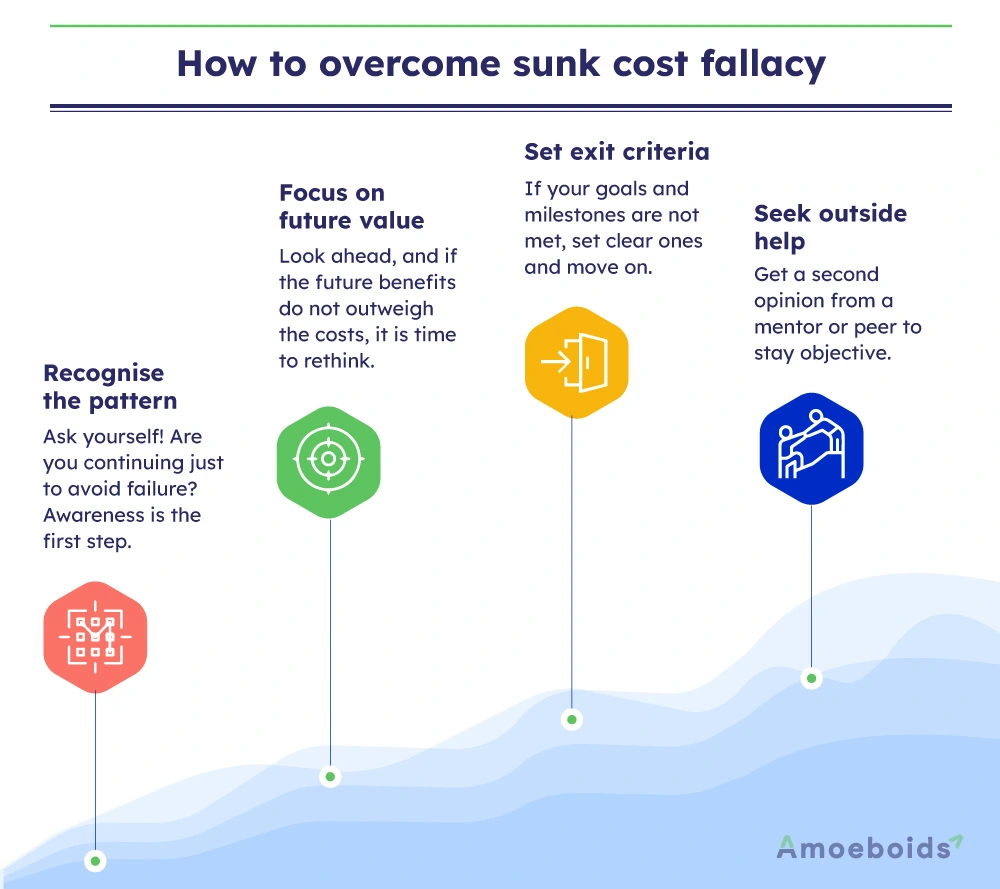
Conclusion
Today you've learned to identify and counteract one of the most common and costly decision-making traps for any entrepreneur. By consciously separating past investments from future opportunities, you can ensure your business stays agile and responsive to what the market truly wants.
Key Takeaways:
- Sunk costs are past, irrecoverable expenditures of time, money, or effort. They are irrelevant to future decisions.
- The decision to pivot should be based on future costs and opportunities, not on trying to justify or recover past investments.
- The sunk cost fallacy is driven by powerful psychological forces like loss aversion and the desire for self-justification.
- Use practical frameworks like Zero-Based Thinking ("Knowing what I know now, would I still do it?") and the Pivot Decision Matrix to make rational choices about whether to pivot or persevere.
Preview of the Next Lesson:
Today, we focused on the internal mindset and framework for making a pivot decision. But what external events should prompt this evaluation in the first place? In our next lesson, you will learn to identify key market signals that might trigger a pivot, such as competitor actions, shifts in customer demand, or new technological developments.