Hello! Welcome to the next lesson in our "Portfolio Management and Value Creation" module.
In our last session, we designed a robust process to collect, analyze, and act on portfolio performance data. You learned how to use a data-driven approach to triage companies into three categories: Accelerate, Monitor, and Intervene. This system tells you which founders need your attention and why.
Today, we transition from analysis to action. We'll focus on the "how" of providing direct, hands-on support. Our learning outcome is to establish a structured framework for regular founder coaching and performance check-ins. For you as a future solo GP, creating a repeatable and scalable coaching system is essential for maximizing your impact across the portfolio while managing your most valuable resource: your time.
1. The Foundation: What is Effective Founder Coaching?
Before diving into the "how," let's clarify the "what." Founder coaching is not simply giving ad-hoc advice. It's a structured partnership designed to help founders solve problems, develop skills, and achieve clear, measurable outcomes.
Startup Business Coaching Guide: Strategies for Success
To understand the fundamentals, let's explore the 'Startup Business Coaching Guide' from Swisspreneur. This will provide a high-level overview of what coaching entails and its benefits.
Please read the first section, 'The Fundamentals of Startup Business Coaching.' Pay close attention to the distinction between coaching and mentoring, and the typical challenges that coaching addresses.
As the article highlights, coaching is distinct from mentoring:
- Mentoring is often informal and based on sharing personal experiences ("When I was in your shoes, I did X...").
- Coaching is a structured process focused on asking powerful questions to help the founder find their own solution, setting actionable plans, and establishing mutual accountability.
While you will certainly share experiences, adopting a coaching mindset will be far more scalable and empowering for your founders.
2. Structuring Your Coaching Program
An effective coaching program isn't a series of random conversations; it's a deliberate cycle of different interaction formats designed to provide holistic support. Your goal as an accelerator manager is to build an ecosystem of support, not just be the sole source of wisdom.
Startup Business Coaching Guide: Strategies for Success
Let's examine the different models of coaching you can implement. The 'Startup Business Coaching Guide' provides a good overview.
Please read the section 'Types of Startup Coaching Models and Approaches' to understand the different formats available, such as one-on-one, group, and peer-to-peer coaching.
These different models can be woven together into a comprehensive coaching cycle.
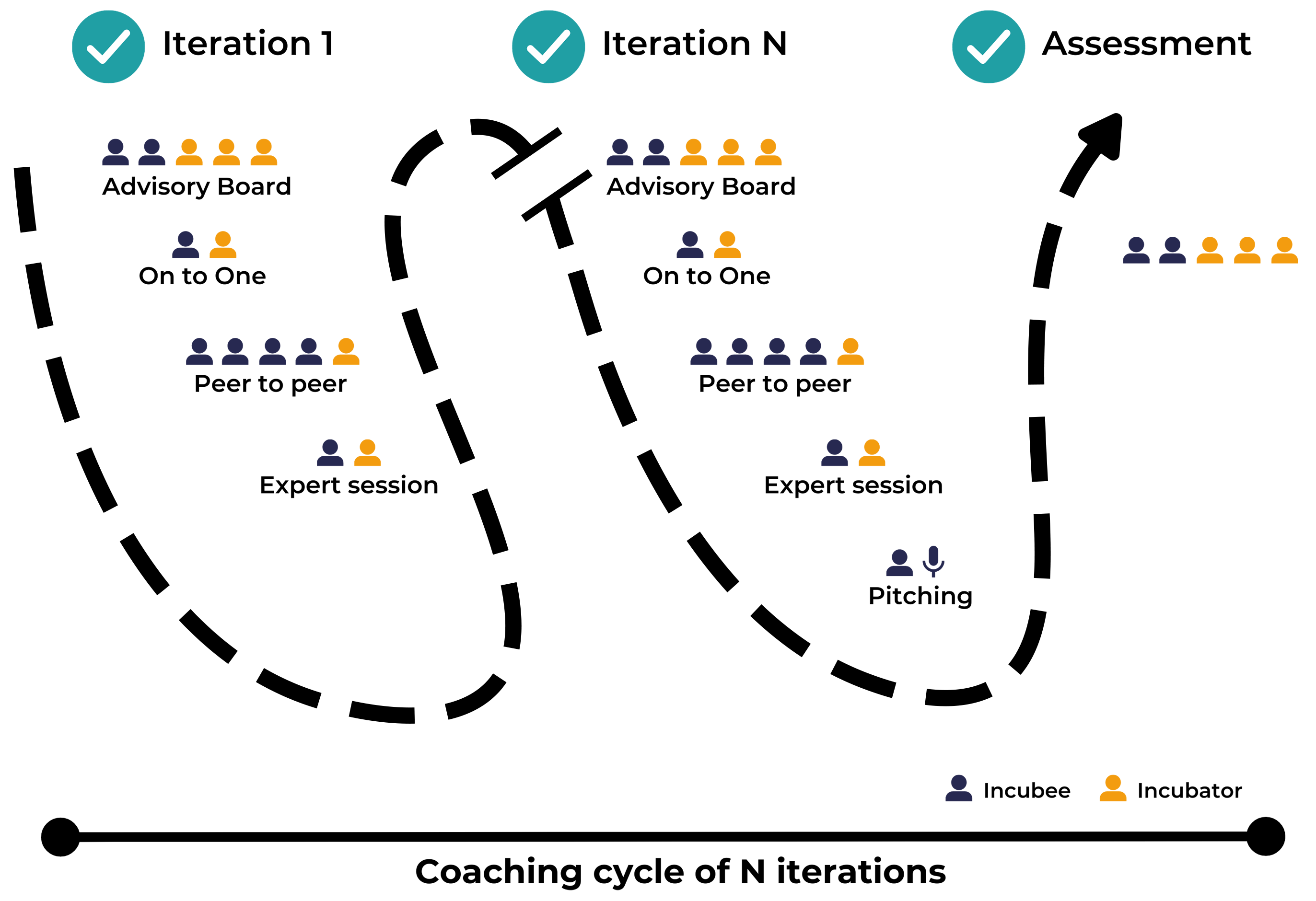
For your solo-led accelerator, a hybrid approach could be highly effective:
- One-on-One Sessions: Your core check-ins for personalized strategy and accountability (we'll detail this later).
- Peer-to-Peer Sessions: Facilitated group meetings where founders in a cohort can share challenges and solutions. This builds community and leverages the collective intelligence of the group, reducing the burden on you.
- Expert Sessions: Bringing in external specialists (e.g., a SaaS pricing expert, a B2B sales coach) for targeted workshops. Your role is curator and facilitator.
3. A 3-Step Framework for Personalized Coaching
Now, let's build the operational framework for your one-on-one coaching. We will use a practical, three-step process that ensures your support is targeted, effective, and measurable.
The 'Incubator Toolkit' by SEED provides excellent, template-driven guidance for structuring a coaching program. We will use it as our primary reference for this framework.
First, skim the section 'Identifying Target Participants' (pages 50-53) to see how needs assessments and empathy maps can be used. Then, read 'Preparing MSMEs for the Incubation Phase' (pages 74-78), focusing on the steps 'Conduct A Detailed Analysis Of Each MSME' and 'Develop Tailored Onboarding Plans'. Finally, read 'Mentoring & Coaching Support' (pages 87-90) to see how this all comes together. Focus on the templates and the process flow.
The toolkit outlines a clear, repeatable process that we can adapt.
Step 1: Conduct a Deep Needs Assessment
Effective coaching begins with a deep understanding of the founder's unique situation. This goes beyond the quarterly KPIs you collected in the last lesson.
- Initial Baseline: Use the "Detailed Analysis" worksheets from the
Incubator Toolkit(p. 77) during onboarding to create a comprehensive baseline of the team's skills, market understanding, and scalability potential. This gives you a starting point. - Ongoing Assessment: The data from your quarterly portfolio monitoring process serves as a recurring needs assessment. A sudden drop in a KPI is a clear signal of a new need.
- Qualitative Understanding: Use tools like the Empathy Map (p. 52) to understand the founder's mindset. What are they thinking, feeling, and saying? This helps you coach the person, not just the business problem.
Step 2: Develop a Tailored Coaching Plan
Once you've identified the needs, you translate them into a concrete plan. This moves your support from being reactive to proactive.
As shown in the Incubator Toolkit (p. 78, "Develop Tailored Onboarding Plans"), this involves creating a simple table for each founder:
| Area for Improvement | Analysis Results (The "Why") | Action Plan (The "What") | Resources/Support (The "How") |
|---|---|---|---|
| Business | Good market understanding, but needs a more rigorous competitor analysis. | Conduct a comprehensive competitor analysis (SWOT) and develop differentiation strategies. | Mentoring from a business strategy expert; access to market research reports. |
| Team | Leadership roles are clear, but the decision-making process is slow. | Establish a structured decision-making framework (e.g., RACI chart). | Workshop on effective decision-making; one-on-one coaching on delegation. |
This plan becomes the backbone of your coaching relationship for the quarter, giving both you and the founder a shared roadmap.
Step 3: Facilitate Structured Check-ins
This is where the coaching happens. Your check-ins are the primary vehicle for reviewing progress, tackling challenges, and providing support. The key is to make them structured and predictable.
- Cadence: For early-stage companies, bi-weekly or weekly check-ins are common. The frequency can be adjusted based on the company's stage and current needs (e.g., an "Intervene" company may need weekly meetings, while a "Monitor" company is fine with bi-weekly or monthly).
- Agenda: Never go into a check-in without an agenda. It ensures the conversation is focused and productive.
4. Anatomy of an Effective Performance Check-in
Let's break down the check-in meeting itself. A well-structured agenda ensures you cover accountability, problem-solving, and forward planning in an efficient manner.

Here’s how to apply this template to a founder check-in:
- Opening (5 min): Start with a personal connection. "How are you doing?" This builds trust and rapport.
- Recap & Refocus (5 min): Review the "Next Steps" from the previous meeting. This immediately establishes accountability. "Last time, we decided you would A/B test the new pricing page. How did that go?"
- Current Projects and Progress (10 min): The founder provides a brief update on progress toward their quarterly goals. This is where they review their key metrics. Frame it around their key goal: "How are we tracking towards the goal of hitting $10k MRR this quarter?"
- Identify & Address Challenges (20 min): This is the heart of the meeting. The founder brings their single biggest challenge to the table. Your role here is to be a coach: ask clarifying questions, help them diagnose the root cause, and brainstorm solutions together. Avoid jumping straight to an answer.
- Feedback & Recognition (5 min): Create space for mutual feedback. Acknowledge a recent win to boost morale. Ask, "What can I be doing better to support you?"
- Goal Setting & Next Steps (10 min): Based on the discussion, agree on 1-3 clear, actionable next steps for the founder to complete before the next check-in. These should be specific and time-bound. Also, define any "asks" for you.
- Conclusion (5 min): Summarize the key decisions and next steps to ensure alignment.
5. Closing the Loop: Monitoring and Evaluation
Finally, how do you know if your coaching is effective? You need to measure its impact.
The Incubator Toolkit (p. 106-110) provides excellent tools for this:
- Monitoring and Evaluation Log: After each check-in, jot down your observations, the feedback you gave, and the agreed-upon next steps. This creates a running record of the coaching journey.
- Satisfaction Surveys: At the end of a program or a set period, ask founders for feedback on the coaching process itself. Questions like "How satisfied are you with the quality of mentorship?" or "What aspects of the program did you find most valuable?" provide crucial data for you to improve your own performance as a coach and program manager.
Test your understanding!
A founder in your portfolio has consistently low user engagement metrics. Their qualitative updates often mention feeling "overwhelmed" by their product roadmap.
Using the framework from this lesson, how would you structure your next coaching intervention?
Show answer
-
Needs Assessment: The data points to a potential product-market fit or usability issue. The founder's feeling of being "overwhelmed" is a key piece of qualitative data. Your initial hypothesis is that they lack a clear prioritization framework.
-
Tailored Coaching Plan:
- Area: Product Strategy & Prioritization.
- Action Plan:
- Conduct a series of 5-10 new customer discovery interviews to re-validate core pain points.
- Implement a simple prioritization framework (e.g., RICE score) to rationalize the product roadmap.
- Focus the next development sprint on a single feature that addresses the most critical pain point identified.
- Resources: You can provide an article on the RICE framework, offer to review their interview script, and connect them with another founder who has navigated this challenge.
-
Structured Check-in Agenda:
- Recap: "Last time we discussed the engagement numbers. What are your latest thoughts on the root cause?"
- Challenge to Address: "Let's use this session to build a framework for prioritizing your roadmap so you can focus your team's effort on what matters most."
- Next Steps: "By our next meeting, please draft a RICE score for your top 10 backlog features. I will review it with you and help you make the final cut for the next sprint."
Conclusion
You have now built a comprehensive, structured framework for providing high-value coaching to your founders. This system ensures your support is personalized, accountable, and scalable—critical attributes for a successful solo-led accelerator.
Key Takeaways:
- Coaching is a Structured Process: It moves beyond ad-hoc advice to a deliberate cycle of assessment, planning, and structured engagement.
- A Hybrid Model is Powerful: Combine one-on-one check-ins with peer groups and expert sessions to create a rich support ecosystem.
- The Check-in is Your Core Ritual: Use a clear, consistent agenda to drive accountability, solve problems, and build strong relationships.
- Measure Your Own Effectiveness: Use monitoring logs and surveys to evaluate and improve your coaching process over time.
Preview of the Next Lesson
As you manage your portfolio, some companies will outperform others. This will force you to make difficult capital allocation decisions. In our next lesson, we will develop a follow-on investment strategy, including capital reservation and decision triggers. This will prepare you to double down on your winners and manage your fund for maximum returns.