Hello! Welcome to the next lesson in our "Portfolio Management and Value Creation" module.
In our last session, we built a framework for founder coaching and performance check-ins. This process helps you identify which companies are excelling and where support is most needed. Now, we move from providing support to making critical capital decisions. When a portfolio company is performing exceptionally well, you'll face a crucial question: should you invest more?
Today's lesson addresses exactly that. Our learning outcome is to develop a follow-on investment strategy, including capital reservation and decision triggers. For you as a future solo GP, mastering this is essential. A well-defined follow-on strategy is how you concentrate capital on your biggest potential successes to drive fund returns, a concept central to the power-law dynamics of venture capital.
We will structure this by answering three key questions:
- How much capital should you reserve for follow-on investments?
- When should you make a follow-on investment? (The "decision triggers")
- How do you make the final decision in a structured, data-driven way?
1. The Core Concept: Follow-On Strategy and Capital Reservation
A follow-on investment is an additional injection of capital into a company you've already backed. The goal is to increase your stake in the most promising companies as they grow, capturing more of the upside. The capital set aside for this purpose is called a reserve or dry powder.
To start, let's get a high-level sense of how VCs think about this.
How VCs think about deploying reserves & follow-on funding + Quaise CEO Carlos Araque | E1546
This clip from 'This Week in Startups' offers a great introduction to the concept of reserves and the strategic thinking behind deploying them. It's a practical, conversational overview.
Please watch from the timestamp 00:02:01 to 00:06:22. Pay attention to the definition of reserves and the rationale for using them to back your 'breakout' companies.
As the video explains, you might invest an initial amount from your fund (e.g., two-thirds) and reserve the rest. This reserve isn't just idle cash; it's your strategic ammunition to double-down when you have more information and a company has demonstrated significant progress.
How Much to Reserve?
Deciding on the size of your reserve is a foundational element of your fund's portfolio construction. There are several ways to approach this, ranging from simple heuristics to complex models.
Let's look at some common strategies for capital reservation. The article 'Follow On in Venture Capital' from GoingVC provides a clear breakdown of the typical approaches and their limitations, while the guide from Allied Venture Partners gives a useful rule of thumb.
Please read the section titled 'How VCs Think About Follow-On Strategy'. This will introduce you to the 'Percentage of the Fund' and 'What’s Left' strategies.
As you've read, common strategies include:
- Percentage of the Fund Strategy: You pre-determine a fixed percentage of your fund for follow-ons. A common rule of thumb, mentioned in the Allied Venture Partners guide
How to Time Follow-On Investments, is to reserve 40%-60% of the fund. - What's Left Strategy: You prioritize initial check size and portfolio size, and whatever capital remains after accounting for initial investments becomes your reserve.
While simple, these methods can be blunt. A more sophisticated approach, which will likely appeal to your analytical background, is the "Graduation Rate" Strategy.
Now, let's explore a more data-driven method. The same GoingVC article details the 'Graduation Rate' strategy, which models follow-on needs based on expected company progression.
Read the sections 'Graduation Rate Follow-On Strategy' and 'Portfolio Construction with Graduation Rate Follow-On Strategy'. Focus on the logic: you estimate the percentage of companies that will 'graduate' to Series A, B, C, etc., and calculate the capital required to participate in those future rounds.
This modeling approach allows you to build a fund strategy from the ground up, aligning your fund size with your investment thesis and follow-on ambitions.
A Contrarian, Data-Driven Perspective
The conventional wisdom is to reserve a large portion of your fund to "double down on winners." However, there's a compelling, data-backed counterargument that you must consider.
Decision Analysis in Venture Capital
This lecture from the Stanford Decisions and Ethics Center presents a powerful, quantitative challenge to the traditional follow-on model. It's a masterclass in applying decision analysis to venture capital and is highly relevant to your goal of making data-driven investment decisions.
Watch the section on portfolio construction from 00:38:48 to 00:52:32. The speaker, Clint Korver, uses data to argue that investing more capital upfront for higher initial ownership can yield better returns than reserving large amounts for later-stage follow-ons.
The key takeaway is that there is a fundamental trade-off:
- High Reserve Strategy: Less capital for initial checks (meaning lower initial ownership), but more "dry powder" to follow on in winners. You're betting on your ability to identify winners later.
- Low Reserve Strategy: More capital for initial checks (higher initial ownership), but less capital for follow-ons. You're betting that the higher ownership in your eventual winners will outweigh the dilution from not following on.
As a solo GP, you must consciously decide which philosophy aligns with your thesis. There is no single "right" answer, only a strategy that fits your fund size, portfolio size, and risk tolerance.
2. The "When": Decision Triggers for Follow-On Investment
Once you have a capital reservation plan, you need a framework for deciding when to deploy that capital. These are your decision triggers—a combination of quantitative metrics and qualitative milestones that signal a company is ready for more funding.
Quantitative Triggers: The Hard Data
These are the measurable indicators of a company's health and scalability. Your portfolio monitoring process, which we discussed two lessons ago, is designed to track these.
How to Time Follow-On Investments
The guide 'How to Time Follow-On Investments' by Allied Venture Partners provides an excellent, actionable list of key metrics and industry benchmarks that serve as powerful decision triggers.
Read the section 'Key Metrics and Milestones for Follow-On Investments,' focusing on the subsections for 'Performance Metrics to Check Before Investing.' Pay close attention to the specific benchmarks provided for revenue growth, LTV to CAC, churn, and gross margin.
Your decision trigger dashboard should include:
| Metric | What it Signals | Strong Benchmark (Early-Stage SaaS) |
|---|---|---|
| Revenue Growth Rate | Market validation and demand. | 15%-30%+ Month-over-Month (MoM) |
| LTV to CAC Ratio | Profitability and sustainability of growth. | > 3:1 |
| Churn Rate | Customer satisfaction and product stickiness. | < 2% monthly |
| Burn Multiple | Capital efficiency. | The lower, the better (ideally < 1.5x) |
| Gross Margin | Core profitability and scalability. | > 80% |
Another critical quantitative check is valuation discipline. The Allied Venture Partners guide notes that traction and KPIs should grow faster than or keep pace with valuation. If valuation is outpacing fundamental growth, it could be a red flag.
Qualitative Triggers: Beyond the Numbers
Metrics tell part of the story, but qualitative signals are equally important. These relate to market positioning, team, and strategic progress.
- Product-Market Fit: Have they moved from searching to executing? Signs include strong organic growth, high user engagement, and customers who are clear evangelists for the product.
- Team Execution: Does the team consistently set and hit ambitious goals? Have they made key strategic hires?
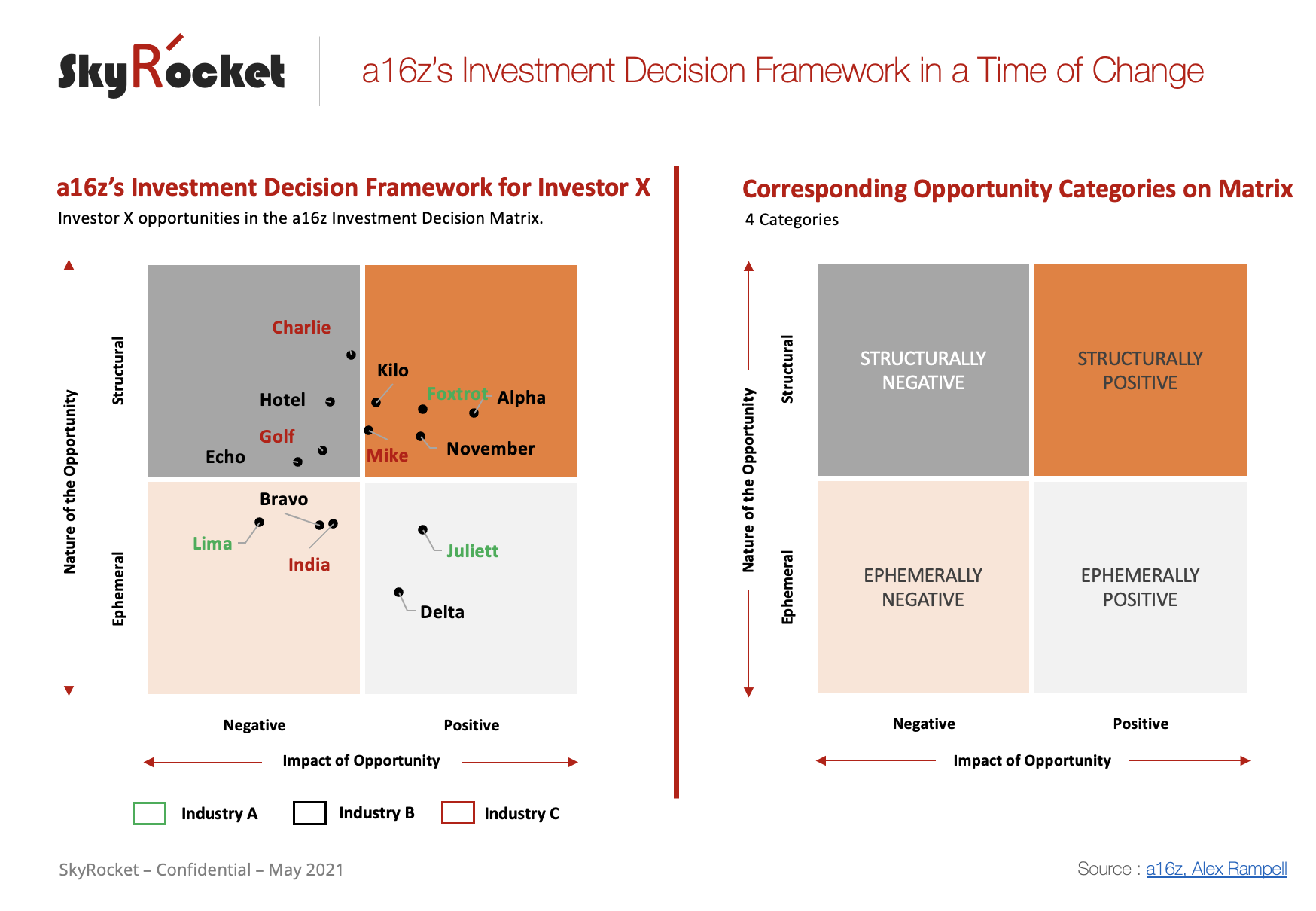
- Strategic Positioning: Is the company's success due to a durable, structural market shift, or a temporary, ephemeral trend?
This last point is crucial. You want to back companies riding long-term waves of change. The a16z investment framework provides a useful mental model for this.
3. The "How": A Framework for the Final Decision
You have your triggers, and a company has hit them. How do you make the final go/no-go decision? Rather than relying on gut feel, you can use a structured process. The Stanford video you watched earlier provides a powerful example of this: Decision Analysis.
The core idea is to move beyond a simple "yes/no" and instead calculate the probability-weighted return of the investment.
Decision Analysis in Venture Capital
Let's revisit the Stanford lecture to see how this framework is applied in practice with the SoFi case study. This is where all the quantitative and qualitative triggers come together into a single, cohesive analysis.
Please re-watch or review the section from 00:13:19 to 00:27:15. This time, focus on how they translate risks and milestones (like 'crossing the chasm') into probabilities and then calculate the 'probability-weighted multiple on invested capital.' This is a template for your own decision memos.
The process, simplified for a follow-on decision, looks like this:
- Define Scenarios: What are the possible future outcomes for the company (e.g., market leader, strong niche player, acquired, failure)?
- Assign Probabilities: Based on all your data (KPIs, market analysis, team strength), what is the probability of each scenario occurring?
- Estimate Value: What would your investment be worth in each scenario?
- Calculate Expected Value: Multiply the value of each scenario by its probability and sum the results.
This gives you an "expected multiple" on your follow-on investment. You can then set a threshold (e.g., "We only make follow-on investments if the probability-weighted multiple is greater than 10x"). This transforms the decision from an emotional one to a disciplined, analytical one.
4. Integrating AI into Your Follow-On Strategy
Your goal is to build an AI-native firm. The data-intensive nature of a follow-on strategy is a perfect place to apply AI. Instead of manually tracking KPIs and building models in spreadsheets, you can leverage AI to automate and enhance your process.

You can design your firm's systems to:
- Automate Data Collection: Use AI tools to pull data from founder updates, financial statements, and product analytics into a central dashboard.
- Create Predictive Alerts: Build models that flag companies whose trajectory suggests they are approaching key inflection points, alerting you to a potential follow-on opportunity before they even start fundraising.
- Enhance Decision Analysis: Use AI to run Monte Carlo simulations (as mentioned in the GoingVC article) on your decision models, stress-testing your assumptions and giving you a range of potential outcomes, not just a single number.
This approach aligns perfectly with your background and goals, allowing you to build a highly scalable and data-driven investment process, even as a solo GP.
Test your understanding!
One of your portfolio companies is raising their Series A. Their MRR has grown 25% MoM for the last 6 months, their LTV:CAC is 4:1, and a top-tier VC is leading the round. However, the new valuation is 10x the post-money of your seed investment, while revenue has only grown 5x.
Using the frameworks from this lesson, outline the key points you would consider to decide whether to exercise your pro-rata rights.
Show answer
Here's a structured approach:
-
Quantitative Triggers (Mostly Positive):
- Revenue Growth (25% MoM): Excellent. Strong signal of product-market fit.
- LTV:CAC (4:1): Excellent. Signals a sustainable, profitable growth engine.
- Valuation Discipline (Mixed Signal): This is the key concern. The valuation (10x) has outpaced revenue growth (5x). You need to dig in here. Is this justified by other factors (e.g., new strategic partnerships, a major technology breakthrough)?
-
Qualitative Triggers (Positive):
- Co-investor Signal: A top-tier VC leading the round is a very strong positive signal. It provides market validation for both the company and the valuation.
-
Decision Analysis Framework:
- You would model this out. Even with the high valuation, what is the probability-weighted return?
- Scenarios: What's the chance this company becomes a $1B+ outcome? A $500M outcome?
- Probability: The strong metrics and top-tier lead investor increase the probability of a large outcome.
- Calculation: Does the increased probability of a massive outcome justify paying the higher price? You would run the numbers to see if the expected multiple on this follow-on check still clears your investment threshold (e.g., >10x). The high price reduces your potential multiple, but the strong signals might increase the probability enough to make it a good bet.
Conclusion: You would likely invest, but not automatically. The decision would hinge on whether you believe the company's future potential justifies the rich valuation, a judgment validated by the new lead investor but one you must confirm with your own analysis.
Conclusion
You now have a comprehensive framework for one of the most critical responsibilities of a fund manager: deciding where to allocate follow-on capital. This is how you nurture your fledgling winners into fund-returning giants.
Key Takeaways:
- Capital Reservation is a Strategic Choice: There is a fundamental trade-off between securing higher initial ownership and reserving capital for follow-ons. Your choice should be a deliberate part of your fund strategy.
- Use a Mix of Triggers: Decisions should not be based on a single metric. A robust framework combines quantitative KPIs (growth, efficiency) with qualitative milestones (PMF, team) and strategic context.
- Embrace Structured Decision-Making: Use a probabilistic framework, like decision analysis, to move beyond gut feel. This enforces discipline and improves the quality of your decisions over time.
- Leverage AI: Your follow-on strategy is a prime area to apply AI for data analysis, predictive alerting, and sophisticated modeling, creating a competitive advantage for your firm.
Preview of the Next Lesson
Deciding to follow on is an internal decision. But for your portfolio companies to truly scale, they need to raise capital from external investors. In our next lesson, we will focus on how you can help them get there by learning to assess a portfolio company's readiness for its next funding round. This will equip you to be a more effective coach and board member as your companies prepare to fundraise.