Hello! Welcome to the next lesson in our "Portfolio Management and Value Creation" module.
In our last session, we developed a strategy for making follow-on investments, focusing on capital reservation and the internal decision triggers that tell you when it's time to double down on a winner. That was about your decision-making process.
Today, we'll shift our perspective from the internal to the external. A company might hit your internal triggers for a follow-on investment, but are they truly ready to convince new, external investors to lead their next funding round? Your ability to help founders honestly answer this question is a core part of the value you'll provide.
This lesson directly addresses the learning outcome: to assess a portfolio company's readiness for its next funding round. We will build a structured framework you can use to evaluate a company's position, combining quantitative metrics, qualitative factors, and the practical necessities of a fundraising process. This framework is especially critical as you prepare companies to leap from the Seed stage to the much more demanding Series A round.
1. Understanding the Journey: What's Required at Each Stage?
Before assessing a company's readiness for the next round, it's vital to understand the typical milestones for each stage of the venture capital journey. The expectations for a Seed round are vastly different from those for a Series A or B. A common mistake founders make is not appreciating how much the goalposts move with each round.
To build this foundational context, let's explore the progression from Pre-seed to Series A.
Startup Funding Explained: Series A vs Seed - Startups 101
The video 'Startup Funding Explained' from Slidebean provides an excellent overview of the different funding stages. It clearly explains the purpose of each round and what a company is expected to achieve.
Please watch from 00:02:37 to 00:06:40. As you watch, focus on two key ideas: The primary goal of a Seed round is to generate enough proof (traction, product-market fit) to be able to raise a Series A. The specific benchmarks mentioned for a SaaS company to be considered 'Series A ready' (e.g., ARR, growth, momentum).
As the video highlights, the core principle is that each funding round must provide enough capital and runway to reach the milestones required for the next round. Your job as an investor and advisor is to help the founder understand what those next-round milestones are.
Here is a helpful visual summary of the key characteristics at each stage.
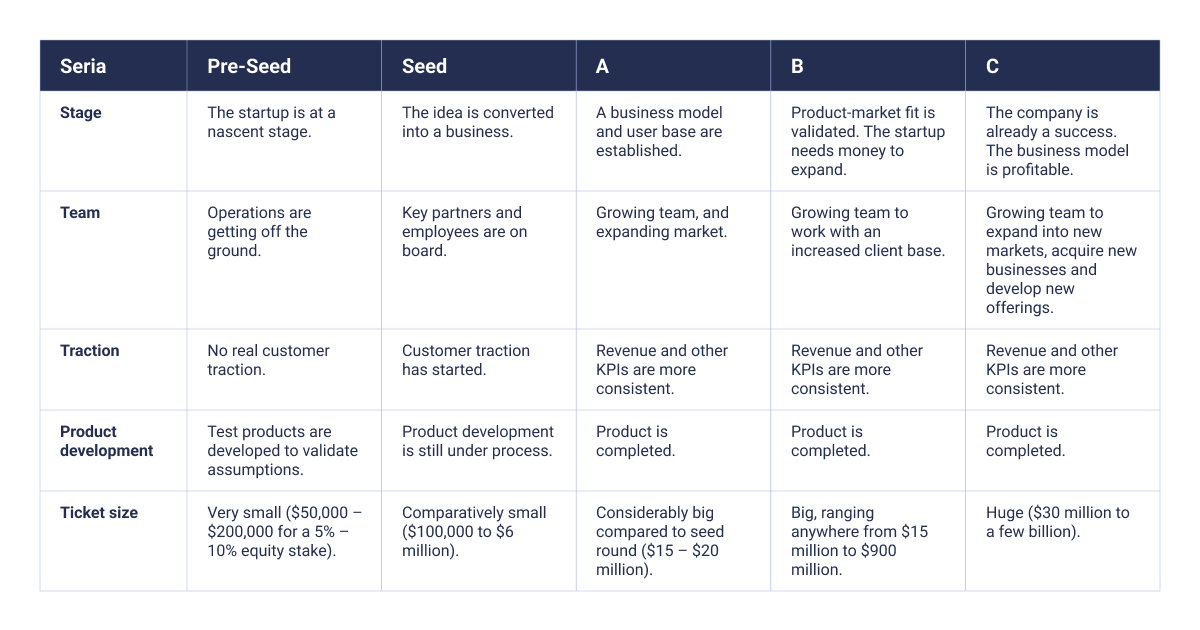
With this stage-by-stage context in mind, we can now build a more detailed assessment framework, breaking it down into quantitative and qualitative readiness.
2. Quantitative Readiness: Do the Numbers Tell the Right Story?
For a post-Seed company aiming for Series A, investors will move past the visionary pitch and dive deep into the numbers. The company must demonstrate not just growth, but efficient and sustainable growth. Your assessment should therefore focus on the key metrics that VCs use as a filter.
A VC Reveals the Metrics They Use to Evaluate Startups — The Startup Tapes #031
This video, 'A VC Reveals the Metrics They Use to Evaluate Startups,' from Scale Venture Partners, gives you a direct look into an investor's thought process. It's a practical guide to the most important financial signals.
Watch from 00:00:49 to 00:06:26. Pay close attention to the definitions and benchmarks for: Net New ARR growth The 'Magic Number' (sales efficiency) Gross Margins Cash Runway
Synthesizing from the video and general market expectations, here is a dashboard of core SaaS metrics for assessing Series A readiness:
| Metric | What it Measures | Series A Target Benchmark |
|---|---|---|
| ARR (Annual Recurring Revenue) | Scale and market adoption. | ~$1M - $2M+ |
| MoM Revenue Growth | Momentum and trajectory. | 15%+ sustained for 6+ months |
| Gross Margin | Core profitability of the product. | >70-80% for SaaS |
| LTV:CAC Ratio | Long-term profitability of a customer. | > 3:1 |
| Sales Efficiency (Magic Number) | Capital efficiency of S&M spend. | ~1.0 or higher |
| Net Revenue Retention / Churn | Product stickiness and customer health. | >100% Net Retention / <2% monthly logo churn |
| Cash Runway | Financial stability. | Raising with at least 6 months of cash left |
A company doesn't need to be perfect on every metric, but significant weakness in any of these areas will make fundraising extremely difficult. Your role is to help the founder identify these gaps long before they start pitching VCs.
3. Qualitative Readiness: The Story, the Team, and the Defensibility
Strong metrics are necessary, but not sufficient. At the Series A stage, investors are betting on the company's potential to become a category-defining business. This requires a compelling narrative, a stellar team, and a clear path to a long-term competitive advantage.
The following resource provides a comprehensive checklist of these qualitative proof points.
The Fundraising Checklist: 13 Proof Points for Series A
The article 'The Fundraising Checklist: 13 Proof Points for Series A' from NFX is an investor's view on what separates a good company from a fundable one. It covers the crucial non-metric elements that build investor conviction.
Please read sections 2, 4, 5, 6, and 7. Focus on how a founder can demonstrate: Product-Market Fit: The 'art' beyond the retention numbers. Big Vision: The path to a $1B revenue outcome. Compelling Narrative: The 'why now?' question. Team Magnetism: The ability to attract top talent. Defensibility: The plan to build a moat (e.g., network effects).
Your assessment should evaluate these qualitative factors with the same rigor as the quantitative metrics:
- Product-Market Fit: Is there "ambient noise" around the company? Are customers fanatical?
- Vision & Narrative: Can the founder articulate a vision big enough to generate a venture-scale return? Is the story clear, compelling, and urgent?
- Team: Has the founding team successfully recruited key hires who are better than them in specific domains (e.g., first VP of Sales, first Head of Marketing)? This demonstrates an ability to scale the organization.
- Defensibility: Does the business model have inherent network effects, data moats, or other structural advantages that will make it harder for competitors to catch up?
Test your understanding!
You are advising a SaaS startup in your portfolio. They have reached $800k ARR, growing 10% MoM. Their LTV:CAC is 2.5:1, and they have 8 months of runway. The founder is a brilliant product person, but they have not yet hired a sales leader and all deals are still founder-led.
Based on the quantitative and qualitative frameworks, how would you assess their readiness for a Series A fundraise? What would be your top 2-3 pieces of advice?
Show answer
Assessment of Readiness: Not Ready.
-
Quantitative Gaps:
- ARR ($800k): Below the typical $1M+ floor for a competitive Series A.
- Growth (10% MoM): Below the 15%+ benchmark, indicating slowing momentum.
- LTV:CAC (2.5:1): Below the 3:1+ benchmark, questioning the long-term profitability and scalability of their growth motion.
-
Qualitative Gaps:
- Team: The lack of a sales leader is a major red flag. It suggests the sales process is not yet scalable or repeatable beyond the founder. Investors will question if growth can continue once the founder is distracted by fundraising.
- Scalability: The combination of slowing growth, borderline unit economics, and founder-led sales points to a business that hasn't yet figured out its repeatable growth engine.
Top Advice:
- Do Not Fundraise Now: Advise them to delay the Series A raise. Going out to market now would likely result in a "no" from top firms, which can hurt their reputation.
- Focus on Unit Economics & Growth Levers: They need to focus all their energy on improving the LTV:CAC ratio. This might involve price adjustments, focusing on higher-value customer segments, or improving retention. They must find the levers that can re-accelerate growth to the 15%+ range.
- Hire a Sales Leader: Finding and onboarding a Head of Sales is a critical milestone. This person will be responsible for building the repeatable sales process that Series A investors need to see. This hire would be a major qualitative proof point that they are ready to scale.
4. Special Focus: Assessing AI Startups
Given your goal to specialize in AI startups, you need an additional layer in your assessment framework. While the core SaaS metrics still apply, AI companies have unique technical and cost structures that require scrutiny. VCs investing in AI will look for specific indicators of technical viability and operational efficiency.
AI Startup Metrics: What VCs Want to See
This article, 'AI Startup Metrics: What VCs Want to See,' is essential reading for your specialization. It details the unique performance indicators that separate a promising AI model from a scalable AI business.
Please read the sections 'Core Metrics VCs Look for in AI Startups' and 'AI-Specific Performance Indicators.' Pay special attention to how AI-specific costs and performance metrics layer on top of traditional SaaS metrics.
Here's a summary of the AI-specific assessment areas:
| Category | Key Metrics to Assess | What it Signals |
|---|---|---|
| Gross Margin Viability | Compute costs as a % of revenue. | Can this business ever achieve software-like margins, or are compute costs a permanent drag? Look for a downward trend. |
| Model Performance | Inference latency, model accuracy, drift detection. | Is the technology robust, fast, and stable enough for production use at scale? |
| Cost to Serve | Inference cost per prediction, cost per training cycle. | Does the company understand and actively manage the unit costs of its AI? Are these costs decreasing over time? |
| Data Efficiency | Data acquisition cost, labeling efficiency. | Does the company have a cost-effective and sustainable strategy for acquiring and preparing the data needed to improve its models? |
For an AI startup, demonstrating a clear path to improving these metrics is just as important as showing top-line revenue growth.
5. The Final Check: Is the Data Room Ready?
A company can have strong metrics and a great story, but if they are not operationally prepared for the rigor of a fundraising process, they are not ready. The final part of your assessment is to determine if the company can quickly assemble a comprehensive and professional data room for investor due diligence.

Your final assessment question should be: "If a top VC committed to a term sheet tomorrow, could you deliver a complete data room within 48 hours?" If the answer is no, they have work to do.
Conclusion
You now have a multi-layered framework to assess a portfolio company's readiness for its next funding round. This process allows you to move from a general "how are things going?" check-in to a specific, actionable, and strategic evaluation that provides immense value to your founders.
Key Takeaways:
- Fundraising is a Step Function: The requirements for each funding round are significantly higher than the last. A key part of your role is to help founders understand and prepare for these new expectations.
- Readiness is Both Quantitative and Qualitative: A company needs both strong, efficient growth metrics and a compelling story, team, and vision to succeed.
- For AI, Technical Viability is Financial Viability: You must assess an AI company's ability to manage its unique cost structure (compute, data) and demonstrate a path to profitable unit economics.
- Operational Preparedness is the Final Gate: A company isn't truly ready until it is prepared for the operational demands of the due diligence process.
Preview of the Next Lesson
Once you've assessed that a company is ready to raise, your next job is to help them connect with the right people. In our next lesson, we will focus on how to facilitate strategic introductions to partners, customers, and follow-on investors, turning your assessment into action and helping your portfolio companies build the relationships they need to succeed.