
Welcome back. In the previous lesson, you calculated a conductor’s resistance from its material, length, and cross-sectional area. Now we use resistance alongside voltage and current to answer another common exam question: how much electrical power is being supplied or used?
By the end of this lesson, you should be able to look at the values given in a question, choose the power formula that matches them, convert units where needed, and calculate an answer in watts with clear working.
Power: the rate at which electrical energy is used
Electrical power is the rate at which electrical energy is converted to another form.
A resistor mainly converts electrical energy into heat. A lamp converts it into light and heat. A motor converts it into mechanical motion, with some heat and sound as losses.
The symbol for power is , and its SI unit is the watt, written .
So a load transfers or converts of energy every second while it operates. This is power, not total energy used over time; energy calculations come next.
The basic power relationship is:
where:
| Symbol | Quantity | Unit |
|---|---|---|
| Power | watts, | |
| Voltage across the load | volts, | |
| Current through the load | amperes, |
The units confirm the relationship:
For an electrical exam question, read in words:
Power equals voltage multiplied by current.
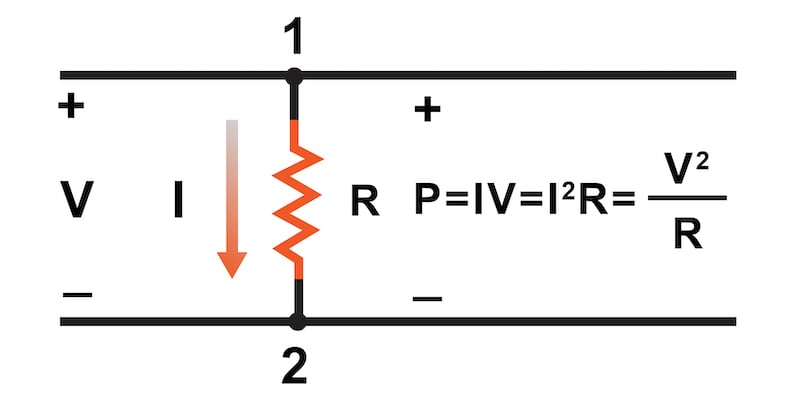
The three power formulas
You already know Ohm’s law:
Combining it with gives two more power formulas:
All three calculate power in watts. The best formula is simply the one that contains the two values you have been given.
| If the question gives you… | Use this formula |
|---|---|
| Voltage and current | |
| Current and resistance | |
| Voltage and resistance |
The superscript means “squared”:
It does not mean doubling the value. For example:
not .
The three equations come from substitution using Ohm’s law:
Substitute :
Or substitute :
You do not usually need to derive these in an exam. The useful point is that they are all connected, so you can select the formula that avoids unnecessary extra calculation.
Electric Current & Circuits Explained, Ohm's Law, Charge, Power, Physics Problems, Basic Electricity
Watch the short power-formula explanation from Electric Current & Circuits Explained by The Organic Chemistry Tutor. It introduces the three equations and then applies them to a resistor circuit.
First watch the three formulas, focusing on why power is measured in watts and how Ohm’s law produces the two formulas involving resistance. Then watch a circuit example. Notice that the current is converted to amperes before it is squared, and that the source power equals the resistor’s power in this simple circuit.
A reliable exam routine for power calculations
Use the same written layout every time. It protects method marks and makes errors easier to find.
- Write what is required: , in watts.
- List the known values with their units.
- Convert prefixes first so your units are compatible.
- Choose the formula containing the values you know.
- Substitute values, including brackets around a squared number.
- Calculate without rounding too early.
- State the answer in , then perform a quick reasonableness check.
Two conversions matter especially often:
Also remember:
When using , it is safest in an exam to convert current to amperes and give the result in watts. When using , convert both current to amperes and resistance to ohms before calculating.
Read the “Electric Power Revisited” section from The Physics Classroom. It gives a clear derivation of the three power equations from Ohm’s law and explains when each equation is useful.
In the subsection “New Equations for Power,” begin with the opening paragraph below the video thumbnail. Read the power derivation. Focus on the fact that each formula uses a different pair of known quantities; do not try to memorise the derivation word for word.
Worked example 1: voltage and current given
Question: A DC load draws . Calculate its power.
Step 1: Required quantity
Step 2: Known quantities
Voltage and current are given, so use:
Step 3: Substitute and calculate
A quick check: multiplied by a current a little over half an amp should be somewhat more than . So is sensible.
Worked example 2: voltage and resistance given
Question: A resistor has across it. Calculate the power dissipated by the resistor.
Step 1: Known quantities
Voltage and resistance are given. Use:
Step 2: Substitute carefully
Square the voltage first:
For a calculator, enter:
Do not accidentally calculate . The is an exponent, not a multiplier.
You could check this answer with Ohm’s law:
Then:
Both methods agree, which is a strong check.
Worked example 3: prefixes, current, and resistance
Question: A resistor carries and has a resistance of . Calculate the power dissipated.
Step 1: Convert the given values
Current:
Resistance:
Step 2: Choose the formula
Current and resistance are known:
Step 3: Substitute
Rounded suitably:
The brackets around make the calculation clear:
Without converting to , the answer would be wildly wrong.
Matching the voltage and current to the correct load
A power calculation only works if the quantities refer to the same component or to the same total circuit.
For an individual resistor, use:
- the voltage across that resistor
- the current through that resistor
- that resistor’s resistance.
For a whole simple circuit, use:
- total supply voltage
- total circuit current
- total circuit resistance.
In later series-parallel work, this becomes important. A branch may have a different voltage and current from the supply. Do not combine the supply voltage with the current in one branch unless the circuit diagram shows they apply to the same part of the circuit.
In an ideal one-resistor circuit, the power supplied by the source equals the power dissipated by the resistor:
For example, if a source provides to one resistor:
The resistor dissipates , mainly as heat.
Interpreting the squared relationships
The squared formulas help with conceptual multiple-choice questions.
If resistance stays constant:
Doubling the voltage makes power four times greater:
Similarly, if resistance stays constant:
Doubling the current makes power four times greater:
This is one reason overheating can occur quickly when current rises above its intended value.
Be careful with statements about resistance. Whether increased resistance increases or decreases power depends on what is held constant:
| Condition held constant | Relevant formula | Effect of increasing |
|---|---|---|
| Current is fixed | Power increases | |
| Voltage is fixed | Power decreases |
For most basic supply-voltage questions, the voltage is treated as fixed. A higher-resistance load then draws less current and uses less power.
Common exam mistakes
Using the wrong formula pair
If given and , do not start with unless you first calculate current. Use:
It is quicker and reduces the chance of an error.
Forgetting to square the current or voltage
These are correct:
This is incorrect:
The expression is voltage, not power:
Leaving milliamps as amps
This is wrong:
This is correct:
Because current is squared in , a missed milli-prefix creates a very large error.
Combining values from different parts of a circuit
Use voltage, current, and resistance that refer to the same load, branch, or total circuit. Label values clearly from the circuit diagram before calculating.
Ignoring the result physically
If a small resistor is calculated to dissipate several hundred watts, check your prefixes, formula, and calculator entry. In practical work, a component’s power rating must be high enough for the power it is expected to dissipate; otherwise, overheating or damage can result.
Key takeaways
Electrical power is measured in watts:
The three core power formulas are:
Choose the equation from the values provided:
- and : use
- and : use
- and : use
Convert prefixes before calculating, square carefully, and ensure every value belongs to the same component or circuit section.
Next, you will build on this by calculating electrical energy used over time and the operating cost from a stated electricity tariff.
Can't find a good explanation? Sign up and we'll make it for you
Sign up