
Welcome back. In the previous lesson, you calculated power using , , and . Power tells you the rate at which energy is being used. This lesson adds time: it shows how to calculate the electrical energy an appliance uses and what that energy costs at a stated tariff.
This is a common exam pattern: identify the appliance power, convert the operating time, calculate kilowatt-hours, then multiply by the price per kilowatt-hour. Clear units at every stage will earn method marks and prevent the most common mistakes.
From power to energy
A watt is a rate of energy use:
So a heater transfers of energy every second while it runs. But an electricity retailer does not normally bill a household in joules. The billing unit is the kilowatt-hour, written .
A kilowatt-hour is an amount of energy:
means a load with a power of operating for .
The key energy relationship is:
where:
| Symbol | Meaning | Required unit for billing calculation |
|---|---|---|
| Electrical energy used | ||
| Power of the appliance or load | ||
| Operating time |
The units show why this works:
It is important not to confuse and :
- measures power: how quickly energy is being used.
- measures energy: the total amount used over a period.
For example, a heater running for uses:
A smaller appliance running for uses exactly the same energy:
So a high-power appliance used briefly can consume the same energy as a low-power appliance used for much longer.
What is a kWh - kilowatt hour + CALCULATIONS 💡💰 energy bill
Watch “What is a kWh - kilowatt hour + CALCULATIONS energy bill” from The Engineering Mindset for a visual explanation of the difference between watts, kilowatts, and kilowatt-hours, followed by short energy-cost examples.
Watch the foundation to establish what a kWh measures. Then watch the calculations, focusing on why watts must become kilowatts and minutes or seconds must become hours. Finish with the cost step, where kWh is multiplied by a tariff.
Set up the units before you calculate
For billing questions, use kilowatts and hours. Convert before substituting into the formula.
Power conversion
To change watts to kilowatts, divide by :
Examples:
Time conversion
To change minutes to hours, divide by :
Examples:
For days:
There is another valid energy pairing used in science:
That gives energy in joules. For an electricity-cost question, however, use and , so the answer is directly in .
Your power bill | Electricity Authority
Read the Electricity Authority’s New Zealand explanation of how household electricity use is measured and priced. It uses the same kWh unit and cents-per-kWh tariff format likely to appear in local course and exam questions.
In “Pricing and rates,” read the kWh explanation. Focus on the two examples that show equal energy can come from different combinations of power and time. Then, under “Can I calculate my power costs?”, read the cost example. Notice that the tariff is charged for each kWh, not for each hour alone.
From energy used to operating cost
A tariff tells you the price of one unit of energy. In New Zealand, it is commonly stated in cents per kilowatt-hour, written .
The cost formula is:
where is the tariff.
The units cancel neatly:
If the tariff is given in dollars per kilowatt-hour instead, your result will be in dollars:
A useful exam rule is:
- tariff in cents per kWh: calculate cost in cents, then divide by if the answer is required in dollars;
- tariff in dollars per kWh: calculate cost directly in dollars.
Worked example 1: energy and cost for one appliance
Question: A heater operates for . Electricity costs . Calculate:
- energy used;
- operating cost.
Step 1: List the known values
Step 2: Convert time to hours
Step 3: Calculate energy
Step 4: Calculate cost
Or, in dollars:
Rounded to the nearest cent:
A quick check: the heater uses less than , and each kWh costs , so the cost must be less than . The answer is sensible.
A reliable exam method
For almost every energy-cost question, use this order.
-
Write the required quantities.
Usually energy in , cost in cents, or cost in dollars. -
List the known values with units.
Include power, time, tariff, number of appliances, and number of days if given. -
Calculate total power if there is more than one identical load.
For example, four lamps have a total power of: -
Convert power to .
-
Convert operating time to .
-
Calculate energy using .
-
Calculate cost using .
-
Round money sensibly.
Usually, round the final answer to the nearest cent, unless the question specifies otherwise.
This layout also protects you from a frequent error: multiplying watt-hours by cents per kilowatt-hour. The numerical answer may look believable, but the units do not match. Convert watts to kilowatts first.
Worked example 2: daily use over a month
Question: Four lamps operate for per day over a -day month. Electricity costs . Calculate the energy used and the operating cost.
Step 1: Find the total lamp power
There are four lamps:
Convert to kilowatts:
Step 2: Find total operating time
Step 3: Calculate energy
Step 4: Calculate cost
Convert cents to dollars:
The total energy is , and the variable energy cost is .
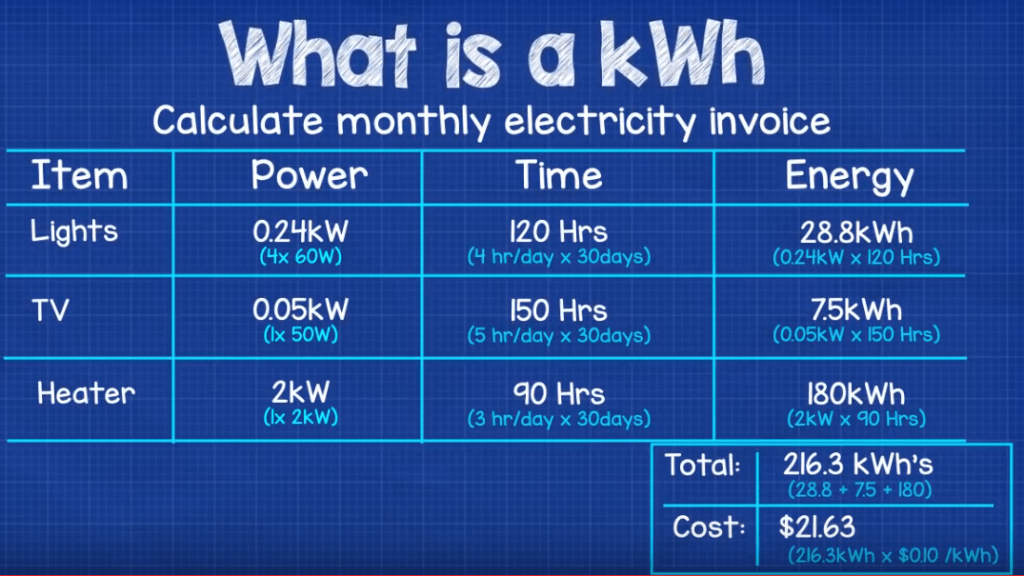
The table shows an efficient way to manage a multi-appliance question. For each item, calculate:
Then add the energy values:
Finally, multiply the total by the tariff.
Worked example 3: calculate power first, then energy and cost
Some questions do not give appliance power directly. They may give voltage and current, which connects directly to the previous lesson.
Question: A appliance draws for . The tariff is . Calculate the operating cost.
Step 1: Calculate power
Voltage and current are known, so use:
Convert power to kilowatts:
Step 2: Calculate energy
Step 3: Calculate cost
Keep the power calculation, energy calculation, and cost calculation on separate lines. Even if a later arithmetic slip occurs, this working can still earn method marks.
What is included in an electricity bill?
For most exam questions, “operating cost” means the variable energy charge:
A real electricity bill may also include a fixed daily charge. The Electricity Authority notes that a fixed charge is paid for maintaining the connection and network access, even if no energy is used.
Only include a fixed charge if the question states one. If it does, calculate it separately:
Then add it to the energy cost.
If a question gives different tariffs for different time periods, such as peak and off-peak rates, calculate each period’s energy cost separately and add the costs. Do not apply one tariff to all energy unless the question tells you to.
Common errors to avoid
Using watts directly with a kWh tariff
This is incorrect:
The correct calculation converts first:
Leaving minutes as hours
This is incorrect:
Convert first:
Forgetting the number of appliances
If there are five identical lamps, heaters, or chargers, multiply the power of one item by five before calculating energy.
Confusing daily use with monthly use
If an appliance operates per day for days:
Do not use as the time for the whole month.
Rounding too early
Keep extra calculator digits until the final cost. For money, then round to the nearest cent unless instructed otherwise.
Treating a stated appliance rating as a guaranteed real-life average
In an exam, use the stated rating and stated operating time unless told otherwise. In real installations, a thermostat-controlled heater, refrigerator, or heat pump may switch on and off, so its actual energy use can be less than its maximum-rated power multiplied by the full elapsed time.
Key takeaways
For electricity billing calculations, use:
Then calculate the energy charge:
Remember these conversions:
The safe exam sequence is: total the appliance power if needed, convert to , convert time to hours, calculate , then apply the tariff. Check whether the final cost is reasonable for the appliance power and duration.
Next, you will calculate efficiency from input and output power or energy, using the same careful unit handling and percentage calculations.
Can't find a good explanation? Sign up and we'll make it for you
Sign up