
Kia ora. In the previous lesson, you used Ohm’s law to calculate resistance when voltage and current were known. This lesson approaches resistance from a different direction: instead of treating a conductor as a resistor with a stated value, you will calculate its resistance from its material, length, and cross-sectional area.
For exam questions, the important skill is recognising the quantities, matching their units, and setting the calculator entry out clearly. By the end, you should be able to calculate the resistance of one conductor and spot the common errors involving millimetres, square millimetres, and cable length.
Why one conductor has more resistance than another
Every conducting material resists current flow to some degree. This inherent material property is called resistivity, represented by the Greek letter (“rho”).
A conductor’s resistance depends on four quantities:
where:
| Symbol | Quantity | Usual SI unit |
|---|---|---|
| Resistance | ||
| Resistivity of the material | ||
| Length of conductor | ||
| Cross-sectional area |
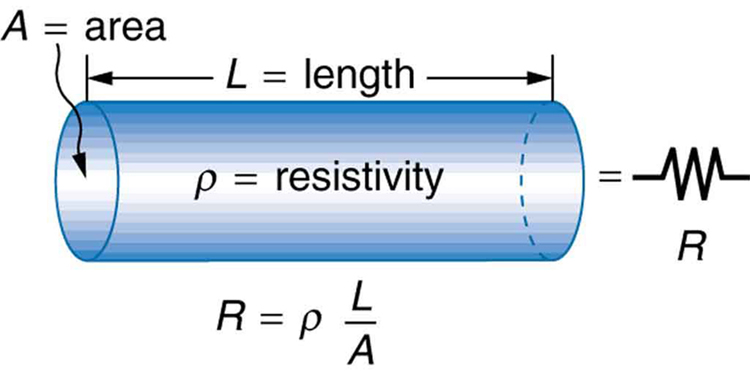
Read the formula in words:
Resistance equals resistivity multiplied by length, divided by cross-sectional area.
This gives three useful physical checks:
- A longer conductor has more resistance.
- A conductor with a larger cross-sectional area has less resistance.
- A material with higher resistivity has more resistance for the same length and area.
For example, copper has low resistivity, which is why it is commonly used for conductors. A long, thin copper conductor still has resistance; it is just lower than an equal-sized conductor made from a more resistive material.
Resistivity is not the same thing as resistance:
- describes the material.
- describes the resistance of a particular piece of that material.
Watch the formula and the important area conversion
How to Calculate the Resistance of a Conductor Based on Resistivity, Length and Cross-Sectional Area
Watch “How to Calculate the Resistance of a Conductor Based on Resistivity, Length and Cross-Sectional Area” by Joe Robinson Training. It gives a practical, calculation-focused explanation of the formula and the most important unit trap: converting square millimetres.
First watch formula and units. Note especially that resistivity is measured in ohm metres, not ohms per metre, and that area is measured in square metres when using SI resistivity. Then watch area conversion. Focus on why an area in \mathrm{mm^2} converts using a factor of 10^{-6}, not 10^{-3}. Finish with the calculation setup. Watch how the entire numerator is kept together and the area is entered as the denominator.
Units must match the resistivity unit
The formula itself is straightforward. The usual exam difficulty is making sure the units match.
If resistivity is given in standard SI units:
then use:
and:
The unit check confirms this:
The metres cancel correctly, leaving ohms.
The square-millimetre conversion
Conductor sizes are often stated in square millimetres, such as , , or .
Because area is squared:
Therefore:
A common mistake is converting to . That is wrong by a factor of .
A second valid unit system
Sometimes a formula sheet or table gives resistivity in:
If that is the unit supplied, keep:
- in metres
- in square millimetres
Do not convert the area to square metres in that case.
For example, these two copper resistivity values represent the same material property:
Your rule is simple:
Read the unit printed beside , then make the units of length and area match it.
Worked exam-style calculation
Question: A copper conductor is long and has a cross-sectional area of . The resistivity of copper is:
Calculate the resistance of the conductor.
1. Identify what is required
2. List the known quantities
Because resistivity is in , area must be converted to .
3. Write the formula
Notice that is already isolated. You do not need to rearrange this formula to find resistance.
4. Substitute values
5. Calculate
Rounded suitably:
6. Check whether it is sensible
This is a length of reasonably thick copper conductor, so a small fraction of an ohm is expected. An answer such as would be unrealistic and would suggest a prefix or calculator-entry error.
For a calculator, enter the numerator and denominator clearly. Use brackets around the denominator:
Length means the actual conductor length
In this formula, is the length of the conductor whose resistance you are finding.
If the question says:
“Calculate the resistance of one conductor”
then:
Do not automatically double it just because circuits normally have an outgoing and return path.
However, if a question specifically asks for the total loop resistance of two equal conductors, then the total conductor length is:
The wording tells you whether you are calculating one conductor or the complete current path.
Cross-sectional area is not diameter
The formula needs cross-sectional area, not conductor diameter.
If an exam question already gives a conductor as , that value is the area. Put it into the formula after checking units.
If it instead gives a circular conductor’s diameter, you must calculate area first:
Since radius is half the diameter:
So:
This matters because diameter and area do not change by the same factor. If the diameter doubles, the area becomes four times larger, so resistance becomes one-quarter as large for the same material and length.
Use a fixed written layout
The supplied resistivity practice resource reinforces a reliable paper-based layout. It is worth using because it separates the data, the conversion, and the formula before you use the calculator.
Read the “Resistivity” practice page from LearnAbout-Electronics for a worked example of setting out a conductor-resistance problem, including the situation where area must first be found from diameter.
In “What you’ll learn in Module 1.6,” begin at the paragraph starting “Before you start.” Read the three setup tips, particularly the advice to write each stage and convert units before substituting. Then find the section beginning “OK so now you have read these instructions.” Read the problem setup, then continue through the complete copper-cable example. Notice its order: list the data, calculate area if needed, return to the resistance formula, then state the answer in ohms.
For your own written answers, use this exam routine:
| Step | What to write |
|---|---|
| Required | , in |
| Given | , , and , including units |
| Unit check | Make , , and compatible |
| Formula | |
| Substitute | Put every value into the correct position |
| Answer | Give a sensible rounded answer in |
| Check | Longer means more resistance; larger CSA means less resistance |
Common mistakes to catch before submitting
Using as though it were
If the resistivity is in , convert:
to:
Treating resistivity as resistance
A copper resistivity value such as:
is not the resistance of a wire. You still need its length and cross-sectional area.
Putting area in the numerator
The formula is:
Area is underneath the fraction line. A larger area should reduce resistance, which helps you remember its position.
Forgetting the square on area
The unit is:
not . The squared unit changes the conversion factor.
Rounding too early
Keep the calculator display or several digits until the final line. Then round to a sensible number of decimal places, usually matching the data in the question.
Ignoring temperature in real work
Most basic questions give a resistivity value and expect you to use it directly. In actual conductors, resistance changes with temperature; copper resistance increases as it gets hotter. For this level of calculation, use the stated value unless the question specifically mentions temperature.
Key takeaways
A conductor’s resistance is calculated using:
- is resistivity, a property of the material.
- is the actual length of conductor being considered.
- is cross-sectional area, not diameter.
- Resistance rises with length and resistivity.
- Resistance falls as cross-sectional area increases.
- If is in , convert area from to using .
- Show the data, conversion, formula, substitution, answer, and unit to protect your method marks.
Next, you will use voltage, current, and resistance relationships again to calculate electrical power in DC circuits.
Can't find a good explanation? Sign up and we'll make it for you
Sign up