
Kia ora. In the previous lesson, you used to link charge flow, current, and time. This lesson adds the most frequently used DC calculation relationship: Ohm’s law. It connects voltage, current, and resistance, and it will appear again in series circuits, parallel circuits, power calculations, cable voltage drop, and fault-finding.
By the end, you should be able to read an exam question, identify which quantity is missing, choose the correct form of Ohm’s law, substitute values with units, and check whether the answer is sensible.
The relationship between voltage, current, and resistance
Ohm’s law describes how three quantities are related in a basic resistive DC circuit:
- Voltage, , measured in volts,
- Current, , measured in amperes,
- Resistance, , measured in ohms,
The core equation is:
Read this as:
Voltage equals current multiplied by resistance.
For an ordinary resistor at a stable temperature, increasing voltage tends to increase current. Increasing resistance tends to reduce current for a given voltage. Most Level 1 exam questions assume the resistance is constant unless the question tells you otherwise.
The relationship only needs two known values. If you know any two of , , and , you can calculate the third.
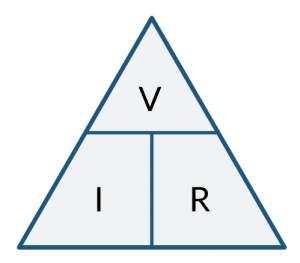
The triangle is a useful memory aid, especially while formula rearrangement is still becoming automatic. But in written work, always write the actual equation you are using. That makes your method clear and can earn method marks even if the final calculator answer is wrong.
How to Calculate Current, Voltage, and Resistance? | Ohm's Law Practice Problems
Watch “How to Calculate Current, Voltage, and Resistance? | Ohm's Law Practice Problems” from Ms. Riaz Academy. It uses a clear exam-ready sequence: list what is given, identify the unknown, choose the equation, then substitute values.
Watch voltage calculation for the core equation and calculation layout. Then watch current calculation to see why finding current requires division by resistance. Continue with resistance calculation, paying particular attention to dividing both sides of the equation by current. Finish with the recap of the two approaches: algebraic rearrangement and the triangle shortcut.
One formula, three useful forms
Start from the core form:
If the question asks for voltage, it is already isolated:
If the question asks for current, divide both sides by :
If the question asks for resistance, divide both sides by :
Keep this compact reference in your notes or beside your formula sheet:
| Question asks for | Equation | Calculator operation |
|---|---|---|
| Voltage, | Multiply | |
| Current, | Divide voltage by resistance | |
| Resistance, | Divide voltage by current |
A quick triangle check gives exactly the same result:
- Cover : and are beside each other, so multiply.
- Cover : is above , so divide by .
- Cover : is above , so divide by .
Some diagrams or formula sheets use rather than for a source voltage or electromotive force. For the simple Ohm’s-law questions at this level, treat it as the voltage value:
So an supply is used in the same way as a supply.
Units: a built-in calculation check
Ohm’s law has a useful unit relationship:
This means:
These are not extra formulas to memorise. They are a check on your final answer.
For example, if you calculate:
the units become:
because volts divided by amps gives ohms.
For most exam calculations, convert to base units before substituting:
For instance, if a supply is connected to a resistor, convert the resistance first:
Then calculate the current:
You could also state this as:
Both answers represent the same current.
Exam-style worked calculations
Use the same layout every time:
- State the required quantity and its unit.
- Write the relevant form of Ohm’s law.
- Convert units if needed.
- Substitute the known values, including units.
- Calculate and state the final answer.
- Check whether the answer makes physical sense.
Finding voltage
Question: A resistor of carries a current of . Calculate the voltage across it.
The question asks for voltage, so use:
Substitute:
Answer: The voltage across the resistor is .
A sense check: multiplied by a value slightly less than should give a value slightly less than . Therefore is reasonable.
Finding current
Question: A DC supply is connected across an resistor. Calculate the current.
The question asks for current:
Substitute:
Answer: The current is .
Notice the physical check: a fairly low resistance connected to should allow a reasonably large current. An answer such as would suggest you divided in the wrong direction.
Finding resistance
The circuit below gives a source voltage and the circuit current. The lamp’s resistance is unknown.
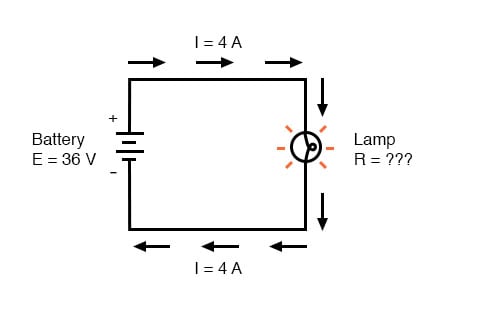
The source is labelled , which you can use as the voltage value. The question asks for resistance:
Substitute:
Answer: The lamp resistance is .
A useful check is to substitute your answer back into the original equation:
The result matches the stated supply voltage, so the answer is consistent.
Common exam mistakes and how to catch them
Using addition instead of multiplication
Ohm’s law is not:
Voltage is calculated by multiplying current and resistance:
Also, amperes and ohms are different quantities, so adding them would not make physical sense.
Dividing in the wrong direction
For current:
Voltage goes on top; resistance goes underneath.
For resistance:
Voltage still goes on top; current goes underneath.
The triangle can prevent this error, but always write the complete fraction clearly.
Forgetting a prefix conversion
A common error is treating as , or as . That creates an answer wrong by a factor of .
For example:
not .
Leaving out the unit
Your final answer should state , , or . Units help the marker follow your work and help you catch formula-selection mistakes.
Ignoring whether the result fits the circuit
Use these quick checks:
- At constant resistance, more voltage means more current.
- At constant voltage, more resistance means less current.
- A very large resistance should not produce a very large current from a small voltage.
- Dividing by a number less than makes the result larger. For example, .
A reliable routine for written calculations
Before touching the calculator, pause and set up the problem:
| Step | What to write or check |
|---|---|
| Required | What is being asked for: , , or ? |
| Given | Which two values are supplied, with units? |
| Formula | Which form has the required quantity alone? |
| Units | Are values in , , and ? |
| Substitute | Put values into the formula using brackets. |
| Check | Does the answer have the right unit and a sensible size? |
This routine is deliberately slower than trying to guess the operation, but it becomes fast with repetition and protects your method marks in the exam.
Do not use Ohm’s law as a substitute for safe electrical testing or isolation procedures. In practical work, a value may be measured only under the correct procedure, using the correct instrument and appropriate supervision. Here, the calculation begins once the question gives you valid values.
Key takeaways
- Ohm’s law connects voltage, current, and resistance:
- The rearranged forms are:
- Use or as the voltage value in basic source questions.
- Convert prefixes before calculation when necessary.
- Show the formula, substitution, working, answer, and unit.
- Use unit checks and physical sense checks to catch reversed divisions and prefix errors.
Next, you will move from a resistor with a stated value to calculating the resistance of a conductor from its material resistivity, length, and cross-sectional area.
Can't find a good explanation? Sign up and we'll make it for you
Sign up