
Kia ora. Last lesson established that current is the rate at which charge moves through a circuit, and that circuit diagrams normally use conventional current. Now we will put that meaning to work in calculations.
By the end of this lesson, you should be able to identify whether a question asks for charge, current, or time; choose the correct form of the relationship; convert time where needed; and show an exam-ready calculation with units.
A useful way to split this revision is: spend your first short session on the formula and worked examples, then use the final practice resource in a second session.
Current is charge per unit time
Current tells us how much electric charge passes a point each second.
- A charge, , is measured in coulombs, .
- A current, , is measured in amperes, .
- A time, , is measured in seconds, .
The fundamental relationship is:
Read it in words:
Charge equals current multiplied by time.
Because one ampere means one coulomb of charge per second:
So, if a circuit carries for , then coulombs pass any point in the circuit each second. Over ten seconds, the total charge transferred is .
The relationship assumes that the current is constant over the stated time. That is the normal assumption in Level 1 calculation questions unless the question says otherwise.
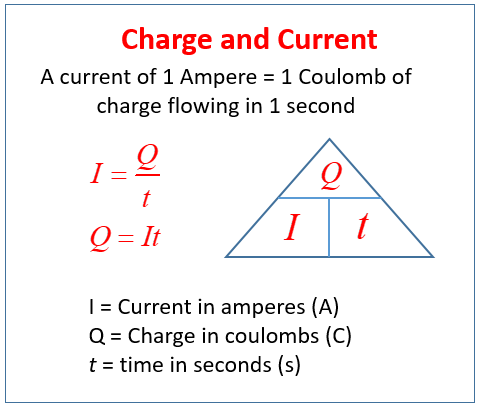
Use the diagram as a memory prompt, but be able to explain what it means: current is the rate; charge is the accumulated total.
GCSE Physics - Q=Ixt Formula Practice
Watch “GCSE Physics - Q=Ixt Formula Practice” from KayScience for a compact visual walkthrough of the symbols, units, and the two most common calculation types.
Watch the formula and rearrangement to see charge and current calculations set out step by step. Then skip to the minutes conversion; it highlights the important rule that time must be in seconds before using the formula with amperes and coulombs.
Choose the form that matches the unknown
The same relationship gives three useful equations:
Rather than trying to memorise a different formula for every question, start with:
Then decide what you need to isolate.
If the question asks for charge
Words such as quantity of charge, charge transferred, or how many coulombs mean the unknown is .
Use:
You multiply current by time.
If the question asks for current
Words such as current, charge flow per second, or how many amperes mean the unknown is .
Start with:
Since is multiplied by , divide both sides by :
The terms cancel, leaving:
If the question asks for time
Words such as how long, duration, or time taken mean the unknown is .
Starting again from:
Divide both sides by :
The terms cancel:
The formula triangle can help you check this:
- To find the top quantity , multiply the two lower quantities.
- To find either lower quantity, divide by the other lower quantity.
But in an exam, writing the equation explicitly is safer than relying only on a triangle. It earns method marks and makes it easier to spot a mistake.
What is charge, current and voltage? - BBC Bitesize
Read the relevant parts of BBC Bitesize’s “What is charge, current and voltage?” for the formula, units, equation triangle, and worked examples.
Under the heading “What is the relationship between current I and quantity of charge Q?”, read the core relationship. Then follow “Example Q1” and the short current examples, paying attention to how the known values are listed before substitution. Finally, locate the question beginning “How much charge flows when a current of 2 A flows for 3 minutes?” and read the minutes example. Notice that minutes are converted to seconds before calculation.
Use base units before substituting
For these equations, the standard unit combination is:
That means:
- current should normally be in amperes;
- time should normally be in seconds;
- charge will then come out in coulombs.
The most common trap is putting minutes or hours straight into the formula.
| Given time | Convert to seconds |
|---|---|
You may also need the current conversion reviewed earlier:
For example:
Do conversions before putting numbers into the equation. It keeps the calculation clean and avoids missing a factor of , , or .
Exam-style worked calculations
Use this layout consistently:
- State the quantity required.
- Write the relevant formula.
- List or convert values into standard units.
- Substitute values with units.
- State the answer with the correct unit.
Example 1: Find charge
Question: A small DC circuit carries for minutes seconds. Calculate the charge transferred.
The unknown is charge, so use:
Convert the time:
Substitute:
Answer: of charge is transferred.
A quick reasonableness check: is less than , and the time is , so an answer a little below makes sense.
Example 2: Find current
Question: A total charge of passes through a conductor in minutes. Calculate the current.
The unknown is current:
Convert the time:
Substitute:
Answer: the current is .
The unit check is useful:
Example 3: Find time
Question: A charge of passes through a circuit carrying . Calculate the time.
The unknown is time:
Substitute:
If the answer is more useful in minutes:
Answer: , or .
Notice the sense check: means only a quarter of a coulomb passes each second. It should therefore take a long time to transfer . An answer such as would be a warning sign because it would have used multiplication when division was required.
Recognise and avoid common mistakes
Using the wrong operation
Use the wording:
| Required quantity | Equation | Operation |
|---|---|---|
| Charge, | Multiply | |
| Current, | Divide | |
| Time, | Divide |
Only charge is found by multiplication in this relationship.
Leaving time in minutes
If you calculate:
you have not used compatible base units. Convert first:
Then:
Treating charge as something a load “uses up”
A lamp or resistor transfers electrical energy into light or heat, but in a closed series circuit the charge carriers continue around the circuit. The calculation asks for the total amount of charge that passes a point over time.
Leaving out units
Units are not decoration. They tell the marker that you know what your answer represents and provide a check on your calculation. Write , , or beside every final answer.
A short practice routine
For exam preparation, practise identifying the unknown before you touch the calculator. Cover the numbers in a question briefly and say:
- “It asks for coulombs, so I need .”
- “It asks for amps, so I need .”
- “It asks how long, so I need .”
Then apply this calculation checklist:
- Circle what the question asks for.
- Write its symbol and expected unit.
- Write the equation with that symbol isolated.
- Convert minutes, hours, milliamps, or kilocoulombs if necessary.
- Substitute values with brackets.
- Check whether the answer size makes physical sense.
For targeted practice, use the Electric Current set below. It is particularly useful because it mixes direct questions with unit-conversion questions.
CalcPad - Electric Circuits Problem Sets
Use Physics Classroom’s CalcPad page for short, calculation-focused practice after reviewing the worked examples.
Under “Problem Sets,” open “Set EC1: Electric Current.” The description begins with the charge-current-time objective. Complete the questions by showing your equation and unit conversion on paper before checking each answer. Focus first on questions that use Q, I, and t directly; leave any electron-count extension questions until the core three-variable calculations feel automatic.
Key takeaways
- Current is the rate of charge flow.
- The fundamental relationship is:
- Rearranged forms are:
- Use , , and together; convert minutes to seconds before calculating.
- For full method marks, show the formula, conversions, substitution, working, and final unit.
- A sensible answer should match the story: more current or more time means more charge; a small current takes longer to transfer a large charge.
Next, you will use another central Level 1 relationship—Ohm’s law—to calculate voltage, current, or resistance in DC circuits.
Can't find a good explanation? Sign up and we'll make it for you
Sign up