
Hello again. In the previous lesson, the Simple View of Reading helped you distinguish the two broad conditions for reading comprehension: word recognition and language comprehension. This lesson moves earlier in development. It identifies the competencies children build before conventional reading and writing are established, and explains how those competencies contribute to later literacy.
For university work, it is important to avoid treating emergent literacy as a checklist a child either “has” or “does not have.” It is a developing set of understandings, skills, and communicative behaviours. Children build these through talk, play, shared reading, drawing, mark-making, writing attempts, and participation in print-rich social settings.
By the end of the lesson, you should be able to describe the main foundational competencies and explain their contribution to emergent reading and writing.
Emergent literacy: a connected foundation
Emergent literacy refers to literacy development that begins well before children can conventionally read books or spell words. A child who pretends to read a familiar story, notices the first letter in their name, claps the parts in ba-na-na, draws a map and “writes” a label, or asks what a sign says is already participating in literacy.
The key word is connected. Oral language helps children understand the messages that books and writing communicate. Knowledge of print, letters, and sounds helps them work out how spoken language is represented on a page. Writing gives children a reason to explore those relationships from the other direction: expressing an idea through marks, letters, and eventually words.
The Institute of Education Sciences groups the foundations into five broad components:
- Background knowledge
- Oral language and vocabulary
- Book knowledge and print concepts
- Alphabet knowledge and early writing
- Phonological awareness
These categories are useful for analysis, but they overlap in real classroom activity. For example, during a shared reading of a book about gardens, children might learn the meaning of seedling, discuss what plants need, notice the title and direction of print, hear that soil and spoil rhyme, and make a labelled drawing of a plant. One experience can strengthen several competencies.
[PDF] Brief 3 Stages of Emergent Literacy and Language Development
Read the five-component overview in this Institute of Education Sciences / REL Northwest brief. It provides the central framework for this lesson and links each competency to later reading and writing.
Begin on p. 4 with the subsection “Background knowledge,” at the explanation of background knowledge. Continue through “Oral language and vocabulary,” focusing on oral language and vocabulary. Then read the subsections “Book knowledge and print concepts,” “Alphabet knowledge and early writing,” and “Phonological awareness” on pp. 4–5. Focus especially on how books and print work, alphabet knowledge and early writing, and the sound foundation for decoding.
Meaning foundations: background knowledge, oral language, and vocabulary
Background knowledge
Background knowledge is what a child knows about themself, other people, objects, places, events, and how the world works. It includes knowledge developed through family life, culture, community, play, media, books, and direct experiences.
This matters because comprehension is not simply a matter of knowing the words on a page. Consider a child listening to a story about a trip to the beach. Understanding why characters pack sunscreen, build sandcastles, or look for shells is easier if the child can connect the story to relevant knowledge and experience. If these ideas are unfamiliar, the educator may need to build knowledge through conversation, images, play, experiences, and repeated reading.
Background knowledge contributes to both reading and writing:
- For reading, it supports vocabulary, inference, prediction, and comprehension of a text’s ideas.
- For writing, it supplies meaningful content: things the child can draw, recount, explain, label, or represent in a message.
Educators should not assume that children share the same experiences or knowledge. A child’s home language, family practices, culture, and community are sources of knowledge, not deficits to be corrected. Strong assessment begins with finding out what the child knows and can communicate in familiar contexts.
Oral language and vocabulary
Oral language includes both:
- Receptive language: understanding what others say.
- Expressive language: using speech, signs, or another communication system to convey ideas.
Within oral language, important competencies include vocabulary, grammar or syntax, listening comprehension, conversation, narrative, and pragmatic language. Pragmatics concerns using language appropriately in social situations: taking turns, responding to others, adjusting what one says for a listener, and using gesture and tone meaningfully.
A child needs words and sentence structures before they can fully understand them in print or use them in writing. For instance, a child who understands enormous, because, and first/next/finally is better positioned to comprehend a story and to tell or write one with connected ideas.
Syntax also matters. Compare:
- “The dog chased the cat.”
- “The cat chased the dog.”
The same words appear, but their order changes the meaning. Oral experience with increasingly complex sentences supports later comprehension of written language, where the reader cannot always rely on gesture, context, or immediate clarification.
Supporting Oral Language Development in a Language Rich Environment
Watch “Supporting Oral Language Development in a Language Rich Environment” from CECE Early Childhood Videos at Eastern CT State U. It clarifies why spoken language is a literacy foundation and introduces the language systems that children draw on when reading and writing.
Watch the foundation for the central claim about oral language and literacy. Then watch three rule systems, focusing on the distinctions among semantics (word meanings), syntax (word order and grammar), and phonology (the sound system). Finish with key predictors, noting receptive language, expressive language, listening comprehension, and the importance of explaining less familiar vocabulary.
A useful way to write about oral language in an assessment is to name both the competency and its literacy contribution:
Oral language, including vocabulary, grammar, and listening comprehension, supports emergent reading because children must understand spoken words and sentences in order to construct meaning from print. It supports emergent writing because children first need ideas, words, and sentence patterns that they can represent through drawings, marks, and letters.
This relationship connects directly to the previous lesson: these competencies develop the language-comprehension side of the Simple View of Reading.
Print and code foundations: books, print, letters, and sounds
Children also need to discover that written language is a system. This discovery involves several related competencies.
Book knowledge and print concepts
Book knowledge means understanding how books work. It includes such behaviours as holding a book appropriately, turning pages, identifying the front and back, and knowing that a book is read in a particular order.
Print concepts are understandings about how print works. For English print, these include knowing that:
- print carries a message;
- print is different from pictures;
- the same printed words communicate the same message each time they are read;
- words are made of letters;
- print is generally read from left to right and from top to bottom;
- spaces separate words;
- different print features have purposes, such as a title, a label, a list, or a question mark.
These are not trivial habits. A child who points to a picture while retelling a story demonstrates valuable meaning-making, but a child who can also point to the printed title and explain that it tells the book’s name is beginning to understand the distinct role of print.
Print concepts support reading because they help children navigate a text and attend to the written code. They support writing because children begin to recognise that their own spoken message can be recorded and revisited through visible marks.
Alphabet knowledge
Alphabet knowledge involves recognising letters, naming them, distinguishing their shapes, and learning that letters are connected to speech sounds. Letter-name knowledge and letter-sound knowledge are related, but they are not identical.
For example, a child may identify the letter by name but not yet reliably connect it with the sound at the beginning of moon. Another child may say the sound but confuse its printed form with . Evidence should therefore be specific: “recognises several letters in their name” tells us something different from “gives the common sound for these letters.”
Alphabet knowledge contributes to reading and writing because it supports the insight that speech can be represented with written symbols. Eventually, children use this knowledge to read words and to select letters when attempting to write words.
Phonological awareness
Phonological awareness is the ability to notice and work with the sound structure of spoken language. It concerns sounds that children hear, rather than letters that they see.
It develops across a continuum that commonly includes:
| Sound unit | Example competency |
|---|---|
| Words | Identify that “I like red apples” contains four words. |
| Syllables | Clap the three syllables in el-e-phant. |
| Onset-rime | Hear that cat begins with and ends with . |
| Phonemes | Blend to say sun, or identify the first sound in sun. |
Phonemic awareness is the most detailed level of phonological awareness: awareness of individual phonemes, the smallest meaningful speech sounds. It is not the same as phonics. A child can orally blend to say map without seeing any letters. Phonics begins when the educator explicitly connects the sounds to graphemes, such as , , and .
Phonological awareness is crucial because it helps children perceive the units of speech that alphabetic writing represents. It therefore supports:
- reading, through blending sounds to read unfamiliar words;
- writing, through segmenting a spoken word into sounds and selecting letters that might represent them.
Early Literacy: Phonological Awareness
Watch selected examples from NeuhausEdCtr’s “Early Literacy: Phonological Awareness.” The video makes the spoken-sound focus of phonological awareness visible and shows how task complexity increases.
Watch the overview for the definition and developmental progression. Then view syllables and rhyme to see early sound-level tasks, followed by phoneme work for segmenting and manipulating individual sounds. End with letters and sounds, noticing the shift from oral sound work to using letters to build words.
The code-related competencies work best when children encounter them in meaningful activity. For example, during a play-based café, children may notice menus and signs, write an order, discuss the first sound in tea, and recognise the letters in a friend’s name. Purposeful play does not remove the need for intentional teaching; it provides a meaningful setting in which the teaching can be used.
Early writing: representing a message
Early writing is more than correct spelling or neat letter formation. It begins when a child uses drawing, marks, scribbles, letter-like forms, letters, or approximated spellings to communicate meaning.
A child’s first writing attempts may not be readable to an adult without explanation. They may nevertheless demonstrate an important understanding: a visible mark can stand for an idea or message. When an educator asks, “Tell me about your writing,” and records the child’s words, the child sees that spoken language can be preserved through print.
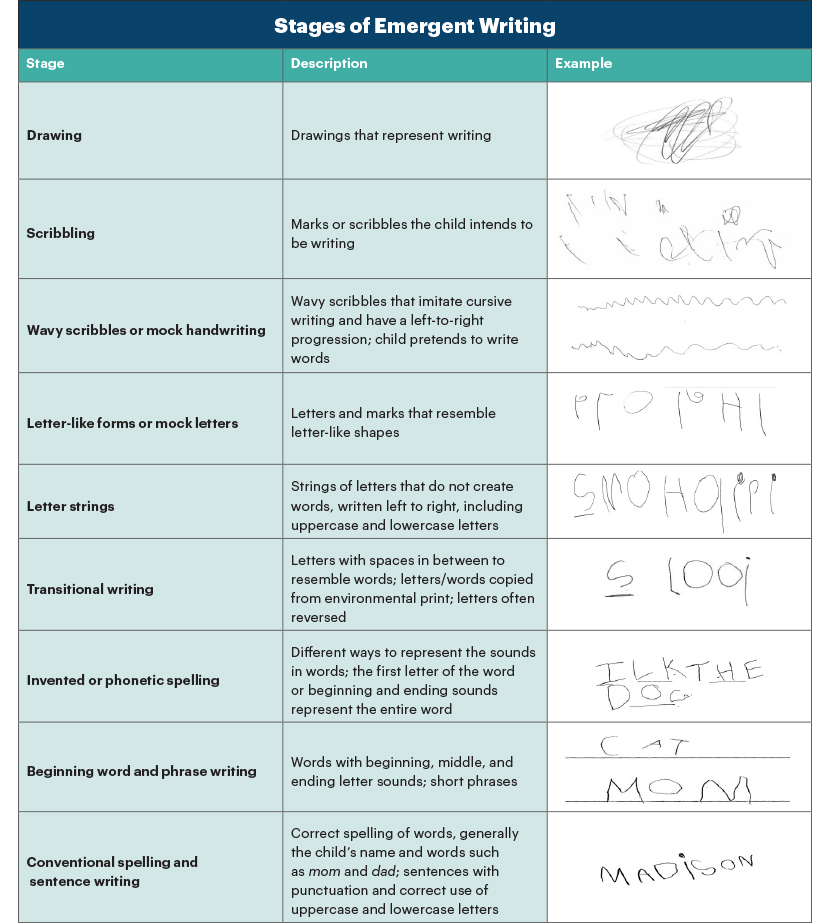
The stages shown in Stages of Emergent Writing are best understood as common features, not a rigid pathway. Children may use drawing and recognisable letters in the same sample, may demonstrate different knowledge in different contexts, and may progress unevenly. A child who writes the first letter of their name conventionally but uses scribbles for another message is not “between” two fixed stages; they are drawing on the knowledge currently available for a particular purpose.
When interpreting an emergent-writing sample, look for several forms of evidence:
| Area | What the educator might notice | What it suggests |
|---|---|---|
| Message and purpose | The child explains, “This is a sign to keep people out.” | Writing is being used to communicate to an audience. |
| Print concepts | Marks move across the page in an intended direction; spaces or lines are used. | The child is noticing features of conventional print. |
| Letter knowledge | The child uses letters from their name or identifies a letter they have written. | Letters are becoming meaningful symbols. |
| Sound representation | The child writes for dog or for dog. | The child is connecting sounds in spoken words with letters. |
| Conventional features | The child writes a familiar word accurately. | The child has stored or is applying more conventional knowledge. |
The same act of writing can strengthen reading. When a child says dog, listens for , chooses , and rereads the mark as dog, they are coordinating oral language, phonological awareness, alphabet knowledge, and print meaning.
At this stage, invented spelling should be understood as evidence of hypothesis-building, not simply as error. If a child writes for boat, the spelling is not conventional, but it may show that they hear and represent the beginning and final sounds. The appropriate response is to acknowledge the message, extend their sound analysis where suitable, and model conventional print without treating early attempts as failure.
Bringing the competencies together
The following table provides a concise university-ready synthesis.
| Foundational competency | What it involves | Contribution to emergent reading | Contribution to emergent writing |
|---|---|---|---|
| Background knowledge | Knowledge gained through experience, family, culture, community, and texts | Supports comprehension, prediction, and inference | Provides ideas and content worth communicating |
| Oral language and vocabulary | Understanding and using words, sentences, conversation, and narratives | Supports language comprehension and understanding of text | Provides the words, grammar, and ideas children attempt to record |
| Book knowledge and print concepts | Understanding books, directionality, words, letters, and the purposes of print | Helps children attend to, navigate, and make sense of print | Helps children understand that writing is organised, meaningful print |
| Alphabet knowledge | Recognising, naming, forming, and associating letters with sounds | Supports identification and decoding of words | Supports choosing and forming letters to represent speech |
| Phonological awareness | Hearing and manipulating words, syllables, rhyme, and phonemes | Supports blending and decoding | Supports segmenting spoken words for spelling attempts |
| Early writing | Using drawings, marks, letters, and spellings to express meaning | Reinforces awareness of print and sound-symbol relationships | Develops message, purpose, audience, letter formation, and spelling knowledge |
These competencies should be considered alongside a child’s participation, opportunities, interests, language background, and access to meaningful literacy experiences. A quiet child may have strong receptive language but offer limited talk in a group. A multilingual child may have rich knowledge and language capabilities that are not fully visible in English. A single observation cannot provide a complete literacy profile.
A proportionate conclusion is therefore more appropriate than a fixed judgement:
The child demonstrates emerging alphabet knowledge by recognising letters in their name and using initial sounds in writing. Further observations across familiar play and shared-reading contexts would help identify how consistently the child applies this knowledge.
Key takeaways
Emergent reading and writing are supported by a connected set of foundational competencies:
- Background knowledge gives children ideas and supports comprehension.
- Oral language, vocabulary, grammar, and listening comprehension provide the meaning base for reading and writing.
- Book knowledge and print concepts help children understand that print has stable forms and communicative purposes.
- Alphabet knowledge connects visual letter symbols with names and speech sounds.
- Phonological awareness helps children notice and manipulate the sound units that alphabetic print represents.
- Early writing allows children to experiment with using marks, letters, and spellings to communicate a message.
Rather than expecting all children to show the same skills at the same time, educators observe the understandings children currently demonstrate and plan meaningful next opportunities. This foundation prepares you for the next lesson, which will focus on planning a Language Experience Approach sequence that turns a shared experience and children’s spoken language into a jointly constructed written text.
Can't find a good explanation? Sign up and we'll make it for you
Sign up