
Hello again. In the previous lesson, you examined the competencies that underpin emergent reading and writing: oral language, vocabulary, print concepts, alphabet knowledge, phonological awareness, and early writing. A Language Experience Approach (LEA) brings these competencies together in one meaningful sequence. Children first do something together, then talk about it, see their words become print, and reread that print.
This lesson focuses on planning an LEA sequence for children aged 3–5. By the end, you should be able to justify each stage of the sequence and produce a practical plan based on a shared experience rather than a pre-written worksheet or decontextualised literacy task.
The central idea: children’s experience becomes readable text
The Language Experience Approach is a literacy approach in which an educator uses children’s spoken language to create a written text about a shared experience. Its core principle can be expressed simply:
What children can experience and talk about can become writing; what is written can then be read.
The shared experience gives children something authentic to communicate. Instead of asking children to generate ideas about an unfamiliar topic, the educator draws on an event the group has just participated in: planting seeds, observing ice melt, making playdough, taking a short walk, welcoming a visitor, or responding to a dramatic weather event.
The children’s words matter because they already carry meaning. When an educator records those words, children can see a connection between speech and print. When the group rereads the text, children encounter familiar language in written form, making reading accessible and purposeful.
Read NAEYC’s “Our Proud Heritage: Making Reading Meaningful,” which explains the Language Experience Approach and its original three-part structure. Focus on why children’s own language is the material for literacy learning.
In the section “What Is the Language Experience Approach?”, read the three core steps. Notice the order: a shared experience, transcription of children’s language, and repeated reading of the resulting text.
The three core steps are:
- Provide a shared, memorable experience.
- Invite children to describe it and record their language.
- Read and reread the jointly created text.
A strong K/PP LEA plan often includes additional stages around these three essentials: setting a language goal, introducing useful vocabulary, drawing or labelling, independent writing attempts, and publishing the text for later reading. These additions should support the central oral-language-to-print connection, not displace it.
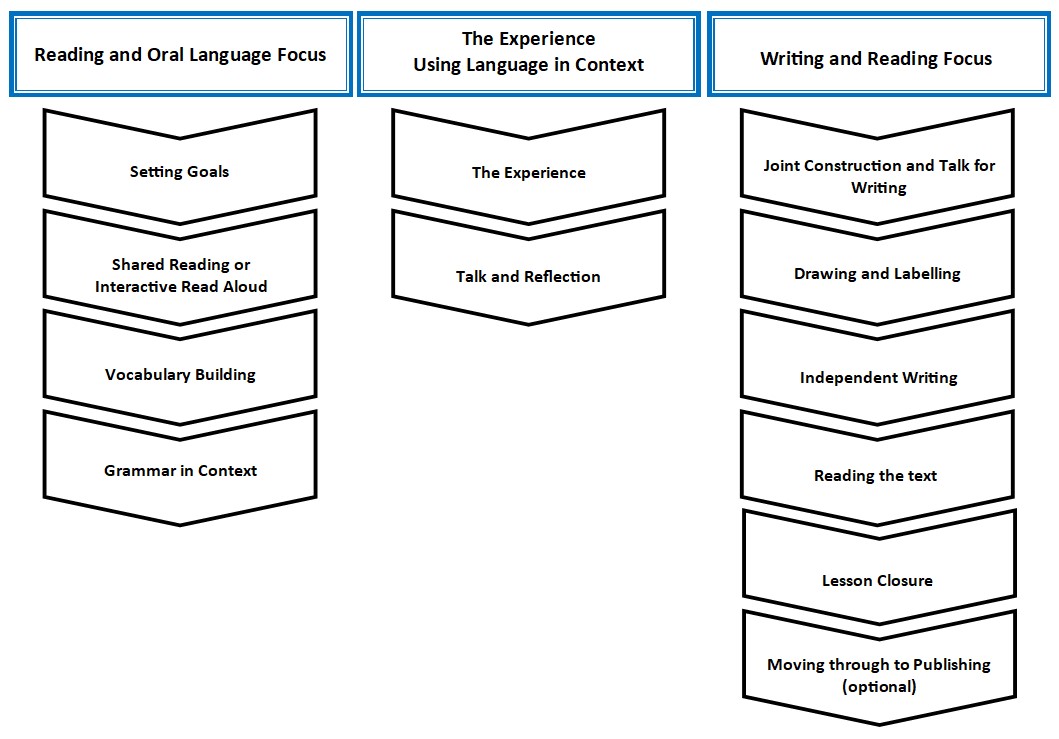
The flowchart is best understood as a planning framework, not a rigid script. With 3–5-year-olds, a complete sequence may occur across several short sessions. The group may revisit the experience, text, vocabulary, and writing over several days.
Planning backwards from a meaningful literacy purpose
An LEA should not begin with, “What sentence will I make children write?” It begins with two connected questions:
- What experience will give children something meaningful to say?
- What oral-language, reading, or writing learning do I want to make visible and support?
For example, an educator may plan a shared investigation of ice because it allows children to observe change, use sensory language, recount a sequence, and create a shared explanatory or recount text.
A suitable broad curriculum goal for this experience might be:
Children use language, images, symbols, and emerging print to communicate observations and ideas to others.
A more observable lesson intention could be:
Children will contribute an observation about the ice investigation, participate in creating a group recount, and join in rereading the shared text.
This is developmentally appropriate because children can contribute through speech, gesture, home language, sign, selecting a photograph, pointing to a symbol, or using augmentative and alternative communication. Participation should not be limited to children who can produce a complete English sentence independently.
The following resource expands the three-step model into a practical teaching sequence. Although it is written with English-language learners in mind, its emphasis on shared context, explicit language scaffolds, drawing, talk, rereading, and individual copies is useful for diverse K/PP groups.
[PDF] Language Experience - Education
Read the Victorian Department of Education’s “Language Experience” guide. It explains how LEA links speaking and listening with writing and reading, then offers practical planning and scaffolding moves.
On page 1, read the purpose explanation to identify the literacy connections LEA makes visible. On page 2, under “Procedure,” read the planning sequence. Then, under “Using language experience with ESL students,” focus on preparation and oral-language scaffolds. Finally, read the rereading extensions, noting how the shared text can support print and sound awareness without becoming a narrow phonics worksheet.
Choose an experience that is genuinely shared
A suitable LEA experience should be:
| Planning criterion | What it means in practice |
|---|---|
| Firsthand | Children participate, observe, or respond directly rather than only hearing about it. |
| Talk-worthy | It gives children something to notice, remember, wonder, or explain. |
| Accessible | Every child has a way to participate, including children with varied sensory, physical, linguistic, or communication needs. |
| Connected to a purpose | The resulting text has a reason to exist: a recount, class book, procedure, sign, letter, poster, or message to families. |
| Manageable | The experience is short enough that children can recall and discuss it in detail. |
A “shared” experience does not mean every child experiences it in exactly the same way. During an ice investigation, one child may focus on the cold sensation, another on the dripping water, and another on how quickly the ice changes. LEA values this variation because it generates rich language.
Plan vocabulary as support, not a test
Before or during the experience, introduce a small number of useful words that children can hear and use in context. For the ice investigation, these may include:
- ice, cold, hard, wet, melt, drip, puddle
- sequence language such as first, then, and after
- observation language such as “I noticed …” or “The ice is …”
Vocabulary should be accompanied by action, objects, pictures, gesture, or demonstration. Rather than asking children to repeat definitions, use the language naturally:
“The ice feels cold. Look: water is beginning to drip. The ice is melting.”
This makes vocabulary available when children later contribute to the shared text.
A worked LEA plan: “What happened to our ice?”
The following sequence shows how an educator could plan a Language Experience Approach for a group of 3–5-year-olds. It could occur in one extended session of about 35–45 minutes, or be split across two shorter sessions.
Context and learning focus
Shared experience: Children investigate several pieces of ice in trays. They observe, touch if they wish, use tongs or containers, and watch changes over time.
Text purpose: Create a group recount titled What Happened to Our Ice? for the class science display and for rereading in the book area.
Literacy learning focus: Children connect oral language to written text, contribute vocabulary from a shared event, notice that print records a message, and participate in rereading.
| Stage | Educator actions | Children’s participation | Evidence to notice |
|---|---|---|---|
| 1. Prepare | Select materials, check safety and sensory access, choose two to four vocabulary items, and prepare photographs or a visual sequence. | Look at the materials and anticipate the experience. | Prior knowledge, relevant home-language vocabulary, willingness to communicate. |
| 2. Shared experience | Invite children to explore ice in small groups. Narrate actions and allow wait time. Take photos of key moments. | Touch, observe, use tools, watch melting, gesture, talk, or use symbols. | Observations, descriptive vocabulary, questions, peer interaction. |
| 3. Talk and reflect | Gather with photos or the materials. Ask open prompts: “What did you notice?” “What happened first?” “What should we remember?” | Recount events and share different observations. Think-pair-share can support children before whole-group talk. | Ability to recall, sequence, describe, and listen to others. |
| 4. Joint construction | State the purpose: “Let’s make a page that tells families what happened to our ice.” Scribe children’s contributions on chart paper, reading aloud as you write. | Dictate words or sentences, watch print appear, suggest what belongs in the text. | Understanding that spoken words can be written; contribution of ideas. |
| 5. Reread together | Point to the text while reading in a natural voice. Invite children to join repeated phrases and locate meaningful words such as ice or water. | Join in, point, predict familiar words, and connect print with the group’s experience. | Directionality, participation in rereading, recognition of repeated words. |
| 6. Extend and publish | Invite drawing and labelling, offer a copy of the text, display photographs and the class text, and revisit it later. | Draw, label, attempt writing, “read” the shared text, or dictate a personal caption. | Emerging writing, use of symbols or letters, sustained engagement with the text. |
What joint construction sounds like
The educator’s role is not to supply all the content. It is to create enough structure for children’s contributions to become a coherent, readable group text.
For example:
Educator: “What happened when we put the ice in the tray?”
Child: “It cold!”
Educator: “You noticed, ‘It cold!’ I will write those words: It cold! What else could we tell people?”
Child: “Water coming.”
Educator: “Yes, water was coming off the ice. Shall we add, ‘Water dripped into the tray’?”
The educator should preserve children’s meaning and make the writing process visible. In a traditional LEA, children’s exact words are transcribed, including non-standard grammar or invented words. This demonstrates that their speech is valued and can be represented in print.
If the group later decides to create a polished text for a particular audience, the educator can model revision transparently:
“Our first words said, ‘Water coming.’ For our display, we could write, ‘Water dripped into the tray.’ Both tell us what we saw. Which version shall we use here?”
The important point is that revision is a shared meaning-making decision, not the silent replacement of children’s language with adult language. Avoid turning the activity into a correction exercise.
A possible class text
The jointly constructed text does not need to be long. For young children, three to five meaningful sentences are enough.
What Happened to Our Ice?
First, we put ice in the tray.
It felt cold and hard.
Then water dripped down.
The ice got smaller.
We made a wet puddle.
This text can be read repeatedly because its ideas, vocabulary, and sentence patterns come from the children’s direct experience. On later readings, the educator might invite children to:
- point to the title and explain its purpose;
- find a repeated word such as ice;
- match a photo to a sentence;
- sequence sentence strips using the photos;
- clap the syllables in puddle;
- draw their own observation and dictate or attempt a caption.
These are extensions, not prerequisites for a successful LEA. The essential achievement is that children experience the transformation of shared talk into meaningful print and back into reading.
Differentiation and assessment within the sequence
Because an LEA begins with a common experience, it creates a shared context without requiring identical responses. Differentiation occurs through the ways children can access, express, and revisit the event.
Supporting participation
For children learning English as an additional language or dialect, do not assume that less English speech means less knowledge. A child may understand the event, contribute through gesture or a home-language word, and develop English participation with modelling and repeated exposure.
Useful supports include:
- real objects, photographs, visual sequence cards, and gestures;
- accepting children’s home language alongside English;
- sentence starters such as “I saw …” and “It was …”;
- partner talk before a contribution to the group;
- allowing a child to point to a photograph or select a symbol;
- offering a familiar adult’s support, sign, or an AAC system where relevant;
- revisiting the shared text many times rather than expecting immediate verbal recall.
Collecting useful evidence
An LEA offers formative assessment opportunities, but the educator should observe rather than test children during a rich interaction. A short anecdotal record might note:
- how the child joined the shared experience;
- the words, gestures, signs, or symbols used to communicate;
- whether the child recalled an event or sequence;
- whether the child noticed the educator writing their words;
- how the child participated in rereading;
- what the child represented in drawing, marks, labels, letters, or attempted spelling.
For example:
During the ice investigation, Amira pointed to the melting ice and said, “Water falling.” During joint writing, she repeated “water” and watched as the educator wrote it. At rereading, she located the photograph of dripping ice and joined the group in saying “water dripped.”
This record separates observation from interpretation. A proportionate interpretation might be that Amira is beginning to use English vocabulary to describe an observed event and is participating in the oral-language-to-print connection. A sensible next step would be to revisit the text with photos and offer opportunities to use drip, melt, and water in play.
A university-ready planning checklist
Before submitting or teaching an LEA plan, check that it includes the following:
- A specific shared experience that children can participate in and discuss.
- A clear literacy and language goal connected to oral language, writing, reading, print concepts, or vocabulary.
- Intentional preparation, including materials, access considerations, and a small set of useful words or sentence patterns.
- Structured reflection talk after the experience, with prompts that invite recall, description, sequence, and personal observations.
- Joint construction of a written text using children’s language as the starting point.
- Visible modelling of writing, including saying aloud what is being written and rereading it as it develops.
- Repeated shared reading of the completed text.
- An optional extension such as drawing, labelling, independent writing, a class book, or a display.
- Differentiation that supports varied language and communication strengths without treating multilingualism or non-standard language as a deficit.
- Specific assessment evidence that will inform the next teaching decision.
A plan that merely asks children to draw a picture after an activity is not necessarily LEA. It becomes LEA when children’s experience and spoken language are intentionally transformed into shared written language that the group can reread.
Key takeaways
The Language Experience Approach links the four language modes in a meaningful cycle: children participate in a shared experience, talk about it, watch their words become writing, and read that writing together.
Its essential sequence is:
- Create a memorable shared experience.
- Support children to reflect and contribute language.
- Transcribe children’s words into a purposeful group text.
- Reread and revisit the text.
- Extend through drawing, labelling, independent writing, or publishing when appropriate.
For K/PP, strong LEA planning is short, concrete, inclusive, and grounded in children’s actual interests and observations. It supports oral language, vocabulary, print awareness, emergent reading, and writing without separating literacy from meaningful experience.
The next lesson moves from a single planned sequence to the wider setting: evaluating a K/PP environment for everyday opportunities to develop oral language, reading, and writing.
Can't find a good explanation? Sign up and we'll make it for you
Sign up