
Hello again. In the previous lesson, you practised linking an early-literacy activity to a focused curriculum goal and to observable evidence. That same habit of moving from evidence to a justified teaching decision is central here.
This lesson introduces the Simple View of Reading as a practical framework for interpreting a reading case study. You will learn to distinguish a need for support with decoding from a need for support with language comprehension, recognise when both areas need attention, and write a concise justification suitable for a university response. The framework is especially useful because a child’s low reading-comprehension result tells you that there is a problem, but not where the problem begins.
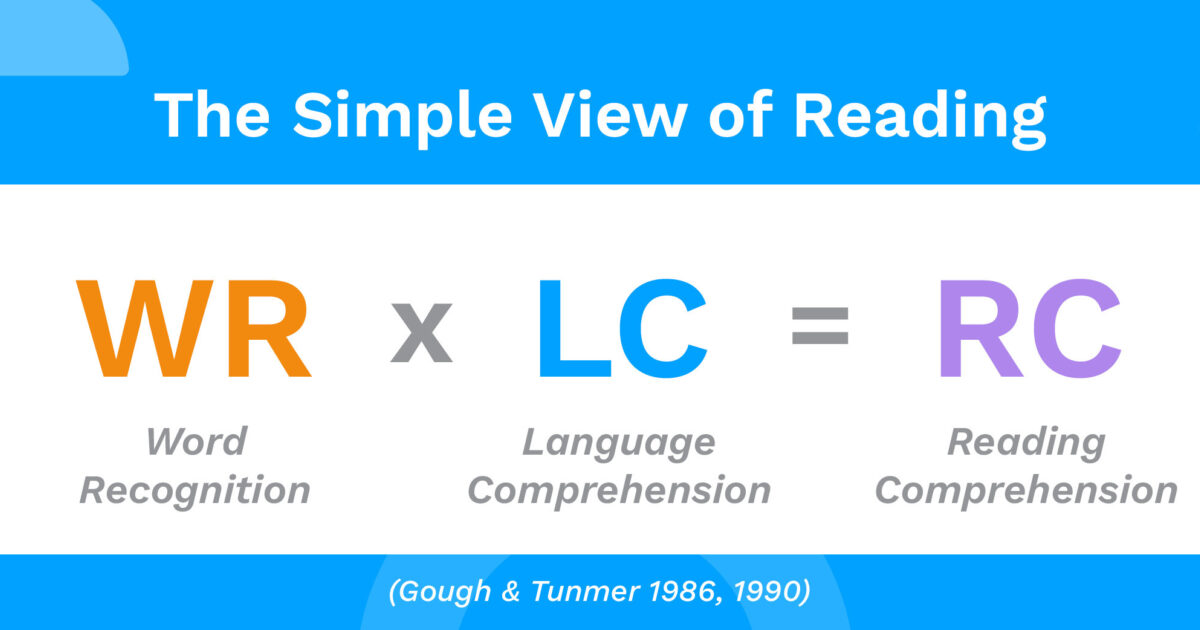
Reading comprehension has two necessary components
The Simple View of Reading proposes that reading comprehension depends on two interacting capabilities:
In many education contexts, word recognition is discussed as decoding, particularly for beginning readers. Strictly, word recognition includes both sounding out unfamiliar words using letter-sound knowledge and recognising familiar words accurately and automatically. For this lesson, when a case study points to difficulty getting words off the page, we will call that a decoding or word-recognition need.
Language comprehension is the ability to understand spoken language: individual words, sentences, ideas, and connected discourse. It draws on vocabulary, grammar, oral narrative knowledge, verbal reasoning, and relevant background knowledge.
The formula is multiplicative, rather than additive. This does not mean educators should assign children numerical scores and literally multiply them in normal classroom practice. It makes a conceptual point: a major weakness in either component limits reading comprehension, even if the other component is strong.
For example:
- A child may understand a rich discussion about insects and accurately explain what a caterpillar becomes. If they cannot yet read the words caterpillar or cocoon, they cannot independently access that information from print.
- Another child may read the words in an information text fluently but not know what habitat means or be unable to interpret a complex sentence. Accurate oral reading alone does not ensure understanding.
- A third child may have difficulty both recognising words and understanding oral language. That child needs support in both areas, rather than a one-size-fits-all “reading comprehension” program.
Understanding the Simple View of Reading and…
Read Reading Universe’s overview to establish the formula, see how different learner profiles can produce similar reading-comprehension difficulties, and identify the skills sitting within each component.
In the section “What Is the Simple View of Reading?”, begin at the core explanation. Focus on why a strength in only one component is insufficient. Then read the hypothetical reader profiles, beginning the four profiles. Notice the evidence that differentiates a child who struggles with print from one who can read print but does not understand it. Finally, in “About the Simple View Formula,” read the terminology clarification and the following explanation of the component skills. Pay particular attention to the distinction between word recognition, language comprehension, and reading comprehension.
What counts as evidence for each component?
When you analyse a case study, first sort its details into two columns. Do not decide on support merely because the child “struggles with reading.”
| Evidence more consistent with a decoding need | Evidence more consistent with a language-comprehension need |
|---|---|
| Guesses from pictures or the first letter rather than reading through the word | Reads words accurately but cannot explain what they mean in the text |
| Has difficulty naming letter sounds or blending sounds into a word | Has limited understanding of key vocabulary |
| Reads inaccurately, slowly, or with substantial effort | Cannot follow or explain complex spoken sentences |
| Cannot read simple unfamiliar words that follow taught patterns | Gives a weak retell after listening to a text read aloud |
| Loses meaning because so much attention is spent identifying words | Has difficulty identifying main ideas, making inferences, or linking ideas |
| Understands a story or explanation when it is read aloud | Has limited relevant background knowledge for the topic |
The most informative comparison is often between what the child can understand when text is read aloud and what they can understand when they read it themselves.
A useful comparison
Suppose an educator reads a short factual text about frogs aloud to a child. The child can explain that tadpoles grow into frogs, uses words such as pond and eggs, and answers questions appropriately. When asked to read a simple version independently, however, the child substitutes words, skips unfamiliar words, and cannot retell the text.
The child’s oral response suggests that language comprehension is a relative strength for this text. The gap appears when print must be converted into spoken words. The priority is therefore decoding support.
Now consider the reverse pattern. A child reads the same simple text aloud accurately and at an appropriate pace. Yet, when asked what a tadpole is or why the frog needs a pond, the child cannot answer. If the educator reads the text aloud and the child still cannot explain these ideas, the difficulty is not caused primarily by decoding. The priority is language-comprehension support, perhaps focused on vocabulary, sentence meanings, connected talk, and relevant knowledge.
This comparison prevents a frequent error:
Weak conclusion: “The child got comprehension questions wrong, so they need comprehension strategies.”
Better conclusion: “The child could answer questions when the passage was read aloud but could not read the passage accurately independently. The immediate barrier to independent comprehension is decoding.”
A child cannot show what they understand from a text they have not been able to access accurately.
A four-step method for analysing a case study
In an exam or assignment, use the Simple View as a reasoning process rather than simply writing the formula.
1. Identify the concern with reading comprehension
Start with the outcome described in the case. This may be low performance on questions after reading, limited retelling, avoidance of independent reading, or difficulty learning from written material.
This evidence establishes that the child needs support with reading. It does not yet establish whether the support should be decoding, language comprehension, or both.
2. Examine word-recognition evidence
Look for details about how the child approaches print:
- letter-sound knowledge
- blending and segmenting
- accuracy with familiar and unfamiliar words
- reliance on guessing or pictures
- reading pace and effort
- ability to read connected text.
For an early reader, evidence such as “says the first sound and guesses,” “cannot blend /s/ /a/ /t/,” or “reads mat as man” indicates a decoding difficulty. Slow, effortful reading can also interfere with understanding because working memory is occupied with identifying words.
3. Examine language-comprehension evidence
Now look beyond print. What happens when the child listens?
Relevant evidence includes whether the child can:
- understand and use vocabulary
- follow oral instructions and sentences
- recount events in a logical sequence
- answer questions after hearing a text
- explain causes, reasons, and relationships
- draw appropriately on relevant experiences or background knowledge.
A child might pronounce every word in a book but not understand terms such as enormous, before, or because. They may also understand each familiar word but fail to interpret the relationship expressed in a sentence such as, “Although the rain stopped, the children stayed inside because the oval was muddy.” These are language-comprehension issues, not decoding errors.
4. Compare the evidence and name the priority
Your conclusion should match the pattern, not a label such as “low reader.”
| Pattern in the case study | Interpretation | Teaching priority |
|---|---|---|
| Weak word recognition; oral understanding is relatively strong | Decoding is limiting access to print | Explicit support with phonological awareness, letter-sound correspondences, blending, word reading, and possibly fluency |
| Accurate word recognition; oral and reading understanding are weak | Language comprehension is the main concern | Support vocabulary, oral language, sentence comprehension, narrative, reasoning, and relevant knowledge |
| Weak word recognition and weak oral understanding | Both components require support | Plan complementary decoding and language-comprehension teaching |
| Only a low reading-comprehension score is provided | Insufficient evidence to identify the source | Gather separate evidence of word recognition and listening comprehension before deciding |
The final row matters. The Simple View is not permission to make quick assumptions. A reading-comprehension score alone cannot tell you whether the child needs phonics, vocabulary work, both, or further investigation.
Watch Reading Rockets’ “The Simple View of Reading” to see why decoding and language comprehension must be assessed and taught separately rather than treated as one undifferentiated reading problem.
Watch separate diagnosis. Focus on the speaker’s central decision: when reading comprehension is low, determine whether the child’s difficulty lies in decoding, language comprehension, or both before selecting an intervention. Note the distinction between a vocabulary/background-knowledge need and a difficulty interpreting language.
Worked case studies
The following cases model the kind of reasoning expected in a university response.
Case 1: Decoding requires support
Case evidence:
A five-year-old, Zara, participates actively in shared reading. When the educator reads The Lost Hat aloud, Zara accurately answers who lost the hat, where the children looked, and why the hat was important. During independent reading of a simple decodable text, Zara points to the pictures and says words that fit the story but do not match the print. She reads sat as saw and cannot blend the sounds in m-a-p.
Interpretation:
Zara demonstrates understanding when language is presented orally. Her difficulty occurs when she must translate letters into sounds and words. Her errors are not simply failures of attention to meaning; they show that she is not yet reliably using grapheme-phoneme correspondences to read the printed words.
Priority:
Zara needs decoding support. An appropriate next step might include explicit practice with taught letter-sound correspondences, oral blending linked to print, and reading decodable words and short texts that allow her to apply the relevant pattern. Shared read-alouds and discussion should continue, because her language comprehension is a strength worth maintaining.
Concise justification:
Zara’s primary need is decoding support. Although she understands the story when it is read aloud, she cannot consistently blend sounds or read printed words accurately, instead relying on picture-based guesses. In the Simple View of Reading, weak word recognition limits her independent reading comprehension despite relatively strong language comprehension.
Case 2: Language comprehension requires support
Case evidence:
Noah, aged six, reads a short text about weather accurately and smoothly. He reads cloud, temperature, and umbrella correctly. However, when asked what temperature means, he says, “It is about clouds.” He cannot explain why the text advises people to take an umbrella, and his retell consists mainly of isolated words. The educator reads the text aloud a second time, but Noah still cannot explain the main idea.
Interpretation:
Noah’s accurate, fluent reading indicates that decoding is not the main immediate barrier. His difficulty remains when the print barrier is removed, pointing to language comprehension. The case suggests particular needs in vocabulary and in making connections among ideas in the text.
Priority:
Noah needs language-comprehension support. The educator might pre-teach and revisit useful vocabulary in meaningful contexts, use visuals and discussion to develop weather knowledge, model how to connect sentences, and invite Noah to retell ideas using prompts such as “What is this text mainly teaching us?” and “What tells us that?”
Concise justification:
Noah’s primary need is language-comprehension support. He reads the words accurately and fluently, but he cannot explain key vocabulary or the text’s ideas even after it is read aloud. This pattern indicates that the main difficulty lies in constructing meaning from oral and written language rather than in decoding.
Case 3: Both components require support
Case evidence:
Eli, aged six, has difficulty identifying common letter sounds and reads dog as dad. During a read-aloud about community helpers, Eli gives no response when asked what a firefighter does. With prompts, he says, “Fire,” but cannot explain the firefighter’s role or retell an event from the book.
Interpretation:
Eli has evidence of weak decoding: inaccurate word reading and insecure letter-sound knowledge. The read-aloud evidence also suggests that oral language comprehension requires attention, because difficulties persist when he does not need to read the print.
Priority:
Eli needs support in both decoding and language comprehension. These can be planned alongside one another. For example, a small-group experience might explicitly teach a small set of letter-sound correspondences while shared books, dramatic play, and purposeful conversation develop vocabulary about community helpers.
Avoid treating either area as unimportant. Phonics alone would not directly address Eli’s limited understanding of oral text, while oral-language experiences alone would not enable him to access print independently.
Use the model carefully in early-childhood settings
The Simple View is a framework for planning and interpreting evidence; it is not a diagnostic label. A teacher can identify an instructional priority, monitor progress, and seek further support through appropriate school processes where needed. The model does not allow an educator to diagnose a learning disorder from a brief observation.
Also interpret evidence in context. A child may not understand a text because:
- the topic and vocabulary are unfamiliar;
- the text has unusually complex language;
- the child has had little opportunity to engage with that type of text;
- the child is learning English as an additional language or dialect;
- the assessment conditions, instructions, or relationship with the assessor affected participation.
For multilingual children, difficulty with English vocabulary should not be interpreted as an absence of knowledge, reasoning, or language capability. Where possible, draw on family knowledge, classroom observations over time, the child’s home-language strengths, and familiar contexts. Later in the course, you will examine these issues in more detail.
The immediate principle is to make a proportionate claim:
“The available evidence suggests a current priority for decoding support”
is stronger professional language than:
“The child has a decoding disorder.”
Writing an exam-ready Simple View response
A clear short response usually has four parts:
- State the identified priority: decoding, language comprehension, or both.
- Cite evidence about word recognition.
- Cite evidence about oral/language comprehension.
- Name an aligned teaching response.
Use this adaptable structure:
The child’s primary need is [decoding / language comprehension / both]. The case indicates this because [specific evidence about reading words, accuracy, blending, or fluency]. In contrast, [specific evidence from listening, vocabulary, retelling, or oral understanding] shows that [the other component is a relative strength / this component also requires support]. Therefore, the educator should prioritise [specific teaching focus] while continuing to monitor both components.
Notice that this structure makes an argument from evidence. It does not merely define the Simple View.
Key takeaways
The Simple View of Reading explains reading comprehension through two essential components:
To apply it in a case study:
- Separate evidence about how the child reads words from evidence about how the child understands oral language.
- Compare independent reading performance with understanding when the same or similar content is read aloud.
- Identify decoding support when access to print is the main barrier.
- Identify language-comprehension support when understanding remains weak despite adequate word recognition.
- Identify both needs when evidence indicates weaknesses in both components.
- Avoid conclusions when the case provides only a general reading-comprehension result; more evidence is needed.
Next, you will examine the foundational competencies that contribute to emergent reading and writing, including the early knowledge and behaviours that later support both word recognition and language comprehension.
Can't find a good explanation? Sign up and we'll make it for you
Sign up