
Hello again. In the previous lesson, you learned to recognise literacy opportunities within play, routines, and transitions by identifying the context, literacy practice, purpose, and possible educator move. This lesson adds the planning step that makes such observations academically and professionally useful: linking an activity to a specific curriculum goal.
For a university response, it is not enough to say that an activity is “good for literacy.” You need to show what children are expected to learn, identify the relevant curriculum language, and describe what evidence would indicate that learning. Here, the primary reference point is the Western Australian Kindergarten Curriculum Guidelines, particularly EYLF Learning Outcome 5: Communication.
Activity, curriculum goal, and evidence: three different things
An activity is what children do. A curriculum goal states the intended learning. Evidence is what the educator could see, hear, or collect to judge children’s participation and development.
Consider a post-office dramatic-play area:
| Element | Example |
|---|---|
| Activity | Children draw, make marks, or use letters to create a postcard for a friend. |
| Curriculum goal | Children explore mark-making to construct and convey messages for a purpose. |
| Evidence | A child explains who the postcard is for, says what their marks mean, adds a drawing or familiar letters, and gives the card to its intended recipient. |
The postcard itself is not the learning goal. Nor is conventional spelling necessarily the goal. The important learning is that a child is using symbols, marks, pictures, and perhaps letters to communicate a message to an audience.
This distinction prevents a common planning error:
Weak connection: “Making postcards supports literacy.”
Stronger connection: “Making postcards gives children a meaningful reason to use drawing, marks, and familiar letters to convey a message to another person. It aligns with Outcome 5, Conveying and constructing messages for a range of purposes in a variety of contexts.”
The stronger version identifies a precise learning focus and explains why the activity makes that learning possible.
Finding appropriate literacy goals in Outcome 5
The Kindergarten Curriculum Guidelines frame literacy broadly. Literacy includes using language, print, visual images, symbols, and digital tools to make and share meaning. For an activity involving 3–5-year-olds, select a goal that reflects what children are actually doing and what the educator intentionally supports.
Kindergarten_Curriculum_Guidelines_2021.pdf
Read the School Curriculum and Standards Authority's Kindergarten Curriculum Guidelines to see how EYLF Learning Outcome 5: Communication turns broad literacy ideas into observable learning.
In the “EYLF Learning Outcome 5” section, begin with the “Outcome 5 | Communication overview.” Read the overview to establish the broad meaning of communication and literacy in Kindergarten. Then read the full focus subsection “Conveying and constructing messages for a range of purposes in a variety of contexts,” paying particular attention to message construction. Next, read “Engaging in reading, writing and viewing behaviours,” especially reading and writing behaviours. Finally, in “Developing concepts of print,” focus on concepts of print. Notice that the examples describe developing behaviours, not a checklist that every child must master in one activity.
For this course, five Outcome 5 focuses will be especially useful when matching early literacy activities to curriculum:
| If children are mainly… | A suitable Outcome 5 curriculum focus | What this can look like |
|---|---|---|
| Talking, listening, explaining, negotiating, or recalling | Building aural and oral language and active listening | Discussing a book, explaining a play plan, listening and responding to a peer |
| Enjoying rhyme, clapping syllables, or noticing sounds | Developing phonological awareness skills | Joining a rhyme, identifying the first sound in a familiar word, playing with syllables |
| Telling, dictating, drawing, or writing for someone | Conveying and constructing messages for a range of purposes in a variety of contexts | Dictating a story, creating a sign, writing an order in café play |
| Exploring books, signs, menus, labels, or digital texts | Developing understanding of purpose and meanings of a range of texts | Identifying that a menu helps customers choose; discussing characters and events |
| Using drawing, marks, letters, or books in meaningful ways | Engaging in reading, writing and viewing behaviours | Making a shopping list, turning pages appropriately, recognising a name or road sign |
| Noticing directionality, spaces, titles, letters, or meaningful print | Developing concepts of print | Tracking print during shared reading; noticing that words are separated by spaces |
An activity may touch several curriculum areas, but choose one primary goal. You may identify a secondary connection where it is genuinely important, but do not make a long list of every possible outcome. A focused match is clearer, easier to teach intentionally, and easier to observe.
A practical method for making the connection
Use the following planning sequence whenever you are given an activity, vignette, or assessment prompt.
1. Describe the activity without adding a claim
State what children will do, what materials they will use, and the social context.
For example:
After a shared reading, children use puppets and simple props to retell the story in pairs.
This is a description, not yet a curriculum alignment.
2. Identify the central literacy action
Ask: What are children doing with language, print, symbols, or texts?
In the puppet activity, children are likely to:
- recall and sequence events
- use oral language to represent characters’ actions and dialogue
- listen and respond to their partner
- construct a narrative for an audience.
The central action is oral retelling and message construction, rather than letter recognition or handwriting.
3. Select the closest curriculum focus
Match the central action to Outcome 5 language. In this case, the strongest match is:
Conveying and constructing messages for a range of purposes in a variety of contexts
The Guidelines specifically include retelling a simple story in a logical sequence through dramatic or block play. A related, secondary connection is Developing understanding of purpose and meanings of a range of texts, because children are demonstrating understanding of a shared text.
4. Write a child-centred learning intention
A learning intention should state the intended learning, not the adult’s procedure.
| Procedure-focused statement | Learning-focused statement |
|---|---|
| “Children will use puppets after reading.” | “Children will use oral language and props to retell key events from a familiar story in a meaningful sequence.” |
| “Children will make a café menu.” | “Children will use drawing, marks, and familiar letters to communicate food choices to others during café play.” |
| “Children will clap names.” | “Children will listen for and explore syllables in familiar spoken words.” |
The second column gives a clear basis for interaction and observation.
5. Decide what evidence would count
Evidence must be observable. Avoid vague statements such as “children understand stories” or “children improve their literacy.”
For the puppet retelling, evidence might include a child:
- identifies a character or setting
- recounts two or more events in a meaningful order
- uses words such as first, then, or after that
- responds to a partner’s contribution
- uses a prop to represent an event, even if the oral retell is brief.
Not every child will show every behaviour. Evidence helps an educator notice each child’s current strengths and decide what support may be useful next.
Worked example: story retelling through dramatic play
The following example shows a complete, defensible connection.
The activity
The educator reads a familiar picture book several times across the week. In a small group, children choose simple character puppets and props. They retell the story together, deciding who will play each character and what happens at the beginning, middle, and end. The educator prompts without supplying the entire story:
“Who is in your story?”
“Where are they at the start?”
“What happened after the character found the mitten?”
“How will your audience know the story has ended?”
The primary curriculum goal
EYLF Learning Outcome 5: Communication
Focus: Conveying and constructing messages for a range of purposes in a variety of contexts.
This is appropriate because children use oral language, movement, and symbolic props to reconstruct a meaningful message for peers. Retelling is not merely recall; it requires children to select events, represent ideas, and make the narrative understandable to an audience.
Supporting curriculum connection
Engaging in and extending literacy practices in personally meaningful ways
Focus: Developing understanding of purpose and meanings of a range of texts.
This applies because children interpret the text’s characters, setting, and events as they decide how to represent them.
Learning intention
Children will retell key events from a familiar story using oral language and props.
Evidence to observe
The educator listens for children naming characters, identifying a setting, sequencing events, using vocabulary from the story, and responding to peers’ ideas.
This activity is play-based, but it is not accidental or aimless. The play remains flexible and child-responsive while the educator holds a clear literacy intention.
Integrating Play Into Literacy Instruction: Strategies For Your Classroom (REL Midwest)
Watch “Integrating Play Into Literacy Instruction: Strategies For Your Classroom” from the Institute of Education Sciences for a concrete demonstration of story retelling with books, puppets, and dramatic play.
Watch story retelling. Focus on how the educator uses characters, setting, events, props, and peer participation to help children organise and communicate a familiar narrative. Notice that the props support comprehension and oral language; they are not an end in themselves.
The image below is also a useful reminder when planning writing activities: children can communicate through drawing, scribbling, mock letters, letter strings, and invented spelling before they use conventional spelling.
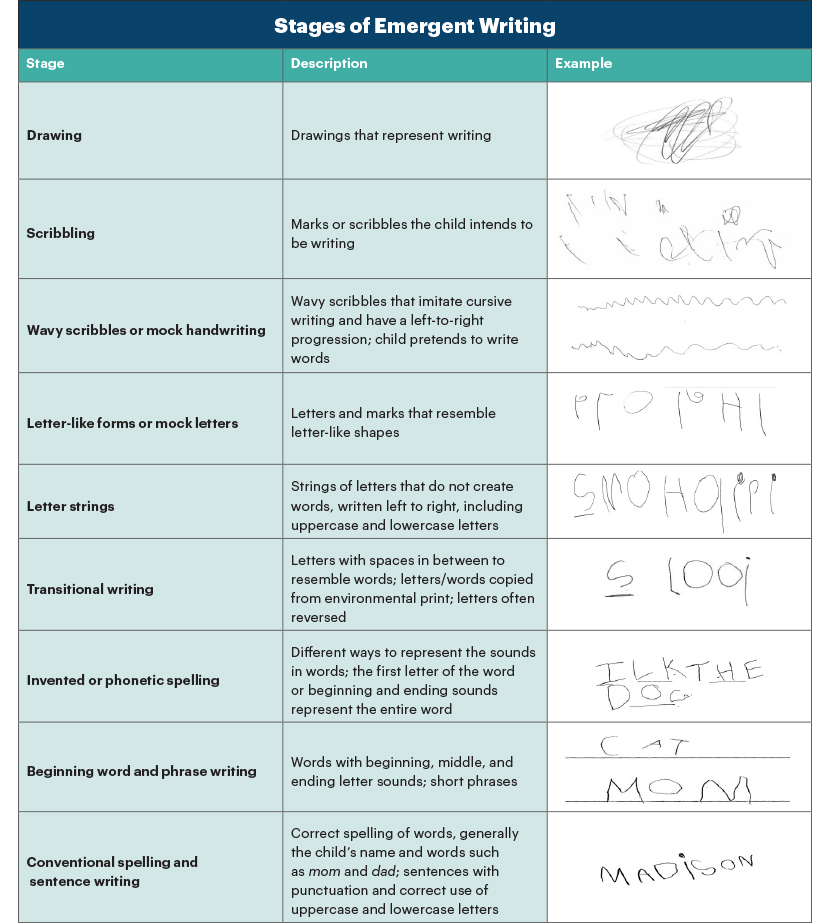
For example, a “make a sign for the veterinary clinic” activity can serve the same communicative purpose for several children:
- one child may draw a dog and explain, “This says pets only”;
- another may make letter-like forms;
- another may write initial sounds, such as “P” for pets;
- another may attempt a conventional word or copied label.
The appropriate curriculum goal remains the use of marks, symbols, and letters to construct and convey a message. The developmental differences affect the educator’s next teaching move, not whether the child participated in meaningful literacy.
Connecting Kindergarten goals with Pre-primary English
The Kindergarten Curriculum Guidelines are your main source for a 3–5-year-old activity. They also show connections to Pre-primary English, which can help you see how early literacy experiences contribute to later, more formal curriculum expectations.
The SCSA Pre-primary English “Telling a story” snapshot provides a useful model: it links an oral storytelling activity to content descriptions and then specifies the observable performance expected in group settings.
Read this School Curriculum and Standards Authority snapshot as a model of explicit alignment between a storytelling activity, a curriculum description, and observable evidence.
On the “English snapshot: Telling a story” page, read the table immediately below the snapshot title. Follow the curriculum-to-evidence link. Then read the “Nature of the assessment” and “Purposes of the assessment” entries. Focus on how the teacher gathers evidence of oral language rather than treating storytelling as a general or unassessed activity.
Do not force a Kindergarten activity to meet a later Pre-primary standard. Instead, use the connection to plan a sensible developmental pathway. A Kindergarten child may retell a story using a few words, gestures, props, or home-language resources; a Pre-primary child may be increasingly able to retell events clearly for peers and known adults.
Three more examples of accurate alignment
1. Café play: menus and order pads
Activity: In a café play area, children use picture menus, order pads, pencils, and name cards. A child acting as the waiter asks a peer what they would like, makes marks on an order pad, and gives it to the chef.
Primary curriculum goal:
Outcome 5, Conveying and constructing messages for a range of purposes in a variety of contexts.
Why it fits: The marks have a real purpose inside the play: they help the waiter communicate an order to the chef.
Possible evidence: The child explains what their marks represent, uses a drawing or symbol consistently, attempts familiar letters, or refers to an order while delivering food.
Do not overclaim: The child may be developing emergent writing, but the activity alone does not demonstrate that they can independently spell words or decode the menu.
2. Shared book walk: front cover, pictures, and predictions
Activity: Before reading a picture book, the educator invites children to examine the front cover, title, and illustrations. Children predict what may happen and explain what they notice.
Primary curriculum goal:
Outcome 5, Developing understanding of purpose and meanings of a range of texts.
Possible secondary connection:
Developing concepts of print.
Why it fits: Children learn that a book is a text that communicates meaning through words and images. If the educator explicitly discusses the cover, title, direction of print, or author, concepts of print are also present.
Possible evidence: A child identifies the cover, uses illustration details to make a prediction, makes a connection to personal experience, or explains something they think the book will be about.
3. Name syllable game during a transition
Activity: While moving to the outdoor area, children clap the syllables in their names and in the names of familiar objects they can see.
Primary curriculum goal:
Outcome 5, Developing phonological awareness skills.
Why it fits: The focus is on attending to and exploring parts of spoken words. It is oral language play, not a handwriting or letter-identification task.
Possible evidence: A child claps one beat for Sam and two for Mi-a, attempts to join a peer, or distinguishes a longer name from a shorter one by its spoken parts.
The next modules will examine phonological awareness in greater depth. At this point, the important planning decision is simply to identify it accurately as the intended curriculum focus.
Avoiding weak curriculum links
A curriculum connection is weak when it is broad, mismatched, or based only on the materials present.
| Common issue | Why it is a problem | Better approach |
|---|---|---|
| “This activity develops literacy.” | It does not identify a learnable literacy behaviour. | Name the particular focus: oral retelling, mark-making, phonological awareness, text purpose, or concepts of print. |
| “Children use pencils, so the goal is writing.” | A pencil can be used for drawing, design, recording, or pretend play. | Identify what the child is communicating and why. |
| Linking a story puppet activity to letter-sound knowledge | The materials may include character names, but phonics is not the central action. | Align it to oral language, narrative, retelling, or text comprehension. |
| Expecting conventional spelling from all children | It ignores emergent writing and developmental variation. | Make the goal message construction; respond differently to each child’s current writing evidence. |
| Listing many outcomes | It obscures the teaching intention and produces unfocused observation. | Select one primary goal and, if needed, one clearly justified supporting goal. |
A reliable test is to ask whether the intended evidence matches the stated goal. If your goal is phonological awareness, you should be observing children listening for, identifying, or playing with sounds. If your goal is message construction, you should be observing children using language, marks, symbols, or images to communicate with someone.
A concise university-response structure
For a short written response, use this four-part structure:
Activity: Describe what children will do.
Curriculum goal: Name the relevant Outcome 5 focus.
Justification: Explain how the activity gives children a meaningful opportunity to demonstrate or develop that focus.
Evidence: State what the educator could observe or collect.
For example:
In a post-office dramatic-play area, children make cards and delivery labels for peers using drawings, marks, and familiar letters. This aligns with EYLF Learning Outcome 5, Conveying and constructing messages for a range of purposes in a variety of contexts. The activity gives children an authentic reason to represent a message for a particular audience, rather than completing writing in isolation. The educator could observe how children explain their marks, identify a recipient, use symbols or letters, and deliver their message during play.
This response is concise, specific, and grounded in the curriculum.
Key takeaways
A well-aligned literacy activity connects four elements:
- What children do in the activity.
- The literacy action at the centre of that experience.
- A specific Outcome 5 curriculum focus that describes the intended learning.
- Observable evidence that would show children’s participation and current development.
For 3–5-year-olds, select goals that value emerging communication: oral language, active listening, retelling, awareness of sounds, purposeful mark-making, reading and viewing behaviours, text meaning, and early concepts of print. Keep the activity meaningful and allow children to participate through their current strengths, including drawing, gesture, home language, talk, marks, symbols, and developing letter knowledge.
Next, you will use the Simple View of Reading to decide whether a child’s reading needs are more strongly related to decoding or language comprehension.
Can't find a good explanation? Sign up and we'll make it for you
Sign up