
Hello again. Previously, you used an emergent-literacy perspective to interpret children’s early reading, writing, oral language, and symbolic behaviours. The central habit was to start with observable evidence and ask what a child may be learning about communication, print, and language—not simply whether their behaviour matches adult conventions.
This lesson shifts attention from an individual child’s behaviour to the K/PP environment. Literacy is not confined to a book corner or a scheduled writing session. It can be embedded in children’s dramatic play, repeated everyday routines, and the short intervals when the group moves from one experience to another. Your task is to identify these opportunities accurately: name the literacy practice available, explain why the context gives it meaning, and recognise the educator’s role in making the opportunity usable.
What makes something a literacy-learning opportunity?
A literacy-learning opportunity is a feature of an experience, environment, interaction, or material that can support children’s developing speaking, listening, reading, writing, print knowledge, or awareness of language sounds.
The word opportunity matters. A menu placed in a pretend café creates the possibility of literacy learning, but it does not guarantee that children will use it or learn from it. A child may use the menu as a plate, ignore it, “read” it from pictures, recognise a familiar word, or use it to negotiate an order with a peer. The educator notices what happens and responds in ways that extend—not replace—children’s purposeful activity.
A useful distinction is:
| Noticing only the resource | Identifying the literacy opportunity |
|---|---|
| “There are labels in the block area.” | “Labels can help children identify, discuss, and return materials; children may also notice that print carries information.” |
| “The children sing while packing up.” | “A familiar song can support listening, vocabulary, rhyme, turn-taking, and attention to the sound patterns of words.” |
| “There is a notepad in the café.” | “A notepad enables children to make and reread orders, using marks or letters to represent a message for another person.” |
A strong university response identifies four connected elements:
- The context: Where and when is the opportunity occurring?
- The literacy practice: Is it mainly oral language, listening, vocabulary, narrative, print concepts, alphabet knowledge, sound awareness, reading, writing, or a combination?
- The purpose: What meaningful work can language or print do for the child in that context?
- The educator move: How might an adult model, prompt, add a resource, or extend conversation without taking over?
This approach keeps analysis specific. Rather than claiming that “play improves literacy,” explain which play materials and interactions invite which forms of literacy behaviour.
Leveraging the Environment to Ignite Children's Literacy Learning
Read “Leveraging the Environment to Ignite Children’s Literacy Learning” from NAEYC. It provides practical examples of how literacy materials and familiar routines can become meaningful parts of an early-years environment.
In “Using Materials to Enrich Early Literacy Environments,” read the examples of literacy materials. Then continue through the discussion of labels and storytelling props, noting that different areas of the room can support different literacy purposes. In “Using Routines to Spark Literacy Expressions,” begin with the explanation of routines. Then read the morning sign-in example from picture-supported names to independent sign-in. Focus on how a routine can be adjusted as children’s knowledge changes.
A practical “opportunity scan”
When observing a K/PP room, avoid looking only for alphabet charts, worksheets, or a library. Scan for the ways people use language, symbols, and print to accomplish something together.
| Look for | Literacy possibilities |
|---|---|
| People talking together | Vocabulary, sentence building, listening, turn-taking, explanation, negotiation, storytelling |
| Print that serves a function | Recognising names, understanding labels and signs, noticing that print carries information |
| Tools for making messages | Drawing, mark-making, dictation, letter use, early spelling, lists, maps, cards, plans |
| Texts children can revisit | Shared reading, retelling, concepts of print, book handling, information seeking |
| Songs, chants, and word play | Listening, memory, rhyme, syllables, alliteration, enjoyment of language |
| A real audience or purpose | Writing an order for a customer, making a sign for peers, recording a discovery, retelling an event |
An environment becomes more literate when children have repeated reasons to use these resources, not merely when it contains a large amount of printed material.
Play: literacy used for a purpose
In sustained play, children often need literacy because it helps them participate in a shared imagined world. A child playing “restaurant” might need to decide what the café is called, explain a menu, take an order, write a receipt, or read a “closed” sign. None of these needs to involve conventional reading or spelling before they count as literacy. The important point is that marks, print, and oral language have a purpose within the play.
Consider three common play contexts.
Dramatic-play area
A home corner can become a café, veterinary clinic, post office, repair workshop, travel agency, animal shelter, or family celebration. Each context can include purposeful literacy props:
- Café: menus, order pads, name badges, recipe books, signs, receipts.
- Veterinary clinic: animal name cards, appointment lists, health charts, adoption forms.
- Post office: envelopes, stamps, address labels, cards, delivery lists.
- Building site: plans, safety signs, material labels, maps, clipboards.
The same prop can support different levels of development. A child may use a menu’s pictures to choose food, recognise the first letter in a word, make scribbled “orders,” or dictate a message for the educator to write. Therefore, identify the available opportunity without assuming that every child is working at the same point on a literacy continuum.
An educator can extend literacy organically:
“You have three customers waiting. How will the chef know what each person ordered?”
This prompt does not demand conventional spelling. It creates a communicative problem for which children might draw, make marks, use copied letters, dictate, or organise symbols. The adult can then model an appropriate next step: “I’ll write Sam at the top so we remember whose order this is.”
Construction, small-world, and outdoor play
Literacy opportunities extend well beyond dramatic play. In block play, children can create signs for a bridge, make a map of a town, label a construction, or explain a plan to collaborators. In a small-world scene, children use oral narrative as they establish characters, setting, events, and problems.
Outdoor play can invite a child-initiated investigation. If children discover insects, fallen leaves, or a bird’s nest, relevant books, magnifiers, clipboards, paper, and drawing tools can support observation and communication. A “wonder” notebook may contain drawings and dictated comments long before children independently write detailed observations.
The literacy purpose remains authentic: children are recording, sharing, remembering, or finding out.
Integrating Play Into Literacy Instruction: Strategies For Your Classroom (REL Midwest)
Watch the Institute of Education Sciences’ REL Midwest video “Integrating Play Into Literacy Instruction: Strategies For Your Classroom.” It shows that play-based learning can be intentional and connected to literacy goals without becoming a disguised worksheet task.
Watch the opening framing for the relationship between active play, planned learning goals, and early literacy. Then watch storytelling in play. Focus on the educator’s use of dictation, questions, acting, and discussion to support narrative language, vocabulary, and comprehension.
Storytelling and story acting
Storytelling is an especially important embedded opportunity because it connects oral language with later reading and writing. A child who tells a story about a lost puppy is composing a message: they select events, characters, and language for an audience. When an educator writes down the child’s words and reads them back, the child can see speech represented in print. When peers act out the story, they must listen, interpret events, and cooperate around its sequence.
This can occur in a planned dramatic-play experience, but it can also be brief and portable: during outdoor time, in a hallway, or while a small group waits for the next activity. What matters is the use of language for meaning and audience.
Routines: repeated moments with familiar literacy purposes
Routines are predictable, repeated parts of the day: arrival, sign-in, attendance, meals, toileting, pack-up, rest time, and home time. Their predictability makes them useful because children can participate repeatedly and increasingly independently.
A routine should not become a series of literacy tests. Instead, it should preserve its practical function while offering accessible choices to notice and use language or print.
Arrival and sign-in
A sign-in system can develop over time:
- At first, children match their photograph to a name card.
- Later, they locate their printed name among several cards.
- Children may notice first letters, compare names, copy their name, or attempt to write it independently.
- An educator might say, “You found Mia. How did you know it was yours?” This reveals whether the child used the photo, the overall visual shape, familiar letters, or another cue.
Recognising a name card is meaningful print knowledge, but it does not by itself demonstrate that a child can decode unfamiliar words. The educator should record what the child actually does and says.
Mealtimes, cooking, and shared care routines
Mealtimes are rich in oral language: children request, explain, describe tastes and textures, recount experiences, and practise conversation. A cooking experience adds a meaningful reason to read a recipe, sequence actions, make a shopping list, label ingredients, or create a class cookbook.
The relevant literacy learning may be vocabulary and oral language rather than letter identification. For example, while making fruit salad, words such as peel, slice, juicy, ingredient, first, and next expand children’s capacity to describe actions and sequence events. These language foundations later support comprehension and writing.
Pack-up, rest, and departure
Labels can make pack-up genuinely communicative: children use picture-and-word labels to decide where materials belong, help peers, and maintain the shared environment. The strongest labels are visible, consistently used, and connected to real objects.
Rest time can include quiet picture-book browsing, listening to a familiar story, or individually dictating a short story to an educator. Departure can prompt a child to select a book to share at home, recount a day’s event, or add a message to a family communication board.
The illustrated Daily Routine Cards show familiar activities such as breakfast, brushing teeth, visiting the library, going to the park, and getting dressed. Such cards can support a routine when children use them to communicate and sequence meaningful events, rather than simply naming isolated pictures.
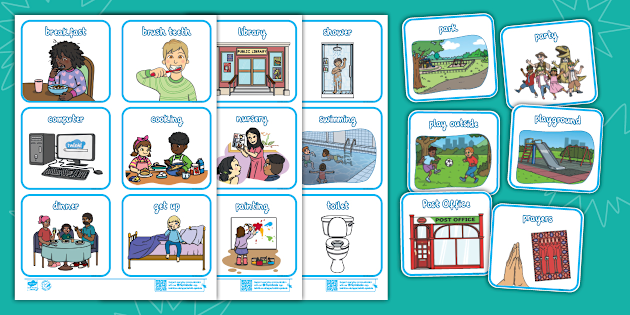
For instance, an educator might invite children to arrange selected cards to retell a morning routine: “First I get up; then I brush my teeth; after that I eat breakfast.” Children can compare their own routines, add a drawing of another event, or dictate a caption. This supports oral sequencing and vocabulary while respecting that family routines differ. If the goal is print learning, the adult might draw attention to the written labels; however, a child who chooses the correct card may be relying on the illustration rather than reading the word.
Transitions: brief does not mean insignificant
Transitions are the intervals between experiences: moving from outdoor play to lunch, waiting for a turn to wash hands, travelling to the mat, or settling after pack-up. Because these moments are often short, movement-based, and social, they are well suited to oral language, listening, songs, rhymes, and playful attention to words.
A transition becomes a literacy opportunity when it involves more than control or compliance. Compare the following:
| Routine-management statement | Literacy-enriched alternative |
|---|---|
| “Walk to the mat quietly.” | “Find a partner and tell them one thing you built. Now bring your idea to the mat.” |
| “Pack up now.” | “When you put away a block, say a word that describes it: smooth, heavy, tall, or tiny.” |
| “Line up for outside.” | “We are going on a sound walk. What might we hear outdoors? Listen first, then share the sound and where you think it came from.” |
| “Wait at the door.” | “Let’s say our familiar rhyme and change one word together. Which new word rhymes?” |
Songs and rhymes offer a developmentally appropriate way to gain attention while also allowing children to hear and play with patterns in spoken language. This is an opportunity for early phonological awareness, but it should remain enjoyable and supported. It is not necessary to turn every transition into formal phonics instruction.
phonological and phonemic awareness - Education Resources
Read the Western Australian Department of Education’s practical resource for its account of a literacy-rich Kindergarten environment and its use of songs and rhymes during daily transitions.
In “Planning for effective learning: The Literacy Environment” on pp. 19–20, read the discussion of a literacy-rich environment. Notice that oral language and print can be integrated into every learning area, including outdoor play. Then, in “Songs, Rhymes and Word Play” on pp. 25–26, read the explanation of transition songs and rhymes. Focus on why familiar language sequences can be both effective transitions and early literacy experiences.
The adult makes the difference
Print, props, and songs are useful, but the educator’s interactions make their literacy potential more likely to be realised. Effective responses are usually brief and contingent on what children are already doing.
An educator can:
- Model a real use of print: “I’m writing a sign so everyone knows this road is closed.”
- Invite explanation: “Tell me what your map shows.”
- Extend vocabulary: “You called it a big bridge. Engineers might describe it as tall or stable.”
- Prompt attention to print: “You wrote a message for Dad. Where should we start reading it?”
- Scribe without taking authorship: “I can write your words exactly as you say them. What would you like your story to say?”
- Offer an appropriate choice: “Would a drawing, a label, or a list help the vet remember?”
These moves connect to the sociocultural account from the first lesson: children learn through participation with more experienced users of language and literacy tools. They also preserve the emergent-literacy principle from the previous lesson: children’s early marks, storytelling, and attempts are meaningful starting points.
Identifying opportunities in a case study
For an assignment or exam response, write with precision. Use this pattern:
In [context], [material, event, or interaction] creates an opportunity for children to [specific literacy practice] because [communicative purpose]. The educator can extend this by [responsive action].
For example:
During café play, menus, order pads, and name badges create opportunities for children to use oral language and emergent writing because these tools help them take roles, communicate orders, and organise the shared play. The educator can extend the learning by modelling how to write a customer’s name and inviting children to explain what their marks say.
Or:
During the transition from outdoor play to group time, a familiar rhyme creates an opportunity for children to listen closely to words and notice rhyme patterns while moving and settling as a group. The educator can invite children to substitute a rhyming word, acknowledging children’s contributions and modelling the sound pattern.
Notice what these responses do not claim. They do not state that every child learns to read from a menu or that a song automatically teaches phonemic awareness. They identify a realistic opportunity, a plausible literacy focus, and a responsive teaching action.
Key takeaways
Literacy opportunities are embedded throughout K/PP life when children use oral language, print, symbols, texts, and writing tools for meaningful purposes.
- Play supports literacy through roles, storytelling, negotiation, purposeful props, signs, lists, messages, and shared narratives.
- Routines support repeated participation in meaningful print and language practices, such as sign-in, cooking, mealtime talk, labelling, pack-up, and shared reading.
- Transitions can support listening, vocabulary, oral retelling, songs, rhymes, and playful attention to words and sounds.
- A resource alone is not enough. Children need access, purpose, interaction, and responsive adult support.
- In academic responses, identify the context, literacy practice, purpose, and possible educator move rather than making broad claims that an activity “does literacy.”
Next, you will connect a specific literacy activity for three-to-five-year-olds to an appropriate curriculum goal.
Can't find a good explanation? Sign up and we'll make it for you
Sign up