
Hello again. The previous lesson focused on the Language Experience Approach: a shared experience gives children something to talk about, their spoken ideas become a jointly constructed text, and that text is reread. This lesson widens the lens. Rather than evaluating one planned activity, you will learn to evaluate the whole K/PP environment for the everyday opportunities it offers children to communicate, read, and write.
By the end, you should be able to make a defensible judgement about a learning environment: identify evidence of literacy opportunity, notice gaps in access or purpose, and recommend realistic improvements. This is not a search for the room with the most posters or worksheets. It is an evaluation of whether the setting invites children to use language and literacy meaningfully, independently, and with others.
An environment is more than its furniture and displays
A K/PP learning environment includes the physical space and materials, but it also includes the daily timetable, relationships, routines, educator interactions, cultural messages, and access arrangements. A well-stocked writing table alone does not create a literacy-rich environment if children have no reason to write, cannot reach the materials, or are not supported to use them.
The EYLF identifies learning environments as having physical, temporal, social, and intellectual elements. This gives you a useful four-part lens:
| Element | What to evaluate for literacy |
|---|---|
| Physical | Are books, writing tools, signs, visual texts, props, and communication resources accessible across indoor and outdoor spaces? |
| Temporal | Do routines, transitions, and sufficient uninterrupted play time allow children to talk, revisit texts, read, and write? |
| Social | Do children have reasons to communicate with peers and educators? Do adults listen, respond, model language, and extend thinking? |
| Intellectual | Do materials and experiences invite children to inquire, represent ideas, solve problems, tell stories, and use literacy for real purposes? |
The Early Years Learning Framework also defines literacy broadly. It includes listening, talking, signing, viewing, reading, writing, storytelling, visual arts, music, movement, drama, media, and digital literacies. Therefore, an evaluation should not treat literacy as print alone, nor treat spoken English as the only valid form of communication.
[PDF] The Early Years Learning Framework for Australia - ACECQA
Read the EYLF guidance from ACECQA to establish a curriculum-based standard for evaluating environments. It is particularly useful for grounding an evaluation in Learning Outcome 5: Children are effective communicators.
In the “Learning environments” practice section on p. 23, read from the definition of learning environments, then continue through the rest of the page. Notice that responsive environments include indoor and outdoor spaces, family and community contributions, accessibility, and time for meaningful interaction. Then read Learning Outcome 5: Children are effective communicators, pp. 57–62. Begin with the explanation of communication and literacy. On pp. 58–62, focus on the “This is evident when children…” and “Educators promote this learning…” examples for oral communication, engagement with texts, expression through media, and symbols. In the text-engagement examples, use these educator practices as a starting point, then continue through the relevant lists rather than treating that short extract as a checklist on its own.
A useful starting principle follows:
Availability is not the same as opportunity; opportunity is not the same as participation; participation is not the same as learning.
For example, a basket of pencils is available. It becomes an opportunity when children have a meaningful reason to record an order, make a map, create a sign, label a construction, or send a message. It becomes participation when a child can physically access the basket, understands its possible uses, and feels entitled to use it. Educator observation and interaction help turn participation into learning.
What to look for: oral language, reading, and writing
An environment should provide connected opportunities across all three areas. They often occur together. In a pretend veterinary clinic, for instance, children may negotiate roles and explain an animal’s problem, look at a health chart, and write or dictate an appointment note. Separating the areas for evaluation helps you identify what is strong and what needs attention.
Oral language: Is there a reason to communicate?
A language-rich setting is not necessarily a quiet room filled with labels. It is a setting where children have frequent, worthwhile conversations with peers and responsive adults. Children need opportunities to describe, explain, question, retell, negotiate, joke, disagree respectfully, listen, and use verbal and non-verbal communication.
Look for:
- small-group spaces where two to four children can sustain play and conversation;
- open-ended materials that give children something to explain or investigate;
- dramatic-play areas with roles, problems, and shared purposes;
- books, photographs, objects, and displays that invite discussion;
- educators who allow wait time, acknowledge gestures and home languages, and extend rather than dominate conversations;
- visual communication, sign, AAC, or other supports where needed;
- opportunities for storytelling, yarning, songs, rhymes, puppets, movement, and role-play.
The quality of educator talk matters. An adult who says, “Good job, what colour is that?” repeatedly may produce brief responses. An educator who joins a block construction and says, “You have made a bridge over the river. How will the cars know where to enter?” gives children language, a communicative problem, and a reason to respond.
Supporting Oral Language Development in a Language Rich Environment
Watch “Supporting Oral Language Development in a Language Rich Environment” from CECE Early Childhood Videos at Eastern CT State University. The examples show that a language-rich environment depends on sustained interaction, not simply on language-related materials.
Watch language rich spaces to see how group arrangements, peer interaction, and educator facilitation support communication. Continue with adult language models, noting the distinctions among child-directed speech, self-talk, and parallel talk. While watching, consider which of these practices you could actually observe during an environment evaluation.
When evaluating oral language, avoid judging only how much a child talks. Children may communicate meaningfully through gesture, sign, facial expression, drawing, movement, a home language, or an AAC system. The more useful question is whether the environment recognises and extends the child’s available ways of communicating.
Reading: Are children surrounded by meaningful texts?
For 3–5-year-olds, reading opportunities include far more than sitting in the book corner. Children can engage with storybooks, information books, labels, maps, recipes, menus, diagrams, signs, photographs, schedules, name cards, predictable chants, digital texts, and the group texts created through an LEA.
Evaluate whether texts are:
- Accessible: books are within reach, displayed invitingly, cared for, and usable by children independently or with a peer.
- Varied: the environment includes narrative, informational, environmental, visual, oral, print, and digital texts for different purposes.
- Relevant: texts connect to current play, children’s interests, families, languages, community, and investigations.
- Used: educators and children actually refer to the print during the day.
- Discussed: reading is interactive; children can predict, notice, ask questions, make connections, and revisit familiar books.
A book display is weak evidence if it is distant from children’s play and rarely used. Conversely, a few familiar texts placed in a dramatic-play restaurant can be powerful when children use menus, cookbooks, order pads, and food labels as part of their shared play.
Interactive read-alouds are also part of environmental evaluation because they concern how time, books, seating, and adult interaction are arranged. A space supports reading development when it makes discussion around texts possible, rather than positioning children as silent listeners.
Utilizing Interactive Read-Alouds to Support Oral Language Development
Watch “Utilizing Interactive Read-Alouds to Support Oral Language Development” from CECE Early Childhood Videos at Eastern CT State University. It demonstrates what strong text engagement looks like when children are invited to think and talk, rather than only listen.
Watch three language benefits for the links among listening, personal connections, vocabulary, and read-alouds. Then watch interactive discussion. Focus on how picture-rich books, predictions, follow-up prompts, and educator responses create oral-language opportunities before, during, and after reading.
Writing: Is print used to communicate something that matters?
Writing opportunities should be distributed throughout the setting. If writing is confined to one “writing centre,” children may learn that it is a school task rather than a way to make ideas visible and act in the world.
A strong environment provides materials and authentic purposes for marks, drawings, symbols, letters, and words. Children may write independently, copy functional print, dictate to an educator, use invented spelling, make marks, select symbols, or use digital tools. These are all potentially meaningful forms of emergent writing.
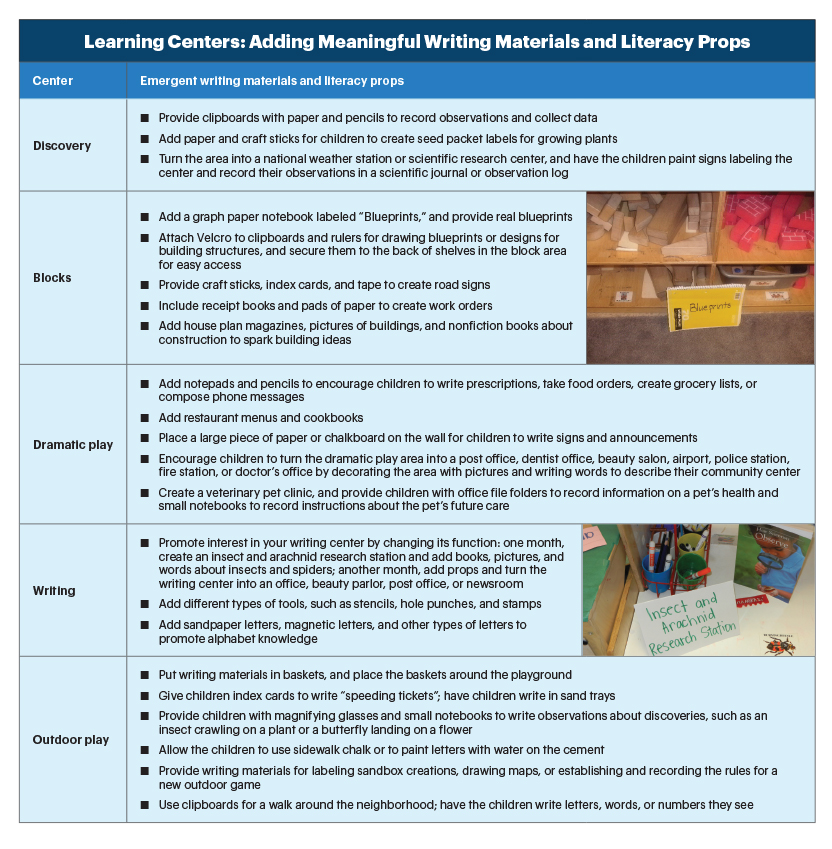
The image is useful because it moves beyond generic “paper and pencils.” In the discovery area, clipboards, notebooks, labels, rulers, and scientific illustrations support observation and recording. In block play, plans, blueprints, road signs, and work orders can become part of design and construction. Outdoors, children can make maps, record discoveries, label sand creations, or establish the rules of a new game.
Leveraging the Environment to Ignite Children's Literacy Learning
Read this NAEYC article for practical examples of how materials, routines, and educator interactions can make literacy purposeful throughout a K/PP setting.
In “Using Materials to Enrich Early Literacy Environments,” read the whole section. Start with the examples from dramatic play and science. Then attend to the section’s explanation of co-created labels, beginning with collaborative labelling. Notice the difference between print children merely see and print they help create or use. Next, in “Using Routines to Spark Literacy Expressions,” read the sign-in example from name recognition to name writing. Continue to the child-initiated investigation example beginning with children noticing ants. Finally, read “Using Interactions to Support Children’s Literacy Engagement.” Focus on how adult response turns materials into learning. In particular, read from arrival conversations and from responsive scaffolding in play.
A practical audit framework
To evaluate an environment systematically, use an evidence-to-judgement process rather than relying on first impressions.
1. Map the setting and the day
Walk through all relevant spaces:
- arrival and sign-in;
- group meeting and shared-reading area;
- book or quiet area;
- writing area;
- dramatic play;
- construction and block play;
- art and making;
- discovery, STEM, or sensory area;
- meal and transition routines;
- outdoor learning spaces.
Include routines because literacy does not begin only when children choose a centre. Signing in, checking a visual schedule, discussing the day’s plan, following a recipe, tidying labelled resources, and recounting an outdoor discovery can all be literacy events.
2. Collect observable evidence
Record what you can actually see and hear. Avoid starting with evaluative words such as excellent, poor, or language-rich.
| Area | Objective evidence | Interpretation comes later |
|---|---|---|
| Dramatic play | Four children use a café. A menu, notepad, pencils, table numbers, and food photographs are available. An educator asks one child, “What would your customer like?” | — |
| Book area | Eight books are displayed face out; two reflect current interest in insects. Children visit for three minutes during free play. No adult joins them. | — |
| Outdoor area | Chalk and clipboards are stored in a locked cupboard. During 30 minutes outdoors, no children use print or writing tools. | — |
Objective records allow you to identify whether an opportunity is physically present, accessible, used, and extended through interaction.
3. Judge each opportunity on five questions
For each area or routine, apply the following questions.
| Evaluation question | What strong evidence might look like |
|---|---|
| Is it meaningful? | Print, talk, or writing serves a real play, inquiry, relationship, or communication purpose. |
| Is it accessible? | Materials are reachable, usable, appropriately adapted, and available when children need them. |
| Is it inclusive? | Home languages, diverse identities, different communication modes, and varied physical and sensory needs are respected. |
| Is it used? | Children choose, revisit, discuss, read, write, or represent ideas with the resources. |
| Is it extended? | Educators respond to children’s interests, model language, prompt thinking, scribe when appropriate, and add resources that deepen play. |
These questions prevent simplistic conclusions. For example, bilingual labels can support inclusion, but only if they are accurate, meaningful to the children and families represented, and accompanied by interactions that value children’s languages. A token label in a language no one in the group uses is not evidence of genuine cultural responsiveness.
4. Make a proportionate judgement and recommendation
A useful evaluation statement has four parts:
- Claim: identify a strength or priority area.
- Evidence: name the observed materials, routines, interactions, or participation.
- Reasoning: explain how that evidence affects oral language, reading, or writing.
- Recommendation: propose one feasible, high-value change.
For example:
The dramatic-play area provides strong opportunities for emergent writing because children use menus, order pads, and table numbers in a café scenario. These materials give print a communicative purpose, while the educator’s question about a customer’s order invites children to use role-specific vocabulary and sentence structures. However, the area could strengthen reading opportunities by adding simple recipe books, food labels, and photographs with captions that children can consult while preparing meals.
This is more convincing than writing, “The dramatic-play area is good for literacy.” It makes the evidence and reasoning visible.
Worked evaluation: an investigation area
Imagine a K/PP discovery area containing shells, magnifying glasses, trays, and animal figures. Children can explore freely. There is a label reading Discovery Area, but no other print, no books, no writing tools, and no photos or displays of children’s investigations.
Oral language judgement
The objects have potential to stimulate language because children can compare, classify, wonder, and share discoveries. However, oral-language opportunity is likely to be inconsistent if the space does not invite peer collaboration or if educators do not join children’s investigations.
A practical improvement is to place a small table or floor mat for shared investigation, introduce specific words in context such as smooth, rough, spiral, and pattern, and use prompts such as “What do you notice?” and “How are these shells alike?” This supports descriptive language and reasoning without demanding a single correct answer.
Reading judgement
The label Discovery Area gives minimal exposure to environmental print, but it does not provide a reason to read. Add a small selection of relevant information books, labelled photographs, a simple visual identification chart, and children’s previous group texts about beach or garden investigations. These texts should be close enough to be used during exploration.
Writing judgement
Without writing tools, children have little opportunity to represent or record their findings. Add clipboards, paper, pencils, crayons, alphabet resources where useful, and cards for making labels. Children may draw a shell, make marks to represent a finding, dictate an observation, attempt a label, or contribute to a shared chart. The educator can model that scientists record what they notice, while accepting emergent marks and invented spelling as meaningful attempts.
The point is not to turn discovery into a worksheet station. The goal is to make literacy tools available because they help children pursue the investigation they already find interesting.
Inclusion, identity, and access are evaluation criteria
An environment cannot be judged as literacy-rich if it consistently privileges only one language, communication style, family experience, or form of text. The EYLF emphasises that children’s home languages support identity and conceptual development, and that children have a right to continue using home languages while developing Standard Australian English.
When evaluating a K/PP setting, look for evidence that:
- children’s names are accurately represented and used meaningfully;
- texts, songs, storytelling practices, and visual materials connect with the children, families, and local community;
- educators welcome home languages, dialects, gesture, signing, and AAC as communicative resources;
- Aboriginal and Torres Strait Islander perspectives are represented through authentic voices, local guidance, and respectful relationships rather than stereotypes or isolated “special occasion” displays;
- children can access resources physically and sensorially, with reasonable adjustments where required;
- calm, small-group, active, indoor, and outdoor spaces offer different ways to engage.
Children and families should contribute to the environment. A family recipe can become a cookbook in dramatic play; a child’s photo sequence of a community walk can become a shared text; home-language words can be included where families support their use. These additions make literacy socially meaningful, not merely decorative.
Key takeaways
To evaluate a K/PP environment for oral language, reading, and writing, examine more than the presence of materials. Consider the physical environment, daily routines, social interactions, intellectual purposes, cultural responsiveness, and accessibility.
A strong environment:
- gives children genuine reasons to talk, listen, negotiate, explain, and tell stories;
- provides varied, accessible, relevant texts that children actively use and discuss;
- embeds writing tools and print across play areas for authentic purposes;
- uses educator interaction to extend children’s language and literacy engagement;
- values home languages, multimodal communication, family knowledge, and community connections;
- identifies a specific next improvement based on observable evidence.
This completes the first module’s focus on literacy theory, curriculum, and K/PP environments. The next module begins by distinguishing four closely related concepts that are often confused in assessments and practice: phonological awareness, phonemic awareness, alphabet knowledge, and phonics.
Can't find a good explanation? Sign up and we'll make it for you
Sign up