
Hello again. In the previous lesson, you compared behavioural, cognitive, and sociocultural explanations of literacy learning. You saw that the same event—such as a child making an “order” in café play—can be understood through consequences and repetition, developing concepts about print, and supported participation in a meaningful social practice.
This lesson brings those ideas together through an emergent-literacy perspective. You will learn to explain what a three-to-five-year-old’s literacy behaviour may show about their developing knowledge, rather than judging it only by whether it looks like conventional adult reading or writing. This is essential for university case-study questions: begin with evidence, interpret it carefully, and avoid overstating what one observation proves.
Emergent literacy: literacy begins before conventional reading and writing
Emergent literacy refers to the knowledge, skills, attitudes, and behaviours that develop before, but are connected with, conventional reading and writing. It includes children’s early experiences of oral language, books, environmental print, drawing, mark-making, letters, sounds, storytelling, and play.
The key shift is away from asking, “Can this child read or write yet?” Instead, ask:
What is this child already learning about how language, print, symbols, and communication work?
A child who scribbles beneath a drawing, “reads” a familiar book from memory, recognises the logo of a favourite shop, writes the first letter of their name, or uses invented spelling is engaging in literacy. These behaviours are not failed versions of adult literacy. They are evidence of developing understandings.
[PDF] Brief 3 Stages of Emergent Literacy and Language Development
Read this evidence-informed brief from Regional Educational Laboratory Northwest to establish a precise definition of emergent literacy and the perspectives educators use to understand it.
Begin on page 2 with the definition beginning “Emergent literacy refers”. Focus on the ideas that development occurs on a continuum, that oral and written language develop together, and that there are no fixed boundaries between emergent and conventional literacy. Then continue in the section “Perspectives on emergent literacy.” Read the three perspectives. Pay particular attention to why a child’s interests, language proficiency, access to materials, and adult-child relationships matter when interpreting behaviour.
An emergent-literacy perspective makes four important claims.
1. Literacy develops over time, not at a single starting line
Children develop through a continuum. They may move from drawing to intentional scribbling, from letter-like forms to familiar letters, and eventually towards representing sounds in words. Yet development is variable. A four-year-old may confidently narrate an elaborate story but still use scribbles for writing; another may know many letters but say little during group discussion.
A continuum is useful for noticing likely next learning, but it is not a rigid timetable. Age alone cannot tell you what a child knows.
2. Reading, writing, oral language, and play are connected
Children do not first “finish” oral language, then begin reading, then begin writing. They build these areas together. For example, a child who tells a peer, “This sign says the shop is closed,” is using oral language, knowledge of signs, symbolic representation, and an awareness that print has a communicative purpose.
3. Meaning and purpose matter
Children learn that literacy is useful when they see it doing real work: labels identify materials, a menu helps a customer order, a card sends a message, and a book enables a shared story. In play, they may use early writing because it helps them take on a role such as doctor, shopkeeper, builder, or parent.
4. Literacy learning is social and cultural
Children’s home languages, family routines, interests, experiences, and opportunities to use print shape what they show in an early-years setting. A child who rarely volunteers in English may still demonstrate rich narrative knowledge in a home language, through drawing, gesture, or play. Limited evidence in one context is not evidence of limited capability overall.
This connects directly to the sociocultural lens from the previous lesson: literacy is learned through participation with people, tools, texts, and purposes.
What to notice in a child’s literacy behaviour
When interpreting a child’s behaviour, it helps to look beyond the product—for example, the marks on a page—and consider the whole event. What did the child say? What were they trying to communicate? What materials and people were involved? Could they explain their marks?
The following five connected areas provide a useful observation framework.
| Area | Behaviours you might observe | What the behaviour may indicate |
|---|---|---|
| Oral language and vocabulary | Retelling an event, negotiating play roles, using descriptive words, explaining an idea | The child is using language to communicate and organise ideas; oral language supports later comprehension and writing. |
| Book and print concepts | Holding a book upright, turning pages, following print, noticing a title, pretending to read | Growing understanding that books and print have forms, conventions, and meanings. |
| Alphabet knowledge | Recognising letters, especially in their name; naming letters; linking a letter to a sound | Developing knowledge that letters are meaningful symbols and, eventually, that they relate to speech sounds. |
| Phonological awareness | Joining in rhymes, noticing alliteration, clapping syllables, identifying an initial sound | Increasing attention to the sound structure of spoken language. |
| Early writing and symbolic representation | Drawing, scribbling, letter-like marks, letter strings, invented spelling, dictating a message | Understanding that marks can represent ideas, language, and eventually individual sounds in words. |
The point is not to turn every observation into a checklist. Instead, use these areas to make a specific, evidence-based explanation.
For example, consider these two statements:
- “Luca cannot write.”
- “When asked to write a delivery label, Luca made a horizontal sequence of marks and told his peer, ‘It says food for Nana.’ He appears to understand that writing can carry a message, although the marks do not yet represent identifiable letters or sounds.”
The second statement is stronger because it describes what happened and explains its literacy significance without making a deficit judgement.
Early writing: marks are meaningful evidence
Early writing is especially easy to misinterpret because children’s marks can look unlike conventional print. However, writing develops gradually from symbolic representation to increasingly alphabetic representation.
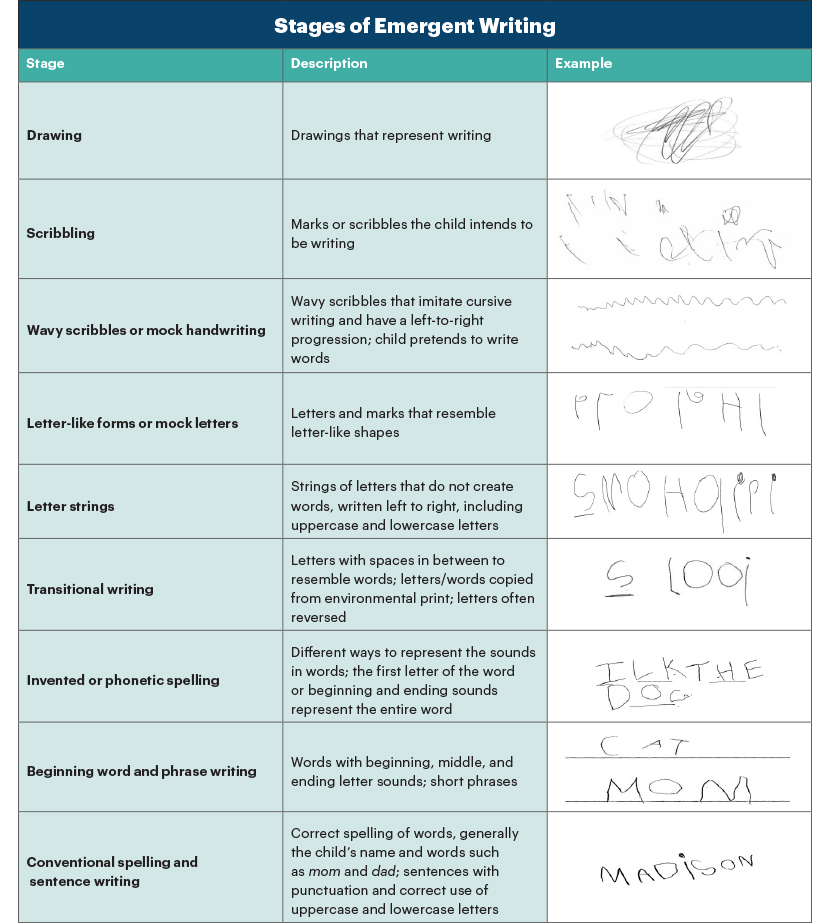
The stages in the image are best treated as descriptive patterns, not a test that every child must pass in exactly this order or at the same age. Different frameworks group the behaviours differently. The important principle is that early writing reveals changing understandings about the purpose, form, and sound structure of written language.
How Do I Write…? Scaffolding Preschoolers' Early Writing Skills
Read this Reading Rockets article for a practical developmental framework for interpreting young children’s writing. It shows how a writing sample can provide evidence about a child’s understanding of print and sound.
In the section “How early writing develops,” start with the rationale for observing writing. Then read the four subsections: “Drawing and Scribbling,” “Letters and Letter-Like Forms,” “Salient and Beginning Sounds,” and “Beginning and Ending Sounds.” As you read, trace the major shift from marks that represent an intended message to marks that represent speech sounds. In particular, read drawing and scribbling, then later the move into invented spelling. Notice that invented spelling is evidence of a developing alphabetic insight, not simply an error.
Interpreting common writing behaviours
Drawing accompanied by an explanation
Suppose a child draws a family at the beach and says, “This says we went swimming.” Even if there is no visible writing, the child may be using drawing as symbolic representation and connecting the image to a message. Ask whether they distinguish the drawing from writing when prompted: “Would you like to add some writing so someone else knows what happened?” Their response can reveal whether they are beginning to see writing as separate from illustration.
Scribbling in a line
A child makes a row of wavy marks beneath a picture and announces, “That says ‘no dogs.’” The left-to-right arrangement may reflect attention to features of environmental print. The child is demonstrating a communicative purpose and an emerging understanding that writing is visually distinct from drawing. It would be inaccurate to say that the child “does not know writing”; they are exploring what writing does and what it looks like.
Letter-like forms or familiar letters
A child labels a block construction with “M A 7 L” and says it is a “fire station.” The use of letters shows that the child recognises writing is made of discrete symbols, possibly drawing on familiar name letters. But unless the child can connect the letters with sounds in the intended words, do not infer that they are spelling phonetically.
Initial-sound spelling
A child draws a snake and writes S, explaining, “Snake starts with sss.” This is important evidence: the child has attended to a sound in spoken language and represented it with a letter. They are beginning to grasp the alphabetic principle: letters represent sounds in speech.
Beginning-and-ending-sound spelling
A child writes DG for dog or MP for map. These are not arbitrary omissions. The child may be hearing and representing consonant sounds while not yet reliably identifying the medial vowel. Their spelling shows a more developed sound-to-print connection than a child who uses unrelated letter strings.
A university response should avoid saying a child has “mastered” a stage from a single sample. Use cautious language:
- “This behaviour suggests…”
- “The sample provides evidence of…”
- “The child appears to be developing…”
- “Further observations across contexts would clarify whether…”
A worked explanation: from observation to interpretation
Consider this observation of four-year-old Amir during café play:
Amir picks up a notepad and tells a peer, “What do you want?” The peer says, “Pizza and juice.” Amir makes two horizontal rows of marks. He points to the first row and says, “Pizza,” then points to the second and says, “Juice.” When the educator says, “Pizza starts with /p/,” Amir finds a magnetic P, copies it at the beginning of the first row, and smiles. Later, Amir notices the word OPEN on the café sign and says, “That means we can come in.”
A weak explanation might be: “Amir is playing a café game and practising writing.”
A stronger emergent-literacy explanation identifies the evidence and connects it to concepts.
Message and purpose
Amir uses the notepad to record a peer’s order. This gives his mark-making a genuine communicative purpose: the marks stand for items requested by another person. His oral “reading” of each row as pizza and juice suggests that he understands writing can represent and preserve a message.
Print concepts
The two separate horizontal rows may indicate that Amir is beginning to notice visual features of writing. However, there is not enough evidence to claim that he understands word boundaries, letter sequences, or conventional spelling. His recognition that OPEN means customers may enter also demonstrates knowledge of environmental print and the function of a sign in its setting. It does not necessarily show that he can decode each letter in the word.
Alphabet knowledge and sound awareness
When Amir copies P after hearing the initial sound in pizza, he is participating in a sound-to-letter connection with educator support. One supported response does not prove independent mastery, but it gives evidence that P can become a productive teaching focus. The child is working at the edge of what he can do, consistent with sociocultural ideas about scaffolding.
Oral language and social participation
Amir asks a peer a role-appropriate question, listens to the reply, and uses language to coordinate café play. Literacy here is not an isolated worksheet skill. It is part of collaborative, imaginative participation. His knowledge of café practices may come from family and community experiences, which should be recognised as a resource rather than treated as incidental.
A concise university-style explanation
From an emergent-literacy perspective, Amir’s writing-like marks are meaningful rather than random because he uses them to record and reread a peer’s café order. This demonstrates an emerging understanding that written marks can represent language for a communicative purpose. His recognition of the OPEN sign shows awareness of environmental print, while copying P for the initial sound in pizza, with educator support, suggests emerging alphabet knowledge and a developing connection between speech sounds and letters. His literacy learning is also socially situated: he uses oral language, print materials, and peer interaction to participate in dramatic play.
Notice the structure: evidence first, interpretation second, theory integrated throughout.
A reliable method for explaining literacy behaviour
For an exam case study, observation note, or tutorial discussion, use this five-part method.
-
Describe the behaviour objectively.
State what the child said, did, selected, pointed to, drew, wrote, or reread. Do not begin with labels such as “struggling,” “lazy,” or “advanced.” -
Identify the literacy area involved.
Is the main evidence about oral language, concepts of print, alphabet knowledge, sound awareness, reading behaviour, early writing, or a combination? -
Explain what the behaviour may show.
Connect the observation to a developing understanding. For example, marks with an intended message may show an understanding that writing represents meaning; an initial letter chosen for a word may show an emerging letter–sound connection. -
Place it on a broad continuum, cautiously.
Use phrases such as “an early form of symbolic writing” or “an emerging alphabetic representation.” Do not assign a fixed level as though it were a diagnosis. -
Include context and uncertainty.
Ask what support was available, whether the child was acting independently, what language was used, and whether the behaviour appears across other settings. A single event is a useful sample, not a complete profile.
This approach prevents two common errors.
Error 1: treating non-conventional writing as meaningless
If a child writes KT for cat, the conventional spelling is incorrect, but the sample may show that the child hears and represents some sounds. Correctness matters eventually, but developmental interpretation asks what knowledge is already visible.
Error 2: over-interpreting one success
If a child identifies M in the word Mum, this might reflect letter knowledge, familiarity with a meaningful word, recognition of the word’s visual form, adult prompting, or several of these at once. More evidence is needed before concluding that the child consistently knows the letter name, its sound, or how to use it in unfamiliar words.
An emergent-literacy perspective is therefore both strengths-based and analytically careful. It values the child’s current attempts while still identifying what is and is not yet demonstrated.
Connecting oral storytelling to later writing
Early literacy is broader than visible print. A child who constructs a story orally is developing ideas that can later be represented through drawing and writing: characters, settings, events, sequence, and audience.
Building Literacy Skills By Sparking Imaginations
Watch Edutopia’s “Building Literacy Skills By Sparking Imaginations” to see how oral storytelling in play can be interpreted as a foundation for later writing rather than as separate from literacy.
Watch the introduction for the connection between playful oral storytelling and foundational writing. Then watch the educator prompts. Focus on how questions about setting, characters, and beginning, middle, and end help children organise ideas before they can represent those ideas in conventional written text.
For example, if a child arranges small-world figures and narrates, “The bird got lost, then the fox helped it get home,” they are not yet necessarily writing. But they are using oral language and symbolic play to create a coherent message. An educator can value that meaning-making, invite the child to draw a scene, take dictated words, or offer writing materials without requiring the child to produce conventional sentences.
This is one reason early-years literacy environments should include books, signs, name cards, writing tools, meaningful play materials, and sustained conversation. They allow children to enter literacy through multiple pathways.
Key takeaways
An emergent-literacy perspective explains a three-to-five-year-old’s literacy behaviour as part of a developing, interconnected continuum rather than as a simple present-or-absent ability.
- Literacy begins before conventional reading and spelling, and includes oral language, storytelling, book knowledge, print awareness, sound awareness, drawing, and early writing.
- Children’s marks should be interpreted in relation to their message and purpose, not only by how closely they resemble adult writing.
- Letter strings, initial letters, and invented spellings can show increasingly developed understandings about the relationship between speech and print.
- Literacy behaviour must be understood in context: adult support, peers, play purposes, home languages, cultural experiences, and access to print all matter.
- Strong explanations start with observable evidence, make cautious inferences, identify the relevant literacy knowledge, and acknowledge what further evidence would be needed.
Next, you will look more closely at the places where literacy learning occurs throughout K/PP settings: play, everyday routines, and transitions.
Can't find a good explanation? Sign up and we'll make it for you
Sign up