
Good to see you again. In the last lesson, you practised the read–underline–plan–solve–check routine so that difficult questions become manageable steps rather than rushed guesses. You also began using mistakes as evidence in an error log.
Now you will use that evidence to make a decision: what should you work on first over the next six weeks? The aim is not to “improve at English” in a vague way. It is to identify a small number of high-value skills, set clear targets, and check whether your methods are actually working.
A diagnostic is a map, not a judgement
A diagnostic test gives a snapshot of what you can do at this point. It is not a label such as “good at English” or “bad at English.”
For selective-school preparation, a diagnostic is most useful when it helps you answer three questions:
- Which question types currently cost me the most marks?
- Why do I lose those marks?
- Which improvements would help me most across future tests?
A low score can have different meanings. For example, getting several inference questions wrong might mean:
- you do not yet know how to combine clues;
- you understand the passage but choose an option that is too extreme;
- unfamiliar vocabulary blocks your understanding;
- you rush past words such as best, mainly, or not;
- you have a sound method but make careless selection errors.
These need different responses. “Do more reading questions” is not enough if you have not identified the actual problem.
The Education Endowment Foundation describes metacognition as monitoring, directing, and reviewing your own learning. That is exactly what you are doing here: you evaluate the diagnostic, plan a response, and later check whether the response helped.
[PDF] Metacognition and self-regulated learning
Read these short extracts from the Education Endowment Foundation guidance to see why planning, monitoring, and evaluating are part of learning—not extra tasks added after learning.
In the bullet-point discussion immediately before “Recommendation 2,” read the planning cycle. Notice that skilled learners adapt their methods rather than repeating what has not worked. Then find “Recommendation 6.” Read the independent-learning example. Focus on the combination of a short-term goal, a strategy, and a way to monitor progress.
Read your evidence at two levels
Your diagnostic results should be organised at two levels.
Level 1: Which skill was being tested?
Group questions by their skill, not merely by the test section. For instance, “English” is too broad to be useful. More precise categories might include:
| Broad area | More useful diagnostic categories |
|---|---|
| Reading | retrieving details, main idea, inference, vocabulary in context, author purpose |
| Grammar | word classes, sentence boundaries, agreement, pronouns, punctuation |
| Writing | planning, paragraph structure, vocabulary precision, spelling, proofreading |
| Verbal reasoning | analogies, classifications, word relationships, verbal logic |
| Numerical reasoning | fractions, ratios, multi-step problems, patterns, data interpretation |
For each category, record:
- number attempted;
- number correct;
- questions you guessed or found uncertain;
- the error type from your error log.
If you want an accuracy percentage, calculate it like this:
However, do not let one percentage make every decision. If a diagnostic contained only two questions on a skill, getting one wrong gives a low-looking result but not much evidence. A category with many questions and repeated similar mistakes is stronger evidence.
Level 2: What caused the errors?
Use the error categories from the earlier lesson:
- Knowledge: You did not know a rule, word meaning, method, or fact.
- Reasoning: You knew relevant information but could not connect it logically.
- Reading: You misunderstood what the question, passage, or condition said.
- Accuracy: Your method was sound, but you made a slip, copied incorrectly, or selected the wrong option.
- Time management: You had the knowledge and method but spent too long or rushed.
This distinction matters. Suppose you miss five reading-inference questions:
- If four errors come from choosing claims with only one weak clue, the priority is inference reasoning.
- If the passage contains words you do not understand, the priority may be vocabulary in context.
- If you ignored the word not twice, the priority is partly careful reading and checking.
A result tells you where the problem appeared. The error log helps tell you why.
Important: Because your first diagnostic was untimed, do not decide that time management is your main weakness solely from that test. You can note slow questions, but timed evidence will be needed later.
Turn patterns into priorities
You may find many skills to improve. That is normal. But six weeks is not long enough to attack every weakness with equal attention.
Choose two main priorities and, at most, one maintenance skill.
A main priority should have three features:
- Clear evidence of need: several incorrect, guessed, or uncertain questions.
- High value: improving it would help in several parts of the test.
- A specific next step: you can name what to practise and how to check progress.
Use this quick decision grid. Give each possible skill a rating of low, medium, or high.
| Question to ask | Why it matters |
|---|---|
| Did this skill cause repeated errors? | Repeated evidence is more reliable than one unusual question. |
| Does it appear often or support other skills? | Reading inference and vocabulary, for example, can support several English tasks. |
| Can I describe the weakness precisely? | “I am weak at English” cannot guide practice; “I choose inference answers with too little evidence” can. |
| Do I know a sensible way to practise it? | A priority needs an action, not just a worry. |
| Is it relevant to my longer-term selective-school goal? | Priorities should support Reading, Writing, Thinking Skills, or Mathematical Reasoning. |
A worked example
Imagine this diagnostic summary:
| Skill | Result pattern | Error-log evidence |
|---|---|---|
| Explicit reading retrieval | Mostly correct | Occasionally reread too much |
| Reading inference | Several wrong or guessed | Used one detail, but ignored a conflicting clue |
| Vocabulary in context | Many uncertain | Guessed from a familiar-looking word |
| Grammar: sentence boundaries | Several wrong | Did not recognise comma splices |
| Fractions | Mostly correct | One arithmetic slip |
| Multi-step numerical problems | Mixed | Began calculating before identifying the final quantity |
A sensible six-week decision might be:
- Priority 1: Reading inference — this is a high-value English skill and the error pattern is clear.
- Priority 2: Vocabulary in context — unknown words can make inference, main-idea, and author-purpose questions harder.
- Maintenance skill: Multi-step numerical problems — this needs regular practice, but the issue may partly be fixed by using read–underline–plan–solve–check carefully.
Notice what is not chosen:
- Fractions are not a main priority because one arithmetic error does not prove a large knowledge gap.
- “Grammar” is not chosen as a single category because it is still too broad. If sentence boundaries are genuinely weak, they could become a later precise goal: fragments, run-on sentences, and comma splices.
Your priorities may look different. Use your own diagnostic rather than copying this example.
Build goals that can be measured
A useful goal tells you exactly what success will look like. Compare these:
| Vague goal | Measurable goal |
|---|---|
| “Get better at comprehension.” | “By the end of Week 6, score at least eight correct from ten unfamiliar inference questions on two separate practice sets, and support each answer with two relevant clues.” |
| “Learn more vocabulary.” | “By the end of Week 6, correctly infer the meaning of at least eight unfamiliar words from ten short contexts and explain the clue used.” |
| “Improve grammar.” | “By the end of Week 6, correctly identify and repair at least eight sentence-boundary errors from ten mixed examples.” |
| “Be better at maths.” | “By the end of Week 6, solve at least eight multi-step word problems from ten, showing a written plan and a final check.” |
The second column gives a clear target, a way to measure it, and a deadline.
The SMART framework is a useful test for goal quality. Different versions use slightly different wording for the letter A, but the important idea is that a goal should be both realistic and linked to practical action.
Watch “SMART Goals - Quick Overview” from DecisionSkills for a compact explanation of how specificity, measurement, action, relevance, and a deadline make a goal usable.
Watch the SMART overview. Pay closest attention to the parts on measurement, practical sub-goals, and reviewing a goal when the evidence shows that your strategy needs changing.
Use SMART as a checklist:
- Specific: Which exact skill or question type?
- Measurable: What result, product, or accuracy level will show improvement?
- Achievable: Is the target a stretch without being unrealistic for six weeks?
- Relevant: Does it address your diagnostic evidence and selective-school preparation?
- Time-bound: When will you test the goal?
A strong goal also includes a baseline: where you started. If you got two inference questions correct from five in the diagnostic, a goal should acknowledge that starting point rather than pretending you began from zero.
Separate the outcome goal from the practice plan
A common mistake is to write only a process goal:
“I will do reading practice every day.”
That may be a useful habit, but it does not prove that your reading has improved. Another common mistake is to write only an outcome goal:
“I will get nine out of ten.”
That gives you a destination but no route.
Use both.
| Part | Example for reading inference |
|---|---|
| Baseline | I answered two out of five inference questions correctly in my diagnostic and often used only one clue. |
| Outcome goal | By the end of Week 6, I will answer at least eight unfamiliar inference questions correctly from ten on two practice sets and justify each answer with evidence. |
| Process goal | Each week, I will complete two short inference sets, underline relevant clues, write a one-sentence reason for each answer, and log mistakes. |
| Checkpoint | At the end of Weeks 2 and 4, I will complete a fresh short set and compare my accuracy and error types with my baseline. |
| Adjustment rule | If I still choose answers based on one clue, I will slow down and require two clues before selecting an inference answer. |
The process goal will later fit into your weekly timetable. For now, focus on deciding what needs to happen and how you will know whether it worked.
Use checkpoints to monitor, not merely wait
A six-week goal should not be ignored until the final day. You need checkpoints, because they tell you whether to continue, adjust, or intensify a strategy.
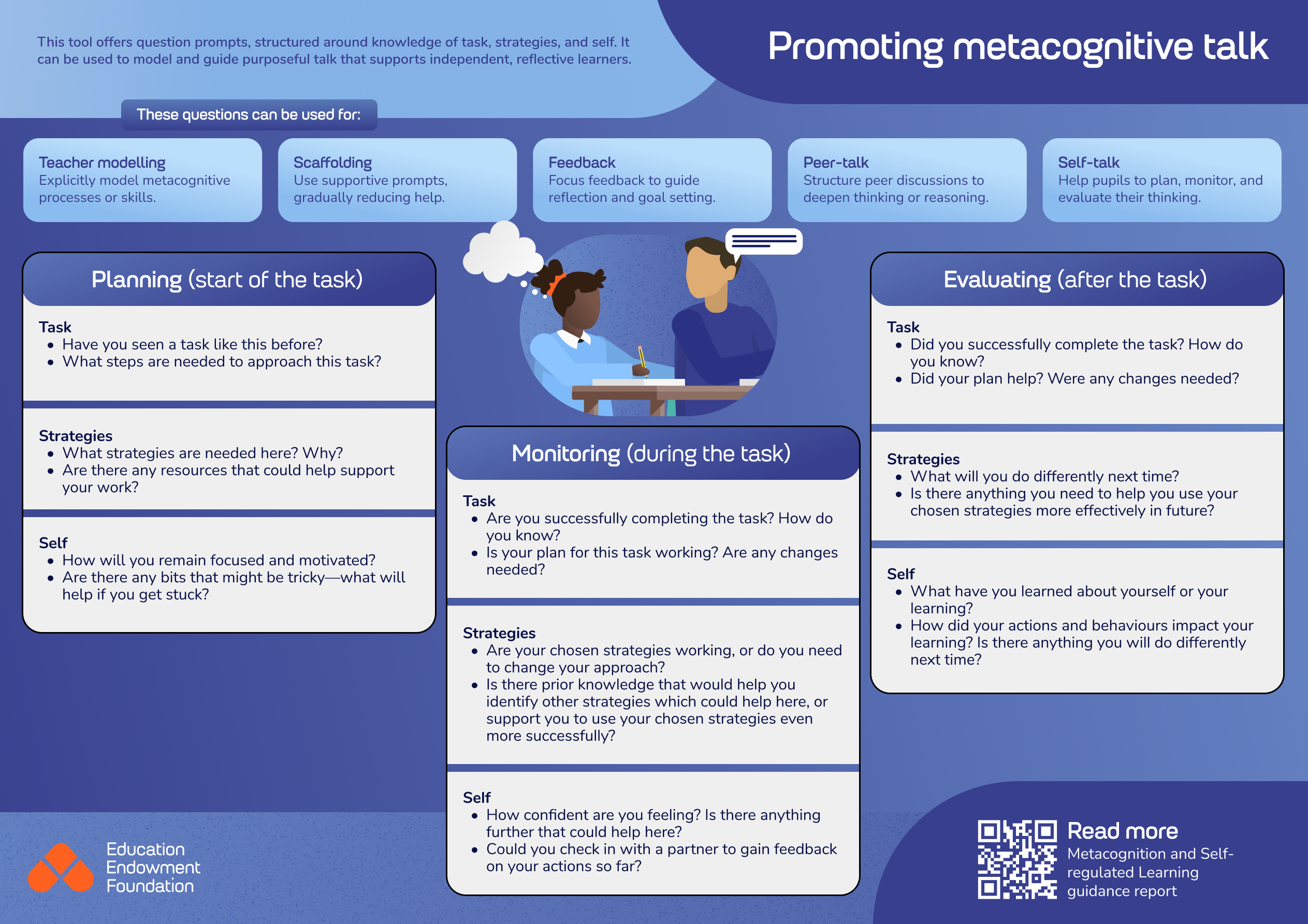
At each checkpoint, ask three kinds of questions:
| Stage | Questions for your six-week plan |
|---|---|
| Plan | Which exact skill am I improving? Which strategy will I use? What material or support do I need? |
| Monitor | Am I improving on new questions, not just familiar ones? Which error type is still most common? Is my strategy being used properly? |
| Evaluate | Did I meet the target? Which practice method helped most? What should I keep, change, or reduce next cycle? |
Do not change your goal just because one practice set goes badly. Look for a pattern across several attempts. Equally, do not keep repeating a method that is clearly failing. If your accuracy is flat but your error log shows the same cause each time, change the method.
For example:
- If vocabulary errors remain high, practise finding context clues rather than simply rereading definitions.
- If grammar mistakes are careless, add a short final check for the exact grammar feature being tested.
- If inference answers are too broad, reject options that go beyond the evidence in the passage.
Your six-week priority plan
Complete this plan using your actual diagnostic and error log. Keep it on one page so that you can revisit it easily.
| Item | Your notes |
|---|---|
| Diagnostic strengths to maintain | |
| Priority skill 1 | |
| Evidence for priority 1 | Number wrong, guessed, or uncertain; main error type; an example question |
| Priority skill 2 | |
| Evidence for priority 2 | Number wrong, guessed, or uncertain; main error type; an example question |
| Maintenance skill | |
| Week 6 outcome goal for priority 1 | |
| Weekly process goal for priority 1 | |
| Week 6 outcome goal for priority 2 | |
| Weekly process goal for priority 2 | |
| Week 2 checkpoint | |
| Week 4 checkpoint | |
| Week 6 review |
Keep the number of main priorities small. Deep improvement in two precise skills is more valuable than shallow, unfocused work on ten skills.
Key takeaways
Your diagnostic becomes useful only when you turn results into decisions.
- Analyse results by specific skill and by error cause.
- Look for repeated patterns, not isolated wrong answers.
- Choose two high-value priority skills and one maintenance skill.
- Write goals with a baseline, a measurable success target, a practice method, and a Week 6 deadline.
- Check progress in Weeks 2 and 4, then adjust the strategy if the evidence requires it.
Next, you will turn these priorities and goals into a sustainable weekly timetable that includes focused learning, practice, reading, review, and a lighter study day.
Can't find a good explanation? Sign up and we'll make it for you
Sign up