
Welcome back. In the previous lesson, you learned to treat mistakes as evidence: identify the main error type, rebuild the correct answer, and record a specific next-time action in an error log.
This lesson gives you a routine to use before an error happens. When a selective-school-style question looks unfamiliar, do not rely on a sudden guess or rush straight to the choices. Use this five-part process:
Read, Underline, Plan, Solve, Check.
It works across reading, grammar, verbal reasoning, and mathematical reasoning. The subject changes, but the habits of careful interpretation, deliberate planning, and evidence-based checking stay the same.
Why a routine helps
Hard questions can create a misleading feeling: I need to think faster. Usually, the better response is to make the first few seconds more organised.
A test question has two jobs:
- It gives you information: a passage, rules, numbers, words, or answer choices.
- It tells you what to do with that information.
Many mistakes happen because a student focuses on the first job but misses the second. For example, they understand a passage but answer the wrong question, calculate correctly but find the wrong quantity, or choose a statement that is true rather than the statement that is most strongly supported.
The routine slows down only the parts that need care. It should eventually make you faster, because you will spend less time restarting, rereading randomly, and changing answers without a reason.
The BEST Test-Taking Strategies - Teaching with a Mountain View
Read this practical guide from Teaching with a Mountain View to see how its multiple-choice and annotation strategies support the routine you are learning.
In “General Test-Taking Strategies and Tips,” read item 2 for the SLAM and CUBES routines, then go to “Multiple-Choice Questions.” Find the “Skim the Question First” bullet and read the first step, followed by the rest of the multiple-choice advice and “Eliminating Wrong Answers.” Then, in “Reading Tips,” read item 1, “Spend Time Annotating and Finding Evidence in the Text.” Focus on active annotation: marks should help you locate proof, rather than colour every sentence.
The five stages
Think of this as a short conversation with the question. You first establish what it asks, identify the important information, choose a method, carry out that method, and then test whether your answer genuinely fits.
| Stage | Main question to ask yourself | What you actually do |
|---|---|---|
| Read | “What exactly must I find, choose, explain, or write?” | Read the question once for meaning and again for traps or limits. |
| Underline | “Which words control the task?” | Mark task words, restrictions, important details, values, and units. |
| Plan | “What is the simplest sensible method?” | Name the question type and make a brief method before committing to an answer. |
| Solve | “Can I prove this answer?” | Find evidence, apply a rule, calculate, or eliminate choices for clear reasons. |
| Check | “Did I answer this question, and does my answer hold up?” | Recheck the task, evidence, logic, calculation, units, and selected option. |
1. Read: find the task before trying to answer
Read the question carefully before becoming absorbed in the answer choices. Then read it a second time, looking especially for a word that changes the task.
Common control words include:
- not, except, least, most, best, mainly
- according to the passage, implies, suggests, proves
- each, altogether, difference, remaining
- must be true, could be true, cannot be true
A useful habit is to rephrase the question in a short sentence. For example:
- “Which choice is not supported?” becomes: Three choices have evidence; I need the one without evidence.
- “What is the value of each ticket?” becomes: I need one ticket’s cost, not the total.
- “Which statement is best supported?” becomes: I need the option with the strongest proof from the text.
Rephrasing prevents a common reading error: choosing an answer to the question you thought you saw instead of the one on the page.
2. Underline: mark the words that control your answer
Underlining is not decoration. It is a way of holding the question steady while you think.
For a reading question, underline:
- the question focus, such as main reason or best supported;
- any named character, event, or paragraph;
- words that tell you where to find evidence, such as according to paragraph 3.
For a mathematical question, underline:
- what quantity you must find;
- numbers and units;
- comparison words, such as more than, twice, remaining, or shared equally;
- conditions such as identical, at least, or exactly.
For verbal reasoning, underline:
- the relationship you must identify;
- any condition, category, or exception;
- whether you are looking for a word that is similar, opposite, included in a group, or related by function.
On a computer-based practice test, use the available highlighting tools if they are quick and reliable. If the software does not make that easy, write only a few short notes on scrap paper. Do not try to copy the whole question. Your marks should reduce confusion, not create more work.
3. Plan: decide what kind of question this is
Planning is the bridge between understanding a question and answering it. It can be very short, but it must be specific.
A weak plan is:
“Think carefully.”
A useful plan is:
“Find two details that support the claim, then compare every option to both.”
Or:
“Subtract the pen’s cost from the total, then divide the remainder by three.”
Or:
“Name the relationship in the first word pair before looking for the matching pair.”
Here are common plans for the sections you will encounter:
| Question type | A suitable plan |
|---|---|
| Reading detail | Locate the relevant sentence; choose the option that restates it accurately. |
| Reading inference | Gather two or more clues; choose only what those clues reasonably support. |
| Vocabulary in context | Reread the sentence and surrounding sentences; replace the word with each possible meaning. |
| Grammar | Identify the relevant word class or sentence part; apply one rule. |
| Verbal analogy | Say the relationship in a precise phrase; test each option against that phrase. |
| Numerical word problem | State the unknown; list the operations in order; label each result. |
| Logic question | List the rules or conditions; eliminate choices that break one of them. |
The plan is not the whole solution. It is a brief decision about how you will reach the solution.
4. Solve: use evidence, working, or rules
Now carry out your plan. The key word is prove.
In reading, proof is a phrase or detail from the passage. In grammar, it is the rule that applies to the sentence. In mathematics, it is clear working. In verbal reasoning, it is the precise relationship that fits one option better than the others.
Multiple-choice options are often distractors: answers designed to look appealing without fully meeting the task. A distractor may:
- repeat a word from the passage but change its meaning;
- state a detail that is true but irrelevant;
- reverse a cause and its result;
- answer a different question;
- make an extreme claim using words such as always, never, or only;
- contain a small but important error.
Eliminate an option only when you can state why. “It feels wrong” is not enough. “The passage says the event happened later, but this option says it caused the change” is a reason.
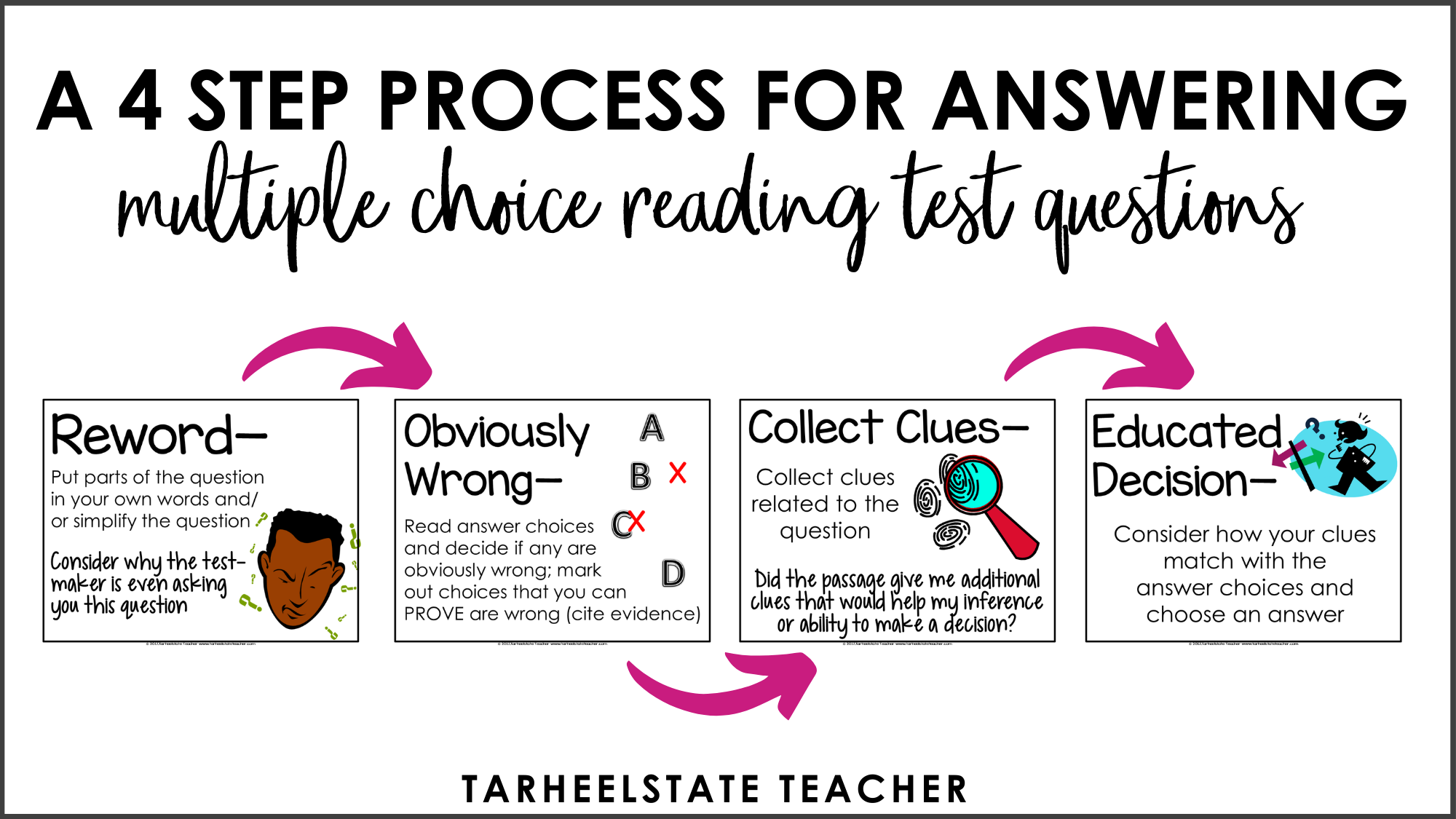
5. Check: search for a real fault, not a reason to panic
Checking does not mean endlessly changing an answer. It means looking for a specific possible flaw.
Use a quick check suited to the question:
- Reading: Does my option answer the exact question? Can I point to evidence? Did I confuse a cause with an effect?
- Grammar: Did I correct the error asked about, rather than changing a different part of the sentence?
- Verbal reasoning: Does my stated relationship fit both pairs equally well?
- Mathematics: Are the operations in the right order? Is the unit correct? Is the answer sensible? Can I substitute it back into the question?
- Multiple choice: Have I selected the intended option on screen or paper?
For now, you will practise a full check on every question. Later, when you work under timed conditions, the check will become quicker and more selective.
5 Rules (and One Secret Weapon) for Acing Multiple Choice Tests
Watch this short section of Thomas Frank’s “5 Rules (and One Secret Weapon) for Acing Multiple Choice Tests” for two useful habits: noticing deceptive wording and checking in manageable batches.
Watch reading traps to see why words such as “not” and “most correct” deserve a second look. Then watch page checks. In online tests, adapt this idea by checking a small group of completed questions, or by checking an answer immediately before you submit it, rather than leaving every check until the final seconds.
A worked reading example
Read this short passage:
At the beginning of the year, litter around the school oval increased during lunch breaks. The principal did not ban bottled drinks. Instead, the school installed a water-refill station and asked students to design posters encouraging reusable bottles. By the end of the term, the monthly litter count had fallen by nearly half, while cafeteria sales remained about the same.
Question: Which claim is best supported by the passage?
- A. The school banned students from buying bottled drinks.
- B. The campaign reduced litter without clearly reducing cafeteria sales.
- C. The water-refill station caused cafeteria sales to increase.
- D. Students designed posters because the principal required a ban on bottled drinks.
Here is the five-stage routine in action.
Read
The important words are which claim and best supported. This is not asking for a detail to copy. It asks for a conclusion that is strongly supported by the whole passage.
Rephrase it:
Which option is supported by the strongest evidence in the passage?
Underline
Mark these ideas in the passage:
- did not ban bottled drinks;
- water-refill station and posters;
- litter count fallen by nearly half;
- cafeteria sales remained about the same.
Plan
This is an inference question. The plan is:
Find the option supported by at least two passage details, then reject choices that add information the passage does not give.
Solve
- A is wrong because the passage directly says the principal did not ban bottled drinks.
- B matches two details: litter fell, and cafeteria sales stayed about the same.
- C is too strong. The passage says sales remained about the same, not that they increased. It also does not prove that the refill station alone caused this result.
- D adds an invented reason. There was no ban.
So B is best supported.
Check
Return to the words best supported. Option B does not overclaim. It says the campaign reduced litter and did not clearly reduce sales, which is exactly what the passage provides evidence for.
Notice why this routine works. You did not choose B merely because it sounded sensible. You gathered the relevant clues, compared each choice with those clues, and selected the answer that made the fewest unsupported assumptions.
A worked numerical example
The same routine works even when the question is mathematical.
Three identical notebooks and one pen cost $17 altogether. The pen costs $2. How much does each notebook cost?
- A. $3
- B. $5
- C. $6
- D. $15
Read and underline
Underline three identical notebooks, pen costs $2, $17 altogether, and each notebook.
The word each matters. The question does not ask for the combined notebook cost.
Plan
Remove the pen’s cost from the total, then divide the notebook total by three.
Solve
The notebooks together cost $15. Since there are three identical notebooks, each costs $5.
So the answer is B.
Check
Substitute the answer back into the original situation:
The total matches, so the answer is sensible.
This last check catches many accuracy errors. A learner can use the correct method but select $15 because it is the cost of all three notebooks, not the cost of each notebook. Reading and underlining protect you from that mistake before calculation begins.
Make the routine automatic
At first, say the stages quietly in your head:
Read: What am I being asked?
Underline: What controls the task?
Plan: What method fits?
Solve: What proves my answer?
Check: Does it answer the exact question?
After enough practice, you will not need to recite every word. But do not skip the thinking. Strong test-takers often seem fast because the routine has become automatic, not because they are guessing faster.
Use the routine especially when you notice any of these warning signs:
- You are about to choose an answer because it contains familiar words.
- You have begun calculating before identifying what must be found.
- You are stuck between two close answers.
- You feel tempted to reread the whole passage without knowing what you are looking for.
- You have finished a question but cannot explain why your answer is correct.
When that happens, return to the last stage you skipped. If you cannot choose between two options, you probably need a clearer plan or stronger evidence during solve. If your answer looks strange, check your interpretation and working.
A short untimed application session
Use current official practice material for this first application. Keep it untimed: the aim is to perform the routine accurately and visibly, not to race.
Selective high school practice tests
Use the NSW Department of Education practice-test page to select a small set of unfamiliar Reading, Mathematical Reasoning, or Thinking Skills questions. These materials are particularly useful because they show the kinds of sections and response formats currently used in official preparation.
In the “Practice tests” section, begin with the practice-test overview. Then choose either an online computer-based practice test or one of the sample practice-test question sets. For this lesson, select only two or three questions from one section. Do not open the answer explanations until after you have used the full routine.
For each selected question, make a small record like this on paper:
| Stage | Your brief note |
|---|---|
| Read | Restate the task in your own words. |
| Underline | List the two to four most important words, values, or details. |
| Plan | Write one sentence naming your method. |
| Solve | Show evidence, reasoning, or working. |
| Check | State one check you performed. |
Then look at the answer or explanation. If your answer was wrong, guessed, or uncertain, make an entry in the error log from the previous lesson. The error log should identify which stage of the routine broke down. For example:
- “I did not underline except, so this was mainly a reading error.”
- “I understood the task but had no method for comparing the options, so this was a reasoning error.”
- “My plan was correct, but I selected the wrong option on screen, so this was an accuracy error.”
Key takeaways
The read–underline–plan–solve–check routine gives you a dependable response to unfamiliar questions:
- Read the task twice, especially for control words such as not, best, each, and most.
- Underline only the information that changes what you must do.
- Plan a specific method before rushing into an answer.
- Solve with evidence, rules, logical relationships, or clear working.
- Check for a specific flaw: task, evidence, logic, calculation, unit, or selected option.
The routine is not a replacement for English, maths, or reasoning knowledge. It helps you use the knowledge you have more accurately and shows you exactly what to improve when you do not yet have the needed skill.
Next, you will use your diagnostic results and error-log evidence to choose priority skills and set measurable goals for the next six weeks.
Can't find a good explanation? Sign up and we'll make it for you
Sign up