
Hello again. In the last lesson, you used diagnostic evidence and your error log to select two precise priority skills, one maintenance skill, and measurable six-week goals. Now you will turn those decisions into something usable: a weekly timetable.
Because selective-school entry is still a few years away, the goal is not to study for the maximum possible number of hours. The goal is to build a routine you can repeat, adjust, and maintain for months. A strong timetable makes English improvement steady: you learn a skill, practise it, read independently, revisit it later, and still have one genuinely lighter day.
What makes a timetable sustainable?
A timetable is not a list of everything you wish you could do. It is a realistic agreement with yourself about what you will usually do during an ordinary school week.
For the next six weeks, your timetable needs five ingredients:
| Ingredient | Purpose | Example |
|---|---|---|
| Learning | Understand a new method, rule, or strategy. | Learn how to use context clues for unfamiliar vocabulary. |
| Practice | Apply the new method to questions or writing. | Complete eight vocabulary-in-context questions and explain each clue. |
| Independent reading | Build comprehension, vocabulary, fluency, and knowledge over time. | Read a novel or quality nonfiction for 20–30 minutes. |
| Spaced review | Revisit earlier material before it fades. | Re-test yourself on vocabulary or grammar learned earlier in the week. |
| A lighter day | Protect energy, allow catch-up, and prevent a missed session becoming a failed week. | Read, complete a short review, or organise your error log. |
The timetable should also include normal school homework, sport, family commitments, meals, relaxation, and sleep. Those are not “wasted” hours that need to be removed to make room for study. They are part of the conditions that make steady study possible.
A useful principle is:
Plan for the week you usually have, not the perfect week you imagine.
If a plan only works when you feel extremely motivated, have no homework, and never have an activity after school, it is too fragile.
Why short, repeated sessions beat cramming
The Learning Center at the University of North Carolina explains distributed practice: spreading study over shorter sessions across days and weeks. This matters especially for English. Vocabulary, grammar rules, reading strategies, and writing skills become reliable through repeated use, not by one huge session on a Saturday.
Studying 101: Study Smarter Not Harder - The Learning Center
Read the “Spacing out is good” section from The Learning Center at the University of North Carolina. It explains why several short, focused sessions are more useful than a single marathon session.
In the section “Spacing out is good,” begin at the explanation of distributed practice. Then continue through the examples of daily short study and flashcard review, ending at periodic review. Focus on the distinction between active work spread over time and simply spending a long time looking at material.
For you, this does not mean trying to study every test skill every day. That would create an overcrowded plan. Instead, it means returning to important skills several times during the week.
For example, if Monday’s learning session is about inference:
- On Monday, learn the method and complete a few carefully checked questions.
- On Wednesday, do a short new inference set and use the same method.
- On Saturday or Sunday, review mistakes and complete a quick mixed check.
Each later session should make you retrieve and apply the idea rather than merely reread notes.
Spaced review: schedule the return visit
When you first learn something, it can feel familiar straight away. Familiarity is not the same as being able to use it independently in a question. Spaced review creates a small gap, then asks your brain to retrieve the skill again.
The NSW Department of Education describes this as spaced repetition. Its key point is that repetition should happen at gradual intervals over days, rather than as one burst of repetition.
Read the NSW Department of Education’s explanation of active recall, spaced repetition, and focused study sprints. Use it to decide how long your study blocks should be and where reviews belong in your week.
Under “Tips To Follow,” first read from active recall. Then read the full “Spaced repetition” subsection, beginning at why reviews need intervals. Finally, in “Fight procrastination through intense focus,” read from the study sprint routine. For your timetable, note that an active review means answering, recalling, correcting, or explaining—not highlighting notes.
For a Year 6 weekly plan, keep the spacing simple. You do not need complicated calculations or a separate calendar for every fact you learn.
Use this pattern:
| When you learn an item | First review | Second review | Weekly review |
|---|---|---|---|
| Monday | Wednesday | Saturday | Sunday or next Monday |
| Tuesday | Thursday | Sunday | Next Tuesday |
| Thursday | Saturday | Next Wednesday | Following weekend |
A review can be brief. For example:
- 10 minutes recalling five new vocabulary words from memory, then checking them;
- 10 minutes correcting grammar questions you got wrong two days earlier;
- 15 minutes redoing two difficult numerical-reasoning questions without looking at the old solution;
- 10 minutes recalling the steps of a reading strategy, then applying it to one new question.
The important question is not “Did I look at it again?” It is “Could I retrieve and use it before checking?”
The Learning Schedules image shows three ways review sessions can be placed after initial learning.
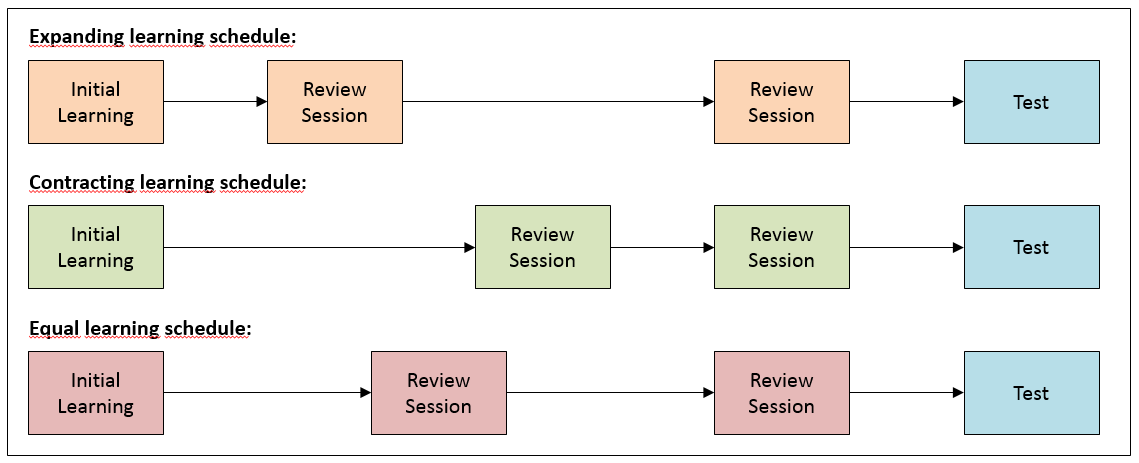
An expanding schedule is often practical when you are becoming confident: review after a short gap, then after a longer one. But do not follow any spacing pattern blindly. If a review reveals that you cannot remember a grammar rule or word meaning, bring the next review closer and practise it again.
Give each study block one job
A common timetable error is writing vague labels such as “English: 1 hour.” When the time arrives, you still have to decide what to do, and that decision can become procrastination.
Instead, each block should have a clear job:
| Weak timetable label | Stronger timetable label |
|---|---|
| English | Learn inference: identify two clues before choosing an answer. |
| Vocabulary | Learn 8 words from reading; write a synonym and an original sentence for each. |
| Maths | Practise 8 multi-step word problems using read–underline–plan–solve–check. |
| Revision | Re-test Monday’s vocabulary without notes; correct errors. |
| Reading | Read 25 minutes; record one unfamiliar word and one inference. |
Notice that strong labels include a skill, an action, and often a small amount of work. This makes starting easier and lets you decide later whether the task was completed.
A focused block can be:
- 25 minutes work, 5 minutes break, particularly on busy school days; or
- 40–50 minutes work, 10 minutes break for a longer weekend task.
During the work period, put the phone away and use only the materials needed for that one task. Avoid switching among reading, messages, video clips, and questions. Focus is part of the timetable, not an optional extra.
Allocate time according to evidence, not emotions
Your diagnostic showed where your marks are currently being lost. Those weaknesses deserve more time than skills that are already reliable.
For example, suppose your two priority skills are:
- reading inference; and
- vocabulary in context;
and your maintenance skill is multi-step numerical reasoning.
A sensible weekly balance could be:
| Area | Sessions per week | Typical session length |
|---|---|---|
| Priority English skill 1 | 2 learning or practice sessions | 25–40 minutes |
| Priority English skill 2 | 2 learning or practice sessions | 20–30 minutes |
| English review / error-log correction | 2 short sessions | 10–20 minutes |
| Independent reading | 5–7 sessions | 20–30 minutes |
| Numerical maintenance | 2 sessions | 25–40 minutes |
| Weekly planning and check | 1 short session | 10–15 minutes |
This does not mean maths is unimportant. It means the timetable responds to your current evidence while preserving regular numerical reasoning practice. As future diagnostics change, the balance can change too.
The timetable video below gives a practical reminder: break work into manageable blocks, give weaker subjects extra attention, and protect one day from becoming another heavy study day.
How to Make The Perfect Study Timetable { study tips + productivity guide }
Watch “How to Make The Perfect Study Timetable” by prettytopia for a concise planning checklist. The useful parts are about realistic time blocks, prioritising weaker areas, varying the week, and keeping a lighter day.
Watch priority time for the principle of assigning more time to weaker areas. Continue with study blocks to see how manageable sessions and subject distribution can work. Then watch balance and flexibility, focusing on the value of a free or lighter day, rest, and adjusting rather than abandoning a plan after one missed block.
Build your weekly timetable in five steps
1. Start with fixed commitments
Before adding study, mark the parts of the week that cannot move:
- school hours and travel;
- sport, music, clubs, tutoring, or family responsibilities;
- dinner and preparation for school;
- a sensible bedtime;
- at least some unplanned relaxation time.
Only then identify realistic study windows. An after-school session might be 4:30–5:15 pm. A weekend session might be 10:00–10:45 am. The exact time matters less than knowing when it will usually happen.
2. Place your priority learning and practice first
Give each priority skill at least two appearances in the week. Usually, one should be a learning session and another should be a practice session.
For instance:
- Tuesday: learn the strategy for inference questions.
- Thursday: practise the strategy on unfamiliar questions.
- Saturday: mixed inference questions under a gentle time limit.
The practice should follow the learning closely enough that you can use the method, but not so closely that you simply remember the earlier answers.
3. Add independent reading as a regular habit
Independent reading is different from test practice. Test practice teaches exam methods; reading builds the language knowledge those methods need.
Aim for 20–30 minutes of reading on most days. Choose a book that is enjoyable but has some challenge. A strong routine is:
- read without stopping to look up every unfamiliar word;
- notice one or two words that seem important;
- after reading, briefly explain what happened, what you learned, or what you think a character may do next.
Do not turn every reading session into a worksheet. Reading should remain enjoyable enough to continue long-term.
4. Insert spaced reviews before filling extra time
Do not wait until “revision week.” Write reviews directly into the calendar.
A review session should name what it revisits:
- “Review Tuesday’s inference errors”
- “Recall vocabulary from Monday and Wednesday”
- “Redo fraction questions from last week”
- “Check grammar rule: subject–verb agreement”
For the six-week cycle, include a brief Sunday planning and review block. Look at your error log, choose the next week’s specific tasks, and move any unfinished work. That is an adjustment, not a failure.
5. Protect one lighter day
A lighter day is not necessarily a day with no learning at all. It is a deliberately low-pressure day that prevents the schedule from becoming exhausting.
A lighter day might include only:
- 20 minutes of independent reading;
- 10 minutes of vocabulary review;
- 10 minutes updating your error log or preparing materials;
- optional catch-up for one missed task.
Avoid putting a major timed test, a difficult writing task, and several new topics on your lighter day. If you end up needing it for catch-up every week, that is evidence that the main schedule contains too much.
A model timetable for the next six weeks
Here is a realistic example. It assumes the current English priorities are inference and vocabulary in context, with numerical multi-step problems as the maintenance skill. Replace those labels with the priorities you identified in the previous lesson.
| Day | Main focused session | Spaced review | Independent reading |
|---|---|---|---|
| Monday | Learn vocabulary in context: definition, contrast, example, and cause clues. 30 min | Review last week’s vocabulary for 10 min. | 25 min |
| Tuesday | Learn reading inference: use at least two clues before selecting an answer. 35 min | Recall Monday’s 8 words for 10 min. | 20 min |
| Wednesday | Numerical maintenance: 6–8 multi-step problems using the full routine. 35 min | Review Tuesday’s inference method with 2 new questions. 15 min | 25 min |
| Thursday | Vocabulary practice: unfamiliar-word questions plus original sentences. 30 min | Re-test Monday’s words; correct any errors. 10 min | 20 min |
| Friday | Inference practice: short unfamiliar passage and evidence-based answers. 35 min | Error log: correct one English and one numerical error. 15 min | 20 min |
| Saturday | Mixed practice: inference, vocabulary, and numerical reasoning. 45–60 min with a break | Review Thursday’s vocabulary for 10 min. | 30 min |
| Sunday — lighter day | Plan the coming week; organise materials. 10–15 min | Quick retrieval review of this week’s hardest skill. 10 min | 30 min or relaxed reading |
This is only a model, not a rule. If you have sport on Saturdays, move the longer mixed session to another available time. If Tuesday evenings are busy, use a shorter 25-minute session and reserve more complex work for the weekend.
What must stay is the pattern:
- priority skills appear more than once;
- new learning is followed by practice;
- earlier learning returns in short reviews;
- reading happens regularly;
- one day remains light enough to recover and reorganise.
Make the plan flexible without making it optional
A timetable should guide decisions when life becomes busy. It should not collapse after one missed session.
Use these adjustment rules:
| If this happens… | Do this… |
|---|---|
| You miss one session. | Move it to the lighter day or replace it with the next scheduled session; do not try to double every task. |
| You miss several sessions. | Keep the next planned priority session, reduce optional extras, and revise the following week’s workload. |
| Homework suddenly becomes heavy. | Keep independent reading shorter, keep one quick spaced review, and postpone a longer practice set. |
| A skill becomes easier. | Reduce its learning time and keep it as a maintenance review; give more time to the next clear weakness. |
| The same error repeats. | Change the task: revisit the method, use worked examples, and practise fewer questions more carefully. |
| You finish early. | Read, review error-log items, or prepare the next session; do not automatically add a large new task. |
At the end of each week, ask:
- Which planned sessions did I actually complete?
- Which tasks took longer than expected?
- Did my reviews involve retrieval, or did I only reread?
- Which error type appeared most often?
- What one change will make next week more realistic?
This weekly check should take about 10 minutes. Small adjustments each week are much better than waiting until you feel overwhelmed.
Construct your own timetable
Now create a timetable for the coming week. Start with the model but make it fit your real commitments.
Use these minimum requirements:
- two sessions for priority skill 1;
- two sessions for priority skill 2;
- two short spaced-review sessions;
- two sessions for your maintenance skill;
- independent reading on at least five days;
- one lighter day;
- one short Sunday planning check.
Keep most weekday blocks between 25 and 45 minutes. If you want to study more, add time gradually after two weeks of successfully following the plan. Consistency is the first target; extra volume comes later.
Key takeaways
A sustainable timetable is a practical system, not a promise to work endlessly.
- Use short, focused sessions across the week instead of cramming.
- Give every session a specific job: learn, practise, review, read, or check errors.
- Spend extra time on diagnostic priorities while maintaining stronger skills.
- Schedule spaced reviews a few days after learning, and make them active by recalling and applying.
- Read independently on most days to strengthen English beyond test drills.
- Keep one day genuinely lighter and use it for recovery, planning, or modest catch-up.
- Review the plan weekly and adjust it using evidence from your error log.
You have now built the study system that will support the rest of the course. Next, you will begin the first major English skills module: word classes and sentence grammar, starting with nouns, main verbs, adjectives, and adverbs.
Can't find a good explanation? Sign up and we'll make it for you
Sign up