
Hello! Welcome to our next lesson in thermodynamics.
In our last session, you learned how to calculate entropy changes for ideal gases. We saw that an isentropic process is an idealized process with zero entropy change (), which serves as a perfect model for components like compressors and turbines.
Today, we will use these concepts to analyze an entire thermodynamic cycle. Our focus is on the Carnot cycle. This is a purely theoretical cycle, but it's arguably one of the most important concepts in thermodynamics. Our learning goal is to analyze the Carnot cycle and define its role as a benchmark for thermal efficiency. We will see that it represents the absolute maximum efficiency any heat engine can achieve between two temperatures, providing the standard against which all real-world engines, including the jet engines you're interested in, are measured.
1. The Ideal of Reversibility
Before diving into the Carnot cycle, we need to understand the concept of a reversible process. A process is reversible if both the system and its surroundings can be returned to their original states, leaving no trace that the process ever occurred. Real-world processes are always irreversible due to factors like friction, electrical resistance, and heat transfer across a finite temperature difference.
The key takeaway is that reversible cycles are the most efficient cycles possible. While we can't build a truly reversible engine, we can use the concept to determine the theoretical upper limit of performance.
The Carnot Cycle Animated | Thermodynamics | (Solved Examples)
This video introduces the crucial concepts of reversible and irreversible processes, which are the foundation for understanding why the Carnot cycle is the most efficient.
Watch the first 2 minutes and 27 seconds (00:00 - 02:27) of the video. Focus on the distinction between reversible and irreversible processes and the introduction of the Carnot cycle as an idealized, fully reversible cycle.
2. The Four Processes of the Carnot Cycle
The Carnot cycle, proposed by French engineer Sadi Carnot in 1824, consists of four distinct, fully reversible processes that occur in a closed cycle. Imagine a gas in a piston-cylinder device.
The four processes are:
- Reversible Isothermal Expansion (Process 1-2): The gas expands at a constant high temperature, . To keep the temperature constant during expansion, heat () must be supplied to the gas from a high-temperature source.
- Reversible Adiabatic (Isentropic) Expansion (Process 2-3): The gas continues to expand, but now it is perfectly insulated (adiabatic). Since the process is also reversible, it is isentropic (). The temperature drops from to .
- Reversible Isothermal Compression (Process 3-4): The gas is compressed at a constant low temperature, . To keep the temperature constant during compression, heat () must be rejected from the gas to a low-temperature sink.
- Reversible Adiabatic (Isentropic) Compression (Process 4-1): The gas continues to be compressed while perfectly insulated, returning it to its initial state. The temperature rises from back to .
The following video and image provide excellent visualizations of these four stages.
The Carnot Cycle Animated | Thermodynamics | (Solved Examples)
Watch this segment to see an animation of the four processes of the Carnot cycle using a piston-cylinder example.
Watch from 02:27 to 05:22. Pay close attention to when heat is added, when it is rejected, and when the system is insulated.
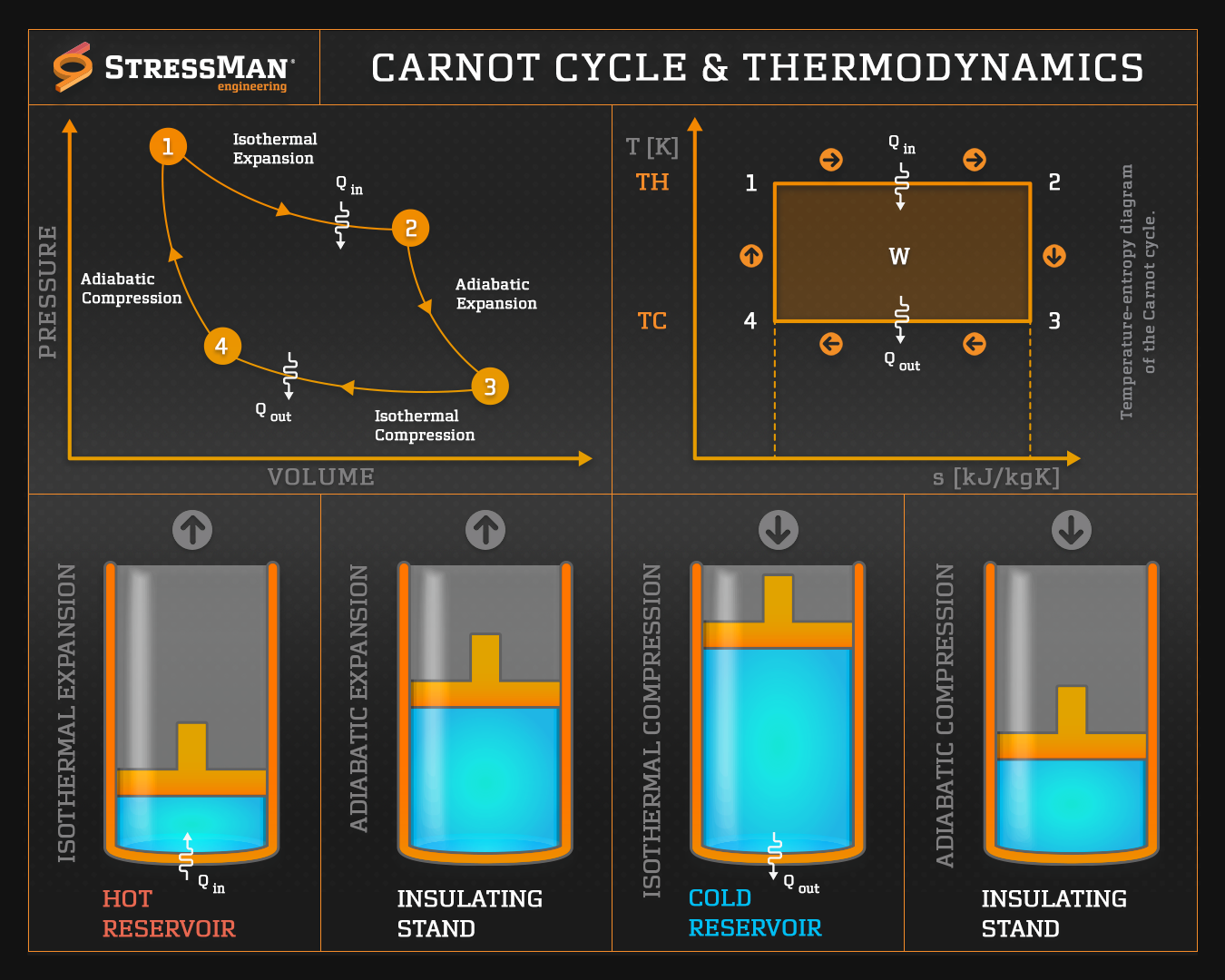
Notice the shape of the cycle on the T-s diagram. It's a perfect rectangle! This is a unique feature of the Carnot cycle. The area under the top line (1-2) represents the heat added (), and the area under the bottom line (3-4) represents the heat rejected (). The area enclosed by the rectangle represents the net work done by the cycle.
3. Carnot Efficiency: The Ultimate Benchmark
The thermal efficiency () of any heat engine is the ratio of the net work output to the heat input:
For the special case of a reversible cycle like the Carnot cycle, it can be proven that the ratio of heat transfers is equal to the ratio of the absolute temperatures of the reservoirs.
This leads to the famous Carnot efficiency formula:
Where:
- is the absolute temperature of the cold reservoir (the "sink").
- is the absolute temperature of the hot reservoir (the "source").
Crucially, these temperatures MUST be in an absolute scale (Kelvin or Rankine). Using Celsius or Fahrenheit will give incorrect results.
This simple formula has profound implications:
- The efficiency of an ideal, reversible engine depends only on the temperatures it operates between.
- No heat engine can be more efficient than a Carnot engine operating between the same two temperatures. This is known as Carnot's Theorem.
Thermodynamic Foundations – Introduction to Aerospace ...
This text from an aerospace engineering course puts the Carnot cycle in the context you're interested in. It explains why it's a fundamental benchmark, even if it's not practical.
Read the section under the heading 'Carnot Cycle & Efficiency Limits'. It clearly states the efficiency formula and its role as a theoretical upper limit for practical cycles like the Brayton cycle used in jet engines.
4. Practical Application and Examples
While no real engine is truly reversible, the Carnot efficiency gives us a target. It tells us the maximum possible performance we could ever hope to achieve. If someone claims to have an engine that exceeds the Carnot efficiency for the temperatures it operates at, you know their claim violates the Second Law of Thermodynamics.
Now, let's see how to apply this formula.
The Carnot Cycle Animated | Thermodynamics | (Solved Examples)
The final part of this video provides several clear, worked examples applying the Carnot efficiency formula.
Watch from 07:08 to the end (11:26). Pay attention to how the temperatures are converted to Kelvin and how the efficiency formula is used to find unknown temperatures or power outputs.
Test your understanding!
A proposed jet engine operates with a maximum combustion temperature () of 1700 K. It exhausts gases to the atmosphere, which is at a temperature () of 300 K. What is the maximum possible theoretical efficiency of this engine?
Show answer
The maximum possible efficiency is the Carnot efficiency, which depends only on the highest and lowest temperatures in the cycle.
We have:
- K
- K
Using the Carnot efficiency formula:
The maximum theoretical efficiency is 82.35%. Any real jet engine operating between these temperatures will have a lower efficiency due to irreversibilities.
5. Why Isn't the Carnot Cycle Used in Practice?
If the Carnot cycle is the most efficient, why don't we build it?
UNIT – III – Aero Engineering Thermodynamics
This document gives a concise explanation of the practical difficulties.
Read the short section titled 'The Carnot cycle cannot be performed in practice because of the following reasons:'.
As the resource explains, the main reasons are:
- Friction is unavoidable in any real mechanical system.
- Heat transfer requires a temperature difference. A truly reversible isothermal process would require an infinitesimally small temperature difference, meaning the process would take an infinite amount of time.
- Contradictory speed requirements: Isothermal processes need to be extremely slow to allow for heat transfer, while adiabatic processes need to be infinitely fast to prevent any heat transfer. It's impossible to build a piston that can accommodate these conflicting demands within the same cycle.
Despite these practical limitations, the Carnot cycle's role as a benchmark is indispensable for engineers.
Conclusion
In this lesson, we have explored the theoretical Carnot cycle and established its importance as the ultimate measure of heat engine performance.
Key Takeaways:
- The Carnot cycle consists of four reversible processes: two isothermal and two isentropic (adiabatic).
- Its thermal efficiency is the maximum possible for any heat engine operating between two temperature reservoirs.
- The Carnot efficiency depends only on the absolute temperatures of the hot () and cold () reservoirs: .
- It serves as a fundamental benchmark for evaluating the performance of real-world engines, but it is not a practical design due to the impossibility of achieving true reversibility.
Preview of the Next Lesson:
Now that we have our theoretical benchmark, we can move on to analyzing a practical cycle that is highly relevant to your aerospace goals. In the next lesson, we will analyze the ideal Brayton cycle, which is the thermodynamic model for gas turbine engines, including the jet engines that power aircraft. We will see how its efficiency compares to the Carnot limit and what factors influence its performance.
Can't find a good explanation? Sign up and we'll make it for you
Sign up