
Hello! Welcome back to our study of the Second Law of Thermodynamics.
In the last lesson, we established that the Second Law provides directionality to processes, something the First Law lacks. We introduced entropy () as a state property and learned the most fundamental statement of the Second Law: for any process in an isolated system, the total entropy change must be greater than or equal to zero ().
Today, we will build directly on that foundation. Our learning outcome is to apply the principle of increasing entropy to determine the possibility and direction of a process. You'll learn how to use entropy calculations as a definitive tool to predict whether a proposed process is possible, impossible, or just an ideal-case (reversible) scenario. This is one of the most powerful applications of thermodynamics in engineering design and analysis.
1. Spontaneity in the Real World: System and Surroundings
In our last lesson, we focused on "isolated systems." However, most engineering systems, from jet engines to electronics cooling systems, are not isolated; they interact with their surroundings, primarily by exchanging heat.
To determine if a process is possible in such cases, we must consider the entropy change of both the system and its surroundings. The combination of the system and its immediate surroundings can be treated as an isolated system, which we often call the "universe" for the scope of our problem. The principle of increasing entropy then applies to this total change:
This inequality is the ultimate test for spontaneity:
- If , the process is irreversible and spontaneous (it can happen in reality).
- If , the process is reversible (an ideal, frictionless process).
- If , the process is impossible.
Let's break down how to calculate the two components:
- : Since entropy is a state function, its change depends only on the initial and final states, not the path. To calculate it, we must use a reversible path between the two states, for which .
- : The surroundings are typically modeled as a large thermal reservoir at a constant temperature, . The heat it absorbs or rejects, , is simply the negative of the heat transferred to the system, . The reservoir is assumed to absorb this heat reversibly. Thus:
Notice the crucial difference: for the system's entropy, we use the heat from an imaginary reversible process. For the surroundings' entropy, we use the actual heat from the real process.
Entropy and the Second and Third Laws of Thermodynamics
The following text from a Pearson textbook provides an excellent discussion on this topic, with clear examples showing the distinction between reversible and irreversible processes.
Read Section 5.7, 'The Change of Entropy in the Surroundings and ΔStotal'. Pay close attention to the worked Examples 5.7 (reversible compression) and 5.8 (irreversible compression). Notice how ΔS_system is the same in both, but ΔS_surroundings and ΔS_total are different.
The key insight from those examples is that a process can be spontaneous () even if the system's entropy decreases (), as long as the entropy of the surroundings increases by an even larger amount.
2. Entropy Generation: A More Direct Measure of Irreversibility
While calculating works well, engineers often use a more direct formulation called the entropy balance equation. This equation states that the change in a system's entropy is the sum of two terms: entropy transferred across the boundary and entropy generated within the system.
- Entropy Transfer occurs via heat transfer. For a process with heat transfer at a boundary temperature , this term is .
- Entropy Generation () is caused by irreversibilities within the system, such as friction, mixing, chemical reactions, or heat transfer across a finite temperature difference.
The entropy balance equation for a simple closed system is:
Here, becomes our new criterion for possibility:
- : The process is irreversible and possible.
- : The process is reversible and possible.
- : The process is impossible.
This approach is often more practical because it focuses just on the system and quantifies the irreversibilities directly. The magnitude of is a measure of how inefficient a process is.
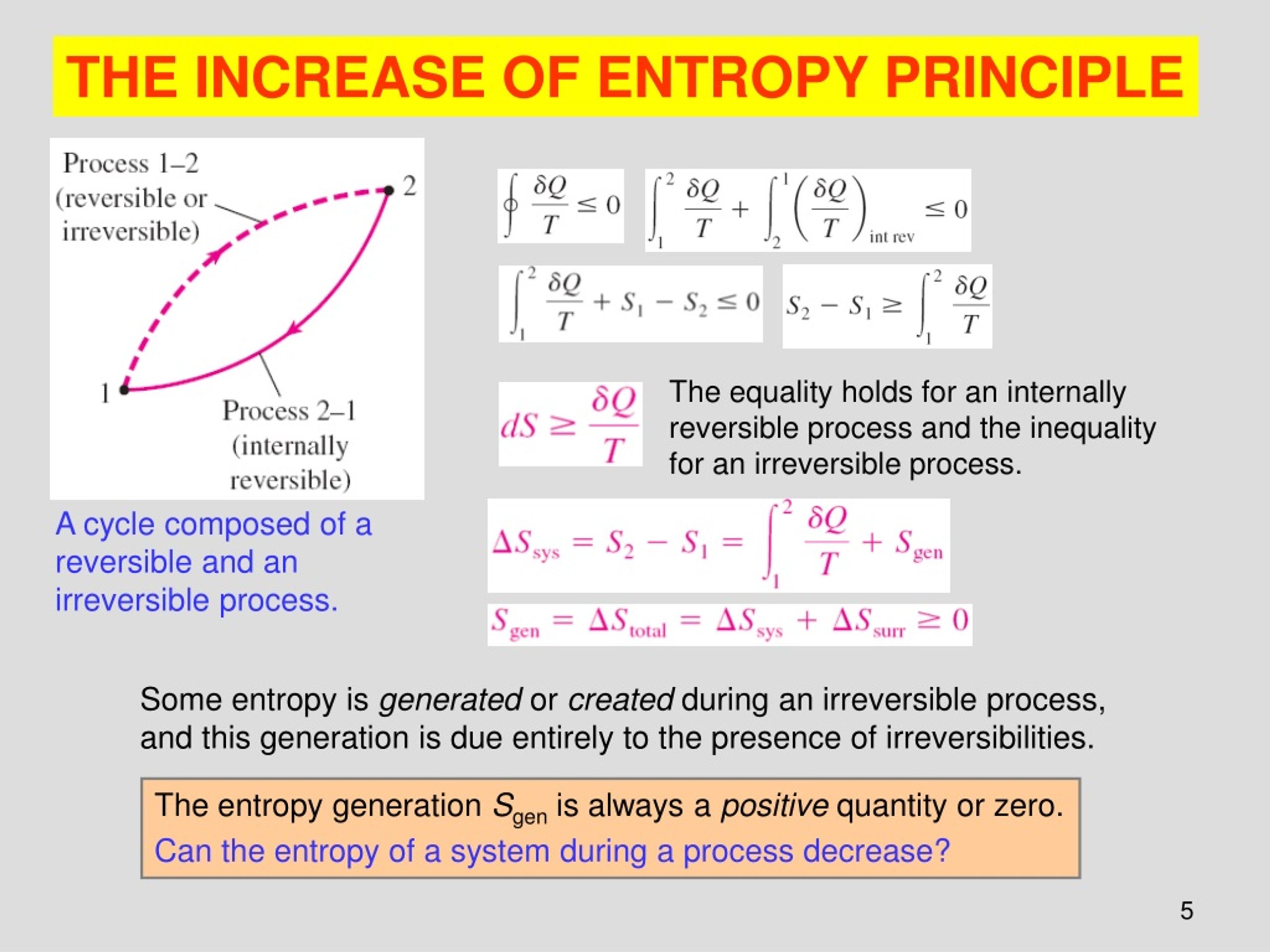
This short PDF provides a very formula-based and direct explanation of the Increase of Entropy Principle using S_gen.
Read the section titled 'The Increase of Entropy Principle' on page 2. Focus on the equation that includes S_gen and the three resulting conditions for a process (irreversible, reversible, impossible).
You might have noticed that is equivalent to the we discussed earlier. The total entropy change of the universe is the entropy generated during the process. They are two different but equivalent ways to check for spontaneity.
3. Applying the Principle: A Worked Example
Let's see how this works in practice. The most common application is analyzing heat transfer.
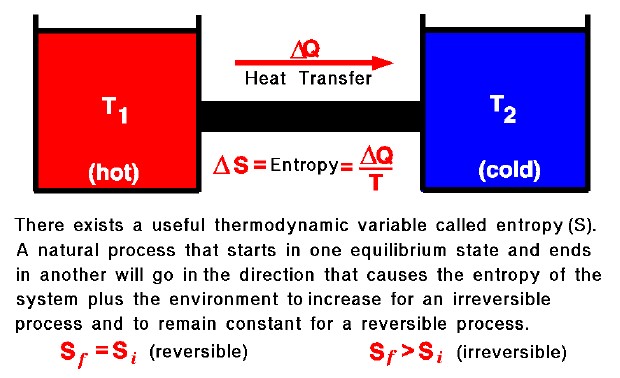
Consider the scenario from the diagram: 100 kJ of heat is transferred from a hot reservoir at 1200 K to a cold reservoir at 600 K. Is this process possible?
We can calculate the total entropy change by summing the changes for each reservoir:
-
Entropy change of the hot reservoir (): It loses heat, so its entropy decreases.
-
Entropy change of the cold reservoir (): It gains heat, so its entropy increases.
-
Total entropy change / Entropy generated ():
Since , the process is possible and irreversible.
What if someone claimed the opposite happened: 100 kJ flowed from the 600 K reservoir to the 1200 K one? The signs would flip, and we would get . Since this is negative, that process is impossible.
The Increase of Entropy Principle | Thermodynamics | (Solved Examples)
This video walks through several examples applying this exact logic. Watching it will help solidify your understanding.
Please watch the video from the beginning up to 06:36. It starts with a good conceptual recap and then works through the same heat reservoir problem we just discussed, confirming our result.
Test your understanding!
An inventor claims to have a device that takes in 2000 kJ of heat from a reservoir at 1000 K, produces 800 kJ of work, and rejects the remaining heat to the atmosphere at 300 K. Is this claim valid?
Hint: Treat the device and the two reservoirs as your complete system. Find the total entropy change.
Show answer
-
Find the rejected heat (): From the First Law, , so .
This is the heat rejected to the atmosphere. -
Calculate entropy change for the hot reservoir:
-
Calculate entropy change for the cold reservoir (atmosphere):
-
Calculate total entropy change / generation: The entropy change of the device itself over a cycle is zero.
Since is positive, the process is possible and irreversible. The inventor's claim is valid.
Conclusion
Today we've transformed the Second Law from a descriptive principle into a quantitative tool for analysis. By calculating the total entropy change, you can now definitively determine if a process is possible and how much irreversibility it involves.
Key Takeaways:
- A process is possible only if the total entropy of the system plus its surroundings increases or, for an ideal case, stays the same: .
- A process that would result in a decrease in total entropy is impossible.
- An equivalent approach is to use the entropy generation (), which must be positive for any real (irreversible) process and zero for an ideal (reversible) one. A negative is impossible.
- The magnitude of is a direct measure of the process's irreversibility and associated inefficiencies.
Preview of the Next Lesson:
To use the entropy balance equation , we need to be able to calculate the entropy change, , for the substance in our system. In the next lesson, we will learn how to calculate entropy changes for ideal gases undergoing various thermodynamic processes (isothermal, isentropic, etc.). This will give us all the pieces needed to analyze the performance of real aerospace components like compressors and turbines.
Can't find a good explanation? Sign up and we'll make it for you
Sign up