
Hello! Welcome to the first lesson of our new module, "Thermodynamics: The Second Law and Aerospace Cycles."
In our last module, we mastered the First Law of Thermodynamics, which is based on the principle of energy conservation. We used the Steady-Flow Energy Equation to analyze components like nozzles and diffusers. However, the First Law has a limitation: it tells us nothing about the direction a process can take. For instance, energy is conserved whether heat flows from a hot object to a cold one, or from cold to hot. But in reality, we only ever observe the former.
This lesson introduces the Second Law of Thermodynamics, the fundamental principle that governs the direction of natural processes and defines the concept of energy "quality." Our learning outcome is to state the Second Law of Thermodynamics and define entropy as a property. We'll see how this law explains why some processes occur spontaneously while others don't, and we'll introduce a new, powerful property called entropy that allows us to quantify these effects.
1. Why We Need a Second Law: Direction and Quality
The First Law treats all forms of energy equally. However, our experience tells us that some energy is more "useful" or has higher "quality" than other forms. For example, the high-temperature chemical energy in jet fuel is of very high quality because it can be readily converted to produce thrust. The low-temperature thermal energy in the vast ocean is of much lower quality, as we can't easily harness it to do useful work.
The Second Law of Thermodynamics addresses this by introducing two key ideas:
- Directionality: It dictates the direction that processes must follow (e.g., heat flows from hot to cold).
- Energy Quality: It helps us understand that as energy is transferred or converted, its quality tends to degrade.
The Second Law of Thermodynamics
To start, let's read a brief introduction that clarifies the purpose of the Second Law and the concept of energy quality. This comes from a set of notes by M. Bahrami at Simon Fraser University.
Read the first page of the document, down to the heading 'Thermal Energy Reservoirs'. Focus on how the Second Law complements the First Law by specifying the direction of processes.
2. The Classical Statements of the Second Law
Before the concept of entropy was fully developed, the Second Law was expressed as two statements based on empirical observations of heat engines and refrigerators.
-
The Kelvin-Planck Statement: This applies to heat engines (like those in power plants or jet engines) and states:
It is impossible for any device that operates on a cycle to receive heat from a single reservoir and produce a net amount of work.
In simple terms, no heat engine can be 100% efficient. Every engine must reject some waste heat to a lower-temperature reservoir (like the atmosphere or a river) to complete its cycle. This is a fundamental limit, regardless of how well the engine is designed.
-
The Clausius Statement: This applies to refrigerators and heat pumps and states:
It is impossible to construct a device that operates in a cycle and produces no effect other than the transfer of heat from a lower-temperature body to a higher-temperature body.
This aligns with our experience: heat does not flow from a cold space to a warmer space on its own. You need to supply work (e.g., run a compressor) to make a refrigerator or air conditioner function.
These two statements are equivalent; if you could violate one, you could devise a way to violate the other. They are fundamental rules that govern all energy conversion processes.
The Second Law of Thermodynamics
The same PDF resource provides concise definitions of these two statements. Reading them will formalize your understanding.
Read the sections titled 'The Second Law: Kelvin-Planck Statement' and 'The Second Law of Thermodynamics: Clausius Statement'. Also, note the brief paragraph right after the Clausius statement that discusses their equivalence.
3. Entropy: A Property for the Second Law
While the Kelvin-Planck and Clausius statements are correct, they are descriptive rather than quantitative. To perform calculations, engineers use a property called entropy, denoted by the symbol . Entropy can be interpreted in several ways, including as a measure of molecular disorder or randomness.
From a classical thermodynamics perspective, it's most useful to think of entropy simply as another state property, just like pressure, temperature, or enthalpy. For any given state of a substance, it has a specific, defined value of entropy.
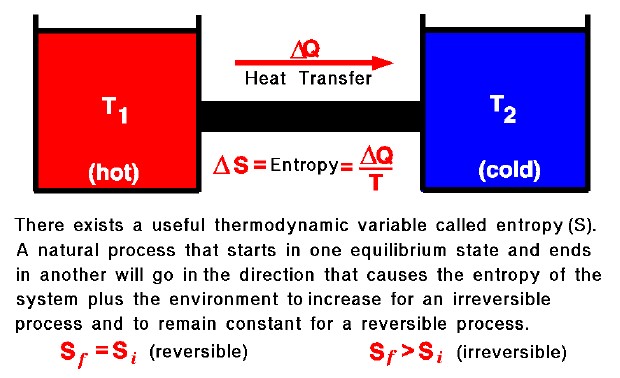
The change in specific entropy () is defined based on the heat transfer () in an idealized, frictionless, reversible process:
For a process from state 1 to state 2, the total entropy change is found by integrating:
If the process is both reversible and isothermal (constant temperature), this simplifies to the formula you will most often see as the basic definition:
- is the change in entropy (in kJ/K or J/K).
- is the heat transferred during the reversible process (in kJ or J).
- is the absolute temperature at which the heat is transferred (in Kelvin).
Thermodynamics - ENTROPY as a Property in 12 Minutes!
To see how entropy is derived and how it relates to heat transfer, please watch this short video. It directly connects the concept to the formula.
Watch from 01:11 to 04:17. The derivation relies on the 'Clausius Inequality', but your main takeaway should be the result: for a reversible process, the quantity δQ/T is a property, which we name entropy (S).
Just as we used P-v diagrams to visualize work, we can use T-s (Temperature-entropy) diagrams to visualize heat transfer. For a reversible process, the area under the curve on a T-s diagram represents the heat transferred. This is a very useful tool for analyzing thermodynamic cycles, which we will do later in the course.
4. The Second Law in Terms of Entropy
Defining entropy allows us to state the Second Law in a more general and powerful way: The Principle of Increasing Entropy.
For any process occurring in an isolated system (a system that does not exchange energy or mass with its surroundings), the total entropy of that system can never decrease.
- For a reversible process (ideal): . The total entropy remains constant.
- For an irreversible process (real): . The total entropy increases.
Real-world processes—like a hot object cooling, a gas expanding into a vacuum, or friction slowing a moving object—are all irreversible. This means they generate entropy, and the total entropy of the universe increases with every real process that occurs. This principle is what gives time its arrow and dictates the direction of all natural events.
Let's use the classic example of heat transfer to see this principle in action. Imagine a hot object at transfers an amount of heat to a cold object at .
- The entropy of the hot object decreases: .
- The entropy of the cold object increases: .
- The total entropy change of the system is .
- Since , the term is larger than . Therefore, is always positive.
The process is irreversible and creates a net increase in total entropy. The reverse process (heat flowing from cold to hot) would result in a decrease in total entropy, which would violate the Second Law.
Entropy and Second Law of Thermodynamics
This video provides a clear, step-by-step explanation of the Principle of Increasing Entropy using the same heat transfer example.
Watch from 03:06 to 08:39. Focus on how the entropy changes of the two objects are combined to show that the total entropy of the isolated system must increase.
Test your understanding!
A reversible heat engine takes in 1000 J of heat from a reservoir at 800 K and rejects heat to a reservoir at 300 K.
- What is the change in entropy of the hot reservoir?
- What is the change in entropy of the cold reservoir? (Hint: First, find the rejected heat using the Carnot efficiency formula we saw earlier, which for a reversible engine is . Remember that and ).
- What is the total entropy change of the universe for this reversible cycle?
Show answer
-
Entropy change of the hot reservoir:
The hot reservoir loses 1000 J of heat. -
Entropy change of the cold reservoir:
First, find the heat rejected, . For a reversible engine, the ratio of heats equals the ratio of absolute temperatures:
The cold reservoir gains this heat. -
Total entropy change:
The total entropy change is the sum of the changes of the reservoirs. (The entropy change of the engine itself is zero over a full cycle because entropy is a state property).
This confirms what the Second Law predicts: for a reversible process, the total entropy change of the universe is zero. Any real (irreversible) engine operating between these temperatures would have .
Conclusion
In this lesson, we introduced the fundamental principles of the Second Law of Thermodynamics, which adds the crucial concepts of directionality and energy quality to the First Law's rule of energy conservation.
Key Takeaways:
- The Second Law of Thermodynamics dictates the direction of natural processes.
- The Kelvin-Planck statement establishes that no heat engine can be 100% efficient.
- The Clausius statement establishes that heat cannot spontaneously flow from a cold body to a hot body.
- Entropy (S) is a state property defined for a reversible process as . Its values can be found in thermodynamic property tables, just like enthalpy.
- The most powerful statement of the Second Law is the Principle of Increasing Entropy: The total entropy of an isolated system always increases for real (irreversible) processes and remains constant for ideal (reversible) processes ().
Preview of the Next Lesson:
Now that we have defined entropy as a property and understand its significance, the next step is to learn how to use it. In the next lesson, we will focus on the practical application of the Second Law by learning to apply the principle of increasing entropy to determine the possibility and direction of a process. We will also begin calculating entropy changes for substances undergoing various common processes.
Can't find a good explanation? Sign up and we'll make it for you
Sign up