
Good to see you again. In the previous lesson, you created a live research brief: a bounded question, a reason it matters, and criteria that distinguish relevant material from merely interesting material. That brief now becomes the control surface for your note system.
This lesson turns rapid capture into a lifecycle with decisions. Rather than treating every captured item as a note you must preserve and organize, you will give each item a temporary status and a clear next action: discard, defer, refine, promote into durable knowledge, or remove later when it no longer earns its place.
The target is a tool-agnostic policy that can be implemented in Obsidian, Roam, Workflowy, or paper. It should make capture frictionless while ensuring that only a small, useful body of research knowledge receives sustained attention. Plan for roughly 30–35 minutes.
A note lifecycle is a policy for attention
A capture is not yet knowledge. It is a signal that might be useful: a quotation, observation, link, idea, code fragment, question, or claim encountered while reading. The moment you capture it, you usually do not know whether it will matter enough to develop.
That is normal. The mistake is to treat uncertainty as a reason to keep everything indefinitely.
A lifecycle separates two kinds of work:
- Capture should be quick, permissive, and low-cost.
- Promotion should be selective, deliberate, and relatively rare.
The practical purpose is not a perfectly orderly vault. It is to reduce the distance between incoming material and usable research output.
The traditional Zettelkasten distinction between fleeting, literature, and permanent notes is helpful here, provided you treat categories as functions in a workflow, not as rigid folder names.
From Fleeting Notes to Project Notes – Concepts of
Read this explanation from zettelkasten.de to establish the basic distinction between temporary capture, source-related material, and durable notes. Pay particular attention to the fact that a “permanent” note is meant to remain understandable later, but is not necessarily immutable.
In the “Workflow” section, read the workflow overview. Then read the full “Fleeting notes” subsection, especially the explanation of fleeting notes. Continue through “Permanent notes” and “Malleability?”; focus on the cautions about revision.
The key idea is simple:
Temporary material earns continued existence only by becoming useful in a more developed form.
A fleeting capture can be discarded after its useful content has been transferred elsewhere. A source note may remain as evidence and context. A durable note remains because it expresses an idea that you can understand and use without reopening the entire original context.
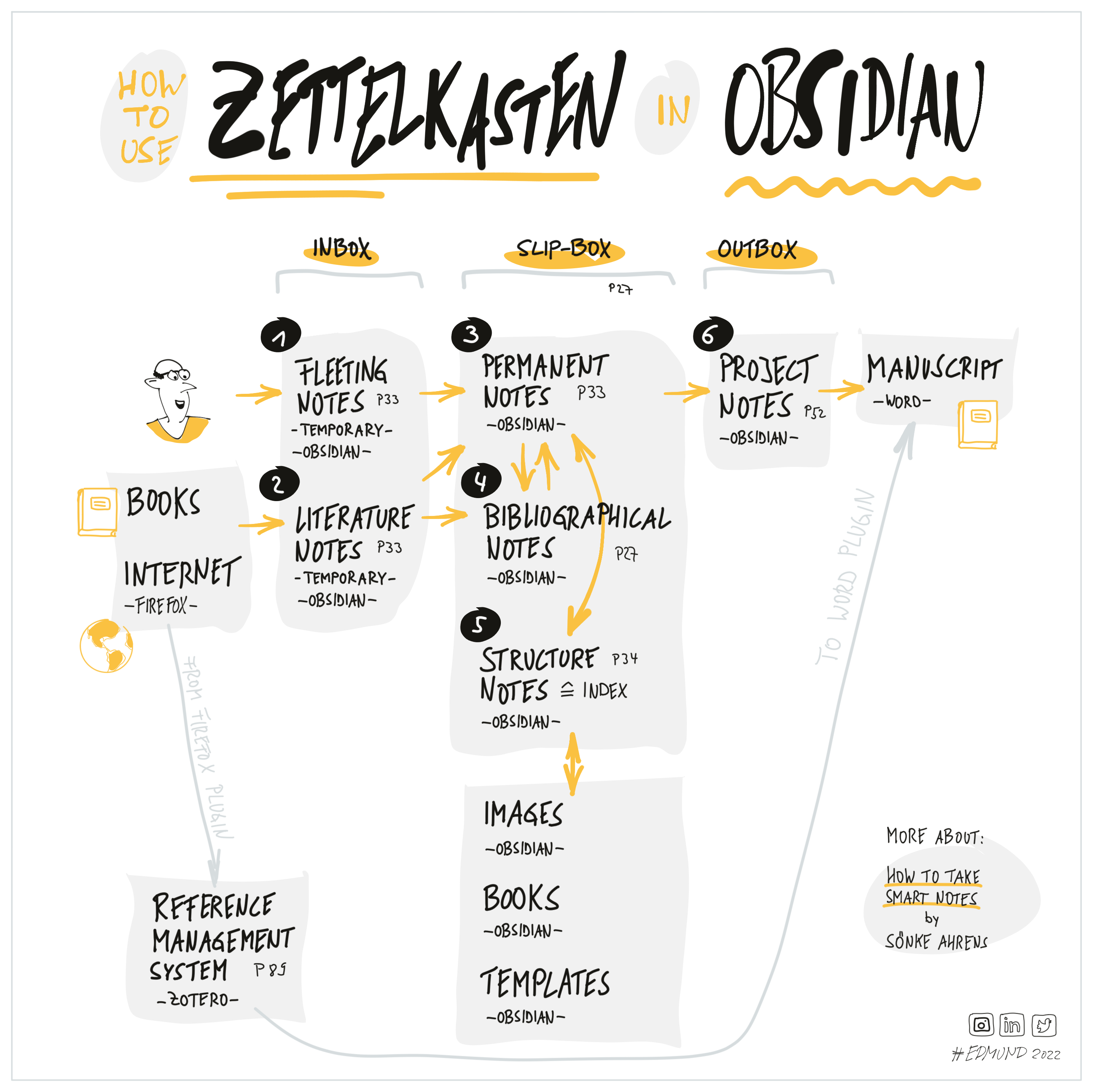
The diagram presents a helpful overall direction, but your workflow needs one extra feature for independent research: explicit exit criteria at every stage. Without them, an inbox becomes a graveyard of good intentions.
The five decisions every capture needs
Your lifecycle should answer one question repeatedly:
Given my current research question, what is the least expensive action that preserves the appropriate amount of value?
The table below provides a practical policy. The precise wording should be adjusted to your research brief, but the logic should remain stable.
| Decision | Use it when | Immediate action | What ends this state? |
|---|---|---|---|
| Discard | The item is outside scope, duplicative, unsupported, trivial, or has no plausible future use. | Delete it, or leave it in its original external location without importing it. | Nothing further is required. |
| Defer | The item may matter, but you cannot responsibly assess or develop it now. | Record why it is deferred and set a review trigger. | A review date, a related project, or a missing dependency brings it back for a decision. |
| Refine | The item is relevant and contains a potentially useful claim, observation, question, or piece of evidence. | Restate, contextualize, compress, and connect the useful part to its source context. | It either becomes durable, returns to defer, or is discarded. |
| Promote | The refined idea stands on its own and is likely to support future reasoning, retrieval, or writing. | Create or update a durable note in your knowledge base. | Later review confirms it remains useful, revises it, merges it, or archives it. |
| Remove later | A note has been superseded, merged, rendered redundant, or is no longer worth maintaining. | Delete, archive, or mark it as superseded—depending on what historical value it retains. | Its unique content is gone, preserved elsewhere, or explicitly retired. |
Notice that defer is not a polite form of keeping everything. A deferred item is a commitment to make a later decision under defined conditions. If no condition exists, it is usually a discard.
The following short video makes this point deliberately sharply: excessive capture creates a maintenance burden that can crowd out actual thinking. Its conclusion is not “never capture,” but “capture in service of a purpose.”
Personal knowledge management is stupid
Watch this short selection from Tools on Tech’s “Personal knowledge management is stupid” as a corrective to the instinct to preserve every potentially useful item. The critique is intentionally provocative, but its filtering questions are useful for lifecycle design.
Watch the filtering test and use its questions—what value does this add, will it be needed, and is it simply interesting? Then watch the maintenance argument, which connects a smaller collection to lower organizational overhead and more space for reflection.
1. Discard: a positive research decision
Discarding does not mean the material is false, unimportant, or permanently irrelevant. It means that it does not justify further attention for this inquiry.
For your current research brief, discard a capture when one or more of these conditions holds:
- It fails every inclusion criterion in your research brief.
- It concerns an adjacent topic but does not alter the answer to the live question.
- It repeats a better capture or a source you already retained.
- It gives an assertion with no source, no reasoning, and no clear way to verify it.
- It is interesting but you cannot state a plausible use for it in research, explanation, or future action.
A useful discard rationale is short:
“Interesting commentary on AI adoption, but it provides no evidence about incremental revenue or operating costs for the defined firms.”
This takes seconds. The goal is not to litigate every item; it is to prevent uncertain material from quietly becoming an obligation.
2. Defer: preserve uncertainty without hiding it
Defer when the item has potential relevance but needs a condition before it deserves deeper work. Typical reasons include:
- You need to compare it with a primary source.
- You lack the time to read a long report carefully.
- A key term in the research question needs clarification first.
- The material may belong to a future research question rather than the current one.
- You have found a promising source but do not yet know what claim it supports.
Every deferred item needs two pieces of information:
- Why it is deferred
- What will cause reconsideration
For example:
Deferred because: This earnings-call claim may indicate AI-related cost pressure, but I need the corresponding annual-report disclosure.
Review when: I process the company’s 2024 annual report, or on the next Friday review.
A deferred queue without a review date, trigger, or linked research question is not a queue. It is storage.
3. Refine: turn captured material into something you can think with
Refinement is the middle layer between raw capture and durable knowledge. It is where you spend attention only after an item has survived initial filtering.
Refine an item when it is relevant and it has at least one of the following:
- Novelty: it adds a distinction, mechanism, counterexample, or framing you did not already have.
- Evidentiary value: it contains direct evidence, a credible source, data, or a well-articulated rationale.
- Explanatory value: it could help explain an observed pattern or challenge an assumption.
- Potential use: you can imagine it contributing to a decision, model, comparison, or written synthesis.
Refinement does not mean making the note beautiful. It means making the item legible to future you.
At this stage, you might:
- preserve the relevant source context;
- write a brief restatement in your own words;
- identify what question the item bears on;
- mark uncertainty or possible limitations;
- extract the one idea worth developing further.
The next module will examine the distinction between an author’s claim, the author’s evidence, and your own interpretation. For now, keep the basic boundary clear: a raw quotation or copied highlight is not yet your durable idea.
A lifecycle diagram with real decision points
Here is a compact lifecycle that fits the workflow you want: rapid capture followed by progressive filtering into a smaller body of deeper knowledge.
This diagram is deliberately a cycle, not a production line. A refined note can return to defer if a key source is missing. A durable note can return to refinement after contradictory evidence emerges. A lifecycle should support correction rather than pretending every promotion is final.
The only truly terminal outcomes are:
- Discard, when the item has not earned more attention.
- Removal or archival, when an item once useful has ceased to justify active maintenance.
Promotion is earned, not automatic
A refined item becomes a durable note only when it meets a higher threshold. Otherwise, “refinement” merely produces a larger collection of half-finished notes.
Use this promotion test:
| Promotion criterion | What it means in practice |
|---|---|
| Self-contained | You can understand the central idea months later without reconstructing an entire browsing session. |
| In your own words | The note is not just copied language or a disguised quotation. |
| Bounded | It expresses one idea, rather than a pile of loosely related observations. |
| Traceable | You can find the source or origin that prompted it. |
| Useful | You can name a likely future use: explanation, comparison, decision support, research synthesis, or a connection to existing knowledge. |
| Appropriately qualified | Its uncertainty, scope, or dependency is not concealed. |
You do not need certainty to promote a note. A well-framed unresolved question can be durable. A cautiously worded inference can be durable. What matters is that the note accurately represents what you know, what you do not know, and why the idea is worth returning to.
This is also where Obsidian’s linking becomes useful, though elaborate linking is not yet the goal. At a minimum, a promoted note should retain a route back to the source material and a route into the relevant area of your existing knowledge base. Later modules will make those semantic connections more precise.
Progressive summarization fits inside refinement
Progressive summarization offers a useful way to avoid doing full note-processing work during capture. Its core insight is that notes need both context and discoverability: enough context to understand them later, but enough compression that you can recognize their value quickly.
Progressive Summarization: A Practical Technique for ...
Read Tiago Forte’s explanation of progressive summarization as a way to make refinement incremental. The useful principle for this course is not a particular highlighting style; it is that deeper processing should be earned gradually and performed when a note is already relevant to current work.
Start with the full “Compression vs. context” discussion. Focus on the cost of notes that are hard to assess later. Then read the later explanation of layers, beginning with the initial capture layer and continuing through the discussion of Layers 2–4 and remixing. Notice that each additional layer is applied only when the material receives renewed attention.

These layers should not be confused with a complete Zettelkasten lifecycle:
- Progressive summarization describes how a source note becomes increasingly discoverable.
- A note lifecycle describes whether the item deserves further work at all.
You can combine them cleanly:
| Lifecycle stage | Possible progressive-summarization action |
|---|---|
| Capture | Save a link, passage, rough thought, or reference with minimal friction. |
| Defer | Leave the capture intact, but record why it may matter later. |
| Refine | Add selective emphasis, a brief summary, or your own contextual restatement. |
| Promote | Extract a durable idea that is useful beyond the source note itself. |
| Remove | Delete redundant raw material, or archive a source note that no longer supports active work. |
The principle is opportunistic compression: do not summarize everything completely on arrival. Improve a note when current research gives you a reason to revisit it.
Later removal: delete, archive, merge, or supersede?
“Permanent” should mean durable enough to be relied on, not untouchable forever. But removing a durable note carelessly can erase useful intellectual history, break traceability, or lose a failed line of reasoning that would prevent you from repeating the same mistake.
Use different actions for different situations:
| Action | Appropriate when | Preserve |
|---|---|---|
| Delete | An accidental duplicate, empty stub, imported clutter item, or raw capture with no unique value. | Nothing, once you confirm there are no useful links or annotations. |
| Archive | Material is out of scope or inactive, but may have historical or occasional reference value. | The note, its source, and its date. |
| Merge | Two notes express substantially the same idea. | The unique content in one surviving note, plus a brief redirect from the retired note if needed. |
| Supersede | A claim has been corrected, narrowed, or replaced by stronger evidence. | The earlier claim, its source trail, and a pointer to the newer note. |
| Retain as disconfirmed | A false or weak idea influenced your research and remains useful as a warning, counterexample, or record of changed thinking. | The original wording, qualification, and reason it was rejected. |
A simple removal check prevents most damage:
- Check whether the note has unique reasoning, annotations, or source references.
- Check whether other notes or active research work still point to it.
- If it is being replaced, identify the surviving or successor note.
- Prefer archiving or superseding when historical context matters.
- Delete only when the note has no distinct value left.
This distinction matters especially for investing and technical research. An obsolete estimate may be useless as a current belief, but it may still reveal an assumption that failed. A discarded programming approach may be worth preserving if it records an important constraint or debugging lesson.
Build your own lifecycle policy
Spend about 10 minutes creating a note titled:
Lifecycle policy — [your current research question]
You may implement it using folders, properties, tags, pages, or a simple list. The tool is secondary. What matters is that you can see the status of current material and know what each status requires.
Write the following policy in your own words.
1. Define your capture boundary
Complete:
I will capture material quickly when it appears relevant to: [working research question].
A capture does not become a durable note merely because I saved it.
2. Write a discard rule
Use a rule such as:
Discard when the item does not meet an inclusion criterion, duplicates stronger material, or cannot plausibly improve my answer, model, or decision.
Add one concrete exclusion from your research brief.
3. Define one defer mechanism
Choose a single place or marker for deferred items. For each deferred item, require:
- a reason for deferral;
- a review date or project trigger;
- a next question to answer.
Keep this lightweight. A status field such as defer, plus a short sentence and date, is enough.
4. Set a refinement limit
Choose a limit that protects your time. For example:
During each processing session, I will refine no more than three captures, beginning with those most likely to change the current research answer.
This is not a permanent quota. It prevents the system from turning every open tab into unpaid work.
5. Use a promotion checklist
Copy or adapt this short checklist:
Promote only when:
- I can state the idea in my own words.
- The idea is understandable without the original browsing session.
- I can trace it to a source or clear origin.
- It has a plausible future use.
- Its uncertainty or limits are visible.
6. Establish a removal policy
Finish with one sentence such as:
I delete raw duplicates and clutter; I archive inactive but potentially useful material; I supersede rather than erase notes whose history may matter.
Finally, take three existing captures from your inbox or recent notes and apply the policy. Make a decision on each in under two minutes. The goal is not to process them perfectly; it is to test whether your criteria produce decisions without friction.
Key takeaways
A note lifecycle is an attention-management system, not a filing system. Fast capture creates possibilities; deliberate filtering prevents those possibilities from becoming note debt.
The core decisions are:
- Discard items with no credible relevance or use.
- Defer uncertain items only when a review trigger exists.
- Refine relevant material into something clearer, more contextualized, and more discoverable.
- Promote only ideas that are self-contained, traceable, bounded, and reusable.
- Remove later through deletion, archiving, merging, or superseding according to the note’s remaining value and historical role.
Your research brief supplies the criteria; the lifecycle turns those criteria into repeatable action.
In the next lesson, you will work at the capture stage in more detail: recording a sourced idea with provenance, a precise locator, and a brief statement of why it may matter to the research question.
Can't find a good explanation? Sign up and we'll make it for you
Sign up