
Hello, and welcome to the first module of the course. This module builds the front end of a useful Zettelkasten workflow: deciding what deserves attention before notes begin to accumulate. The aim is not to find a permanently perfect question. It is to create a live research question that gives your captures a purpose, filters peripheral material, and can be revised deliberately as your understanding grows.
By the end of this lesson, you will have a compact research brief containing one bounded question, a statement of why it matters, and explicit criteria for what belongs in the investigation and what does not. Expect to spend about 35–40 minutes, including the short resources and drafting time.
A topic is an area; a research question is an instrument
“Investing,” “learning programming,” and “AI” are topics: broad areas in which one can collect indefinitely. A research question creates a limited inquiry within such an area. It tells you what sort of evidence could change your current understanding.
Compare these:
| Level | Example | Why it is insufficient or useful |
|---|---|---|
| Topic | AI and investing | A vast reading area; it gives no basis for deciding what to capture. |
| Interest | Whether AI will improve software-company profits | Has a practical concern, but leaves “AI,” “software companies,” “improve,” and the evidence horizon undefined. |
| Bounded research question | For US-listed horizontal software firms reporting from 2022 to 2024, what evidence in annual reports and earnings calls indicates that generative-AI features produced incremental revenue rather than primarily increasing research, development, and inference costs? | Identifies cases, period, evidence, comparison, and an analytical issue. |
A good question does not merely request facts. “Which companies launched AI features in 2024?” may be a useful subquestion, but a list can answer it. A research question should call for interpretation, comparison, explanation, or qualified judgment.
For independent research, the underlying “problem” need not be an academic gap in the formal sense. It can be a decision-relevant uncertainty:
- You want to distinguish a durable mechanism from a fashionable narrative.
- Credible sources disagree.
- An important concept is being used too loosely.
- You need a better model before acting, building, or studying further.
The question is live when it remains connected to a real need for understanding and is actively used to decide what enters your notes. It is not a thesis statement, and it is not a promise that the wording will never change.
Narrow by choosing dimensions, not by merely shortening the sentence
A broad topic becomes manageable when you make boundaries explicit. The U of G Library video presents four especially portable narrowing dimensions: time, place or setting, category, and angle or problem.
Four Steps to Narrow Your Research Topic
Watch Four Steps to Narrow Your Research Topic from U of G Library for a quick, concrete model of moving from a broad subject to a defined investigation.
Watch the full example. Notice how each stage adds one constraint: a period, location, category, and analytical angle. Treat these as choices that make a question answerable, not as a formula that every inquiry must follow unchanged.
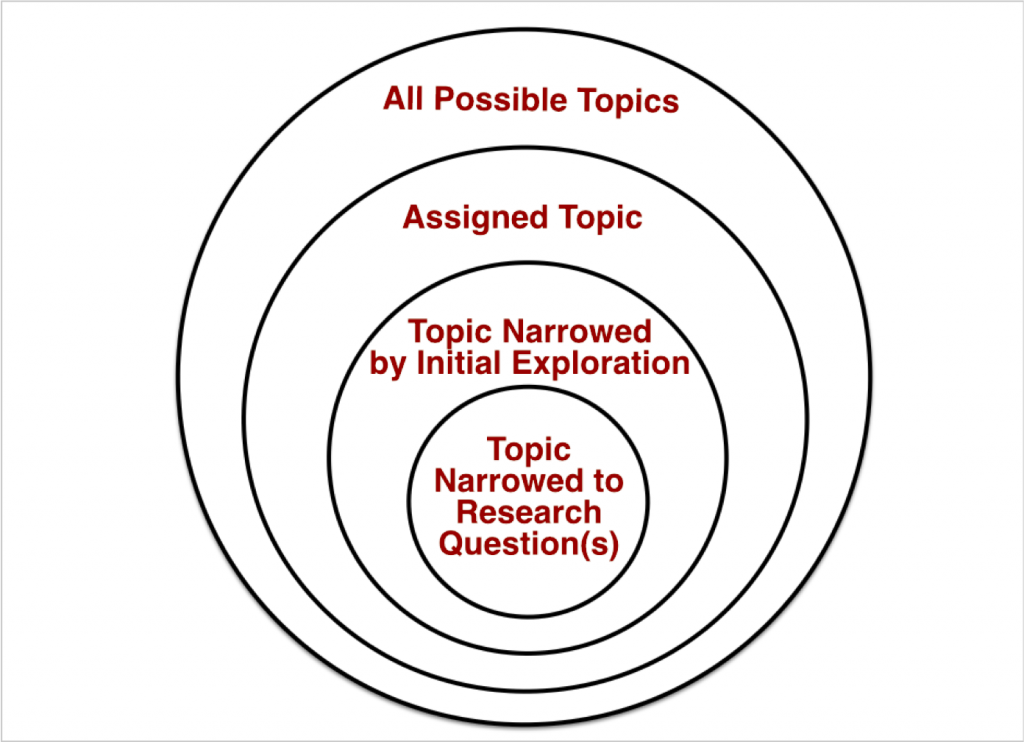
For your research, the available dimensions are usually richer than the video’s four:
| Dimension | Questions that establish a boundary |
|---|---|
| Case or population | Which companies, systems, people, codebases, or texts count? |
| Time | What period, release range, market cycle, or evidence cutoff applies? |
| Setting | Which market, language ecosystem, platform, jurisdiction, or context? |
| Central concepts | What do key terms mean in this investigation? |
| Analytical angle | Are you asking about causes, mechanisms, tradeoffs, comparison, evaluation, or application? |
| Evidence | Which source types can bear on the answer: filings, documentation, benchmark studies, primary data, expert analysis? |
| Intended use | What decision, model, or practical understanding should the answer improve? |
You do not need to constrain every dimension. But an unspecified dimension is a scope risk. If a source arrives later and you cannot explain why it is relevant, the missing boundary is often the reason.
Consider a programming-learning example:
Too broad: What is the best way to learn Rust?
Bounded but still live: For an experienced programmer learning Rust through small systems projects, which recurring ownership and borrowing errors persist after introductory study, and which forms of practice most directly address them?
This version excludes general language advocacy and beginner syntax tutorials. It asks about a defined learner situation, a specific class of difficulty, and a comparison among interventions. Its answer can remain provisional while guiding what you read and build.
Establish relevance before collecting evidence
Narrowness alone can produce an arbitrary question. The other requirement is a clear answer to “So what?” Why should this question occupy a scarce portion of your attention?
For personal research, relevance can be practical without being simplistic. “This might be interesting” is not yet a relevance statement. A stronger version names the consequence of being wrong or remaining uncertain:
Understanding whether AI-related revenue is incremental or mostly offsets new costs would improve how I interpret software-company growth claims and would prevent treating product announcements as evidence of margin expansion.
The Purdue Writing Lab activity supplies useful prompts for turning an interest into a research space: identify the conversation, name what you are not researching, and articulate stakes.
Introduction to Graduate Writing - CARS Model Activty
Read the selected prompts from Purdue Writing Lab’s CARS Model Activity. They are designed for academic projects, but the distinction between a topic, its boundaries, and its stakes is equally useful for independent research.
On page 2, under “Activity: Creating a Research Space,” read the topic prompts. On page 3, focus on the exclusion prompts, especially adjacent areas that could look relevant but are not. Then, on pages 5–6 under “Why does it matter?”, read the stakes prompts. Translate “field” and “stakeholders” into your own setting: an investment decision, a technical project, or a learning objective.
A relevance statement should be short enough to be operational. It has two jobs:
- Motivation: explain why answering the question is worth the time.
- Selection: identify what kinds of information could materially improve the answer.
For example, a relevance criterion for the software-company question might be:
A source is relevant when it offers direct evidence, a defensible interpretation, or a useful counterexample concerning the revenue or cost effects of generative-AI features for firms in the defined set and period.
That is much more useful than “keep high-quality information about AI.” Quality matters, but a rigorous paper on a neighboring issue can still be irrelevant to the present inquiry.
Write exclusions as positive boundaries
Exclusions are not an apology for what you have failed to cover. They are a design decision that protects the inquiry from expansion.
A useful exclusion is concrete enough that you can apply it when a tempting capture appears. Notice the difference:
| Vague boundary | Operational boundary |
|---|---|
| “I will not research irrelevant AI news.” | “I will exclude product announcements that provide no evidence about revenue, pricing, customer adoption, or operating costs.” |
| “I will focus on public companies.” | “I will include US-listed horizontal software firms and exclude private firms, semiconductor manufacturers, hyperscale cloud providers, and firms whose main business is consulting.” |
| “I do not need basic Rust material.” | “I will exclude introductory syntax explanations unless they clarify an ownership or borrowing error encountered in a project.” |
Exclusions typically fall into one of five forms:
- Cases excluded: entities, populations, or examples outside the defined set.
- Time excluded: material outside the period, except when it supplies necessary background.
- Question excluded: adjacent issues that do not bear on the central relationship or mechanism.
- Evidence excluded: source types that cannot reasonably support the inquiry.
- Use excluded: information that may be interesting but cannot improve the intended decision or understanding.
An item can be valuable and still be out of scope. This distinction is essential for a Zettelkasten: declining to process a capture is not a claim that the material is false, unimportant, or permanently useless. It is a claim that it does not currently serve this investigation.
Test the question before you build around it
A bounded question can still fail if it is trivial, impossible to investigate with available sources, too broad for your actual capacity, or so narrow that it cannot support meaningful reasoning. Scribbr’s checklist provides a compact quality test.
How to Develop a STRONG Research Question | Scribbr 🎓
Watch How to Develop a STRONG Research Question from Scribbr for a practical distinction between choosing a niche, identifying a problem, and checking whether a proposed question is workable.
First watch forming a question, which moves from broad interest to a research problem and then an interrogative question. Then watch the quality test. Focus on focus, researchability, feasibility, specificity, complexity, and relevance; assess feasibility against your own 30-minute daily study rhythm rather than an imagined large research project.
Use this short diagnostic on your draft:
- Focused: Does the question concern one central uncertainty rather than several loosely related ones?
- Researchable: Could a credible body of accessible evidence plausibly change your answer?
- Feasible: Can you make meaningful progress with the time and sources available now?
- Specific: Are the key terms, cases, and relevant period clear enough to guide selection?
- Complex: Would an answer require weighing evidence or reasoning, rather than reporting a fact or choosing yes/no?
- Relevant: Can you state what improved understanding would affect?
If the question fails, revise the boundary rather than adding prose. For example:
- If it is too broad, specify cases, period, or angle.
- If it is too shallow, ask about conditions, mechanisms, tradeoffs, or competing explanations.
- If it is not feasible, shrink the evidence set or choose a tractable case.
- If it lacks relevance, connect it to a genuine decision, model, or skill obstacle.
Your working artifact: a one-page research brief
Draft the following in the place where you keep active research work. Give it a date and version label, such as Research brief — v0.1. Keeping versions makes revision visible rather than making the question feel like a commitment you must defend.
1. Working question
Use one of these patterns where appropriate:
- Mechanism: Under what conditions does contribute to in ?
- Comparison: What explains the difference between and with respect to ?
- Evaluation: Which evidence best distinguishes from for ?
- Application: Which practices address for , and why?
Write one question, not a question cluster. If it naturally requires more than one sentence to state, it may contain two investigations.
2. Relevance statement
Complete this in two or three sentences:
This question matters now because . A better answer would improve . The answer is not currently obvious because .
3. Inclusion criteria
Specify three to five criteria in a form you could apply to a source:
- Include material about: .
- Include evidence from: .
- Include material from: .
- Include claims that bear on: .
- Include background only when: .
4. Exclusion criteria
Name at least three exclusions, especially the attractive adjacent topics most likely to create note debt:
- Exclude: , unless .
- Exclude: , because it does not change the answer to the working question.
- Exclude: , unless it provides .
5. Revision triggers
Finally, make the question live by recording conditions under which you will revisit it. Examples include:
- The first ten relevant sources reveal that a key term has two incompatible meanings.
- The inquiry consistently produces two separate questions with different evidence needs.
- Accessible evidence cannot distinguish the competing explanations.
- The originally intended use has changed.
- A new contradiction changes which uncertainty is most important.
Do not revise simply because a source is inconvenient or challenges your initial expectation. Revise when the question’s boundaries no longer represent the problem you genuinely need to understand.
A finished brief is successful if you can take any new article, transcript, book passage, or video and state one of two things quickly: “This belongs because…” or “This is outside scope because…” That decision rule is what begins turning capture into selective research.
Key takeaways
A topic becomes a research question when it identifies a defined uncertainty and an analytical task, rather than merely a subject to read about. Make the question bounded through explicit choices about cases, time, setting, concepts, evidence, and angle. Make it relevant by naming the decision or understanding it will improve. Make it usable by writing inclusion and exclusion criteria that can govern captures in real time.
Most importantly, treat the question as a versioned research instrument: stable enough to filter material today, but revisable when evidence reveals a genuine problem in its framing.
In the next lesson, you will turn this question into a note lifecycle: deciding exactly when a capture should be discarded, deferred, refined, promoted into durable knowledge, or later removed.
Can't find a good explanation? Sign up and we'll make it for you
Sign up