
Good to see you again. You now have two controls for keeping research notes from becoming accumulation: a bounded research question and a lifecycle that treats capture as provisional rather than automatically valuable.
This lesson focuses on the smallest useful unit at the capture stage: a sourced idea you can recover and reconsider later. By the end, you will be able to record an idea with its provenance, a precise locator within the source, and one sentence explaining why it might matter to your live research question. The goal is not a polished permanent note; it is a reliable handoff from reading, watching, or browsing to later refinement. Plan for about 30 minutes, including a short reading, a video demonstration, and a capture pass on one real source.
A capture is a recoverable research handle
A useful capture lets future-you answer four questions quickly:
- What source did this come from?
- Where exactly in that source did I find it?
- What did the source say, show, or lead me to notice?
- Why did I think it could matter to my current question?
If any of these is missing, the capture becomes more expensive to use later.
- Without provenance, it is an orphaned quotation or assertion.
- Without a locator, you may have to reread a whole book, report, or video to check it.
- Without the idea itself, a link is merely a bookmark.
- Without possible relevance, it is another item waiting for you to rediscover why you saved it.
The word possible matters. At capture time, you are recording a reason to revisit something, not declaring it true, central, or ready to become a durable claim.
A compact capture might therefore say:
This source describes a mechanism that could explain the cost increase in my defined set of firms; verify whether the mechanism applies under the operating conditions I am studying.
That sentence anchors the item to a research decision. Compare it with:
Interesting point about AI.
The second statement gives you a topic. The first gives you a reason for future work.
The four parts of a sourced capture
Think of the capture as a small evidence record with four layers.
| Part | Purpose | Minimum standard |
|---|---|---|
| Idea payload | Preserves the relevant claim, evidence, data point, observation, or question. | A short quotation, a clearly labelled source claim, or a concise factual description. |
| Provenance | Identifies the source well enough to retrieve and cite it. | Author or organization, title, date or version when available, and a stable route back to it. |
| Precise locator | Identifies the relevant place within the source. | Page, section, table, paragraph, timestamp, or another source-specific location. |
| Possible relevance | Connects the item to the live research question. | One sentence stating what it may support, challenge, clarify, or prompt you to investigate. |
The provided Reflective Annotation example shows a fuller, later-stage version of this structure. It distinguishes the reference, topic and arguments, evaluation, and connection to the writer’s own research.
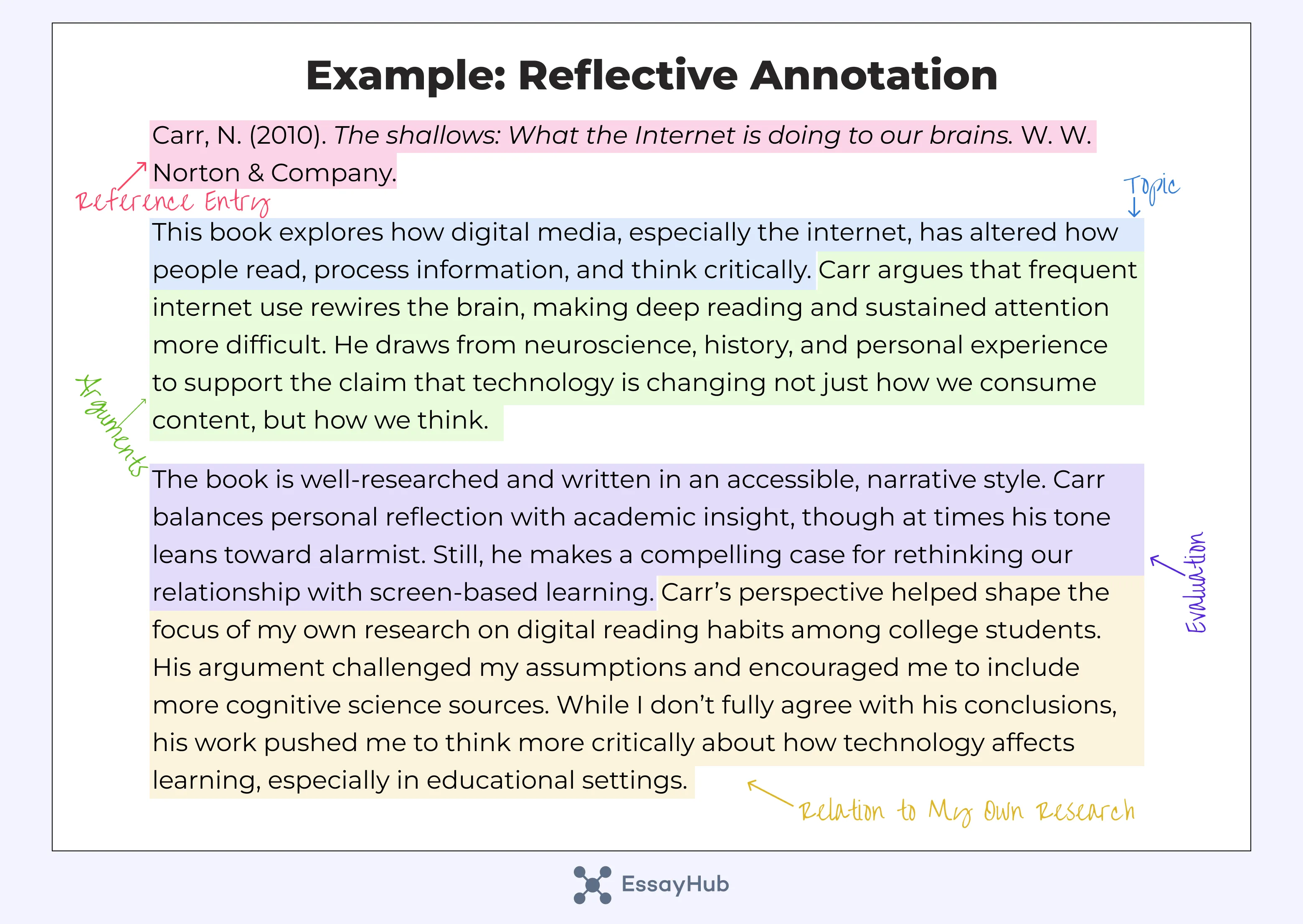
Your capture need not be this developed. In fact, making every highlight into a reflective annotation would recreate the note-processing burden you are trying to avoid. At this stage, take the thin but reliable spine:
source identity + exact location + relevant idea + possible use
Evaluation, careful paraphrase, and durable claims will come later. For now, prevent the original context and your initial reason for saving the item from disappearing.
Provenance: identify the source, not just the website
Provenance means the information needed to establish where an idea originated and return to its context. It is more than a URL, and it is not necessarily a formal bibliography formatted perfectly in a particular citation style.
For a book, provenance normally includes:
- author;
- full title;
- edition, if relevant;
- publisher and publication year;
- a source key you use consistently, such as
Ahrens 2017.
For an article, report, or research paper, include:
- author or issuing organization;
- title;
- publication date;
- journal, publisher, or report series;
- DOI, document URL, or stable file location when available.
For a web page, include:
- author or organization;
- page title;
- page URL;
- publication or update date when visible;
- date you accessed it.
For a video, include:
- channel or creator;
- video title;
- platform;
- URL;
- access date if that matters to your research trail.
A simple implementation is to keep a source record for each substantial source. The full provenance lives there; individual captures point to it with the source key. This avoids copying long citations into every capture while preserving traceability.
For a quick, one-off capture, it is fine to keep provenance directly in the capture. What matters is that you do not leave yourself with something like:
“Article on semiconductor demand, good graph.”
That is neither attributable nor retrievable.
The UNC Writing Center’s guidance is useful here because it treats note-taking as both recordkeeping and active thinking, rather than mere collection.
Read the “Research and note-taking” portion of this UNC Writing Center handout. It establishes two practical standards for research notes: keep quotations distinct from your own wording, and record full source information while the source is in front of you. It also gives strong prompts for writing a brief statement of significance.
Locate the section beginning “Research and note-taking.” First read the two rules on distinguishing quotations from paraphrase and recording citations at capture time. Then read the citation template, noting how source details vary across books, archives, and web sources. Finish with the significance prompts. You do not need to answer every prompt for every capture; use them to write one focused relevance sentence.
A source record is not automatically a summary. Its core job is to preserve identity and retrieval. You can later add annotations, source-level observations, and links as the source earns more attention.
A locator must take you to the evidence
A citation tells you which source you used. A locator tells you where in it the useful material appears.
Precision is relative to the medium:
| Source type | Strong locator | Weak locator |
|---|---|---|
| Printed book | Edition, chapter or subsection, and page number | “Middle of the book” |
| Ebook | Chapter or section, location number if stable, and a distinctive opening phrase | A page number that changes across devices |
| Journal article | Page, section, figure, table, or paragraph near a distinctive phrase | The article URL alone |
| Report or filing | Page, heading, table name, figure, or row label | “Annual report” |
| Web page | Section heading plus a distinctive phrase or paragraph description | Homepage URL |
| Video or podcast | Timestamp range and a short description | Entire video link |
| Dataset | Publisher, release or version, table or file, variables, and filters used | “Data from website” |
For example, if you capture a statement from a quarterly filing, “p. 37, Operating Expenses, paragraph beginning ‘Research and development expenses…’” is much better than “2024 annual report.” You can verify the context rapidly and distinguish the source’s wording from your later interpretation.
For web material, pages can be edited or removed. Record the page title, organization, URL, access date, and the relevant heading. If the page has no stable paragraph numbers, add a short phrase from the beginning of the passage in your own locator field. That extra clue often saves several minutes later.
The following video shows a practical version of this workflow: preserve the reason you marked a passage, retain its source origin, then connect a rewritten note back to the page that prompted it.
The FUN and EFFICIENT note-taking system I use in my PhD
Watch these excerpts from “The FUN and EFFICIENT note-taking system I use in my PhD” by morganeua. The workflow is Obsidian-based, but the essential pattern is tool-agnostic: capture the relevant passage, preserve why it was marked, and retain the source and page-level route back to it.
Watch initial capture to see the distinction between marking a passage and recording the reflection that made it worth marking. Then watch source tracing, focusing on the separate source reference, the page number, and the move from copied wording to an independently usable note. In this lesson, adopt the source and locator discipline; the fuller transformation into a durable note is the subject of the next module.
Keep source material and your reaction visibly separate
At this point in the course, do not force every item into a polished paraphrase. But do make the origin of the words clear.
Use simple labels such as:
- Quote: exact wording from the source.
- Source claim: your provisional, concise description of what the author or speaker appears to claim.
- Data or observation: a recorded figure, result, event, or demonstration.
- My reaction: your immediate question, connection, objection, or relevance statement.
For example:
Quote: “…”
Source claim: The presenter argues that preserving the reader’s reason for marking a passage makes later processing more useful.
My reaction: This may support a required relevance field in my capture template, but I should test whether it adds enough value to justify the extra capture friction.
The labels are not bureaucratic metadata. They prevent a common research error: returning months later and being unable to tell whether an assertion came from the source, from your own inference, or from a half-remembered mixture of both.
The next module will make this distinction much more rigorous. For now, your only requirement is honesty about the note’s status.
Relevance is a hypothesis about use
Your relevance statement is the bridge between selective capture and future synthesis. It should point back to your bounded research question and, ideally, one of its inclusion criteria.
Useful sentence patterns include:
- “This may provide direct evidence about [defined condition or variable].”
- “This may explain the mechanism behind [observation or claim].”
- “This may qualify my current assumption that [assumption].”
- “This may offer a counterexample if [scope condition] holds.”
- “This identifies a missing dependency: I need to determine whether [follow-up question].”
- “This appears relevant to [criterion], but I need a primary or more recent source before relying on it.”
For an investing inquiry, a relevance statement might be:
This may help distinguish a temporary margin decline from a structural cost change; check whether management reports the same mechanism in filings across multiple periods.
For programming or technical learning, it might be:
This may explain why the proposed optimization fails under concurrent access; verify the stated memory-model assumption in the language specification.
Neither sentence claims that the source settles the matter. Each identifies a possible research function and a next condition for responsible use.
Avoid relevance statements that are merely topic labels:
| Too vague | Research-directed |
|---|---|
| “Useful for valuation.” | “May provide an industry-specific reason to adjust the margin assumption in my valuation model.” |
| “Interesting programming idea.” | “May offer a trade-off between simpler code and latency under the workload I am studying.” |
| “Related to AI.” | “May provide evidence about whether AI spending is treated as capital expenditure or operating expense in this company’s disclosures.” |
A minimal, tool-agnostic capture template
Use this as a note template, a Workflowy bullet structure, a Roam block, an Obsidian template, or a paper card. Do not add fields unless they solve a real retrieval or research problem.
Research question:
[Write or link the current bounded question.]

Source key:
[Short, consistent identifier.]

Provenance:
[Author or organization; title; publication or version details;
stable URL or library/reference-manager location; access date if needed.]

Locator:
[Page + section; heading + opening phrase; timestamp range;
table/figure; dataset version and variables.]

Captured idea:
[Quote, source claim, data point, or observation.
Label exact quotations clearly.]

Possible relevance:
[One sentence: what this may support, challenge, clarify,
or require you to investigate.]

Status:
[capture / defer / refine]
Here is a compact example based on the video you watched:
Research question:
What capture practices make technical research notes reusable for
later decisions or synthesis?

Source key:
morganeua — note-taking video

Provenance:
morganeua, “The FUN and EFFICIENT note-taking system I use in my PhD,”
YouTube. Accessed [your date].

Locator:
00:06:05–00:06:13; the speaker emphasizes preserving the reader’s
reason for saving an idea and the source origin.

Captured idea:
Source claim: A literature capture should retain both why the passage
stood out and where it came from, so it can be cited and retrieved later.

Possible relevance:
May support adding a mandatory relevance field to my capture workflow;
test whether this improves later triage without slowing reading too much.

Status:
capture
This is still a capture, not a durable Zettel. It has not yet established whether the creator’s advice is well supported, generally applicable, or worth integrating into your permanent knowledge. It has simply preserved the item in a form that makes that later judgment possible.
A short capture pass on a real source
Use one current item from your own research: a book passage, technical document, company filing, article, video segment, or dataset result. Set a timer for 8 minutes.
- Choose one passage, figure, transcript segment, or data result that meets at least one inclusion criterion from your research brief.
- Create or reuse a source record and fill in enough provenance to locate the source again without relying on memory.
- Record a locator precise enough that you could reopen the relevant passage in under a minute.
- Capture the idea in no more than three or four lines. If you copy wording exactly, label it as a quote.
- Write one relevance sentence tied to the research question.
- Mark the capture
refine,defer, ordiscardaccording to the lifecycle policy from the previous lesson. - Test the record immediately: close or navigate away from the source, then use your provenance and locator to find the passage again.
That last step is important. A locator that works only while the source remains open is not yet a trustworthy locator.
Common failure modes
| Failure mode | Why it causes trouble | Repair |
|---|---|---|
| Saving only a highlight | The wording survives, but not the source context or your reason for keeping it. | Add a source key, locator, and one relevance sentence. |
| Saving only a URL | A web page may change, and the URL does not identify the relevant passage. | Add page title, organization, access date, section heading, and passage clue. |
| Treating a chapter title as a locator | You still need to search through many pages. | Add page number, subsection, table or figure, or a distinctive opening phrase. |
| Writing “interesting” as relevance | The capture has no stated role in the inquiry. | Name the claim, assumption, decision, or open question it may affect. |
| Turning each capture into an essay | Capture becomes too slow, leading either to missed material or note debt. | Preserve the four required parts; defer deeper interpretation. |
| Mixing quotation and interpretation | You can later misattribute your own inference to the source. | Use simple labels such as Quote, Source claim, and My reaction. |
The standard is not perfection. It is recoverability with enough context to make a later decision.
Key takeaways
A sourced capture is a provisional but reliable research record. Its essential parts are:
- Provenance: enough information to identify and retrieve the source.
- Precise locator: the specific page, section, timestamp, table, or passage.
- Captured idea: clearly labelled source material, observation, or question.
- Possible relevance: one sentence connecting the item to your live research question.
Keep the capture light. Do not demand that it already be a permanent note, a full summary, or a settled conclusion. Its job is to preserve a promising piece of evidence or thought so that refinement is possible without redoing the search.
Next, you will use these structured captures to triage a small batch into discard, defer, or refine by assessing relevance, novelty, evidentiary value, and potential use.
Can't find a good explanation? Sign up and we'll make it for you
Sign up