
Welcome back. Your captures now preserve four things that make later judgment possible: the source, a precise locator, the idea itself, and a tentative reason it may matter. The next discipline is deciding which of those captures deserve attention.
This lesson gives you a repeatable, tool-agnostic triage pass for a batch of captures. You will assess each item for relevance, novelty, evidentiary value, and potential use, then assign one of three outcomes: discard, defer, or refine. The aim is not to decide whether an idea is ultimately true. It is to allocate limited processing time intelligently. Plan for about 30 minutes.
Triage is an attention decision, not a judgment of worth
Capturing is permissive: you save something because it might matter. Triage is selective: you decide whether that possibility is strong enough to justify further work now, later, or not at all.
A capture can be interesting and still be a poor candidate for refinement. For example:
- A well-supported fact may be outside your current research boundary.
- A relevant claim may simply duplicate a stronger note you already have.
- A useful source may deserve deferral because no active question yet requires it.
- A weak or untraceable assertion may be worth refining only if it points to an important lead that you can verify elsewhere.
The distinction matters because your knowledge system is not a museum of everything that caught your attention. It is a working environment for research, decisions, and developing thought.
For this course, use these outcomes:
| Outcome | Meaning | What happens next |
|---|---|---|
| Discard | The capture has too little current value to justify keeping in the processing queue. | Delete the capture or archive it outside the active workflow. Keep the source record only if the source itself may matter later. |
| Defer | The capture has plausible value, but its use, fit, or priority is not sufficiently clear now. | Move it to a reviewable holding area with a reason and a trigger for revisiting it. |
| Refine | The capture is important enough to spend focused effort on now. | Verify context, distinguish source material from your interpretation, paraphrase, compare it with existing notes, or develop it toward a durable claim. |
A key point: defer is not a polite form of hoarding. A deferred item must earn its place by having a stated uncertainty, possible use, and review trigger.
The four lenses for a triage decision
Use the same four lenses every time. They are not a rigid scoring formula; together they form a short argument for why a capture should receive more of your attention.
1. Relevance: does it serve the live question?
Relevance is about fit with the research question and its inclusion or exclusion criteria from the first lesson.
A capture is highly relevant when it directly bears on a claim, variable, mechanism, decision, or open question you are currently investigating. It is weakly relevant when it merely shares a topic.
For a live investing question about whether a company’s margin decline is structural, these are very different:
- “A general article about market volatility” is topical but likely weakly relevant.
- “The company’s filings attribute margin pressure to a change in product mix over three consecutive quarters” may be directly relevant.
Use this scale:
| Relevance | Diagnostic |
|---|---|
| 0 — outside scope | Fails an inclusion criterion or clearly falls under an exclusion criterion. |
| 1 — adjacent | Could matter, but the connection to the current question is indirect or uncertain. |
| 2 — direct | Addresses a defined criterion, assumption, mechanism, or subquestion. |
2. Novelty: what does this add to what you already know?
Novelty is not whether the idea is new to the world. It is whether the capture changes, extends, sharpens, or tests your current note network and working model.
A capture has low novelty when it repeats an existing idea without improving its source quality, precision, scope, or applicability. It has high novelty when it supplies a missing mechanism, a counterexample, a more exact condition, or an important contradiction.
Do not automatically discard repetition. A repeated claim may still matter if it is:
- supported by a more authoritative or primary source;
- independently corroborated;
- expressed with clearer scope or conditions;
- a concrete example needed for explanation;
- evidence that a widely held assumption deserves scrutiny.
| Novelty | Diagnostic |
|---|---|
| 0 — duplicate | Adds no meaningful evidence, precision, or alternative perspective. |
| 1 — incremental | Adds a useful example, wording, qualification, or corroboration. |
| 2 — consequential | Introduces a new mechanism, stronger evidence, contradiction, or missing premise. |
3. Evidentiary value: how much can this item support?
Evidentiary value concerns what the capture can responsibly do in your reasoning. It is not simply a prestige ranking of sources.
A firsthand measurement, technical specification, company filing, or transparent research paper may have high evidentiary value for a narrow factual claim. A thoughtful blog post may have lower direct evidentiary value but still be valuable as an interpretation, a map to primary sources, or a prompt for further research.
Assess:
- Traceability: Can you return to the exact source and passage?
- Directness: Does the source directly support the claim at issue, or is it several interpretive steps away?
- Method and incentives: Are the source’s method, evidence, expertise, and potential incentives visible?
- Scope: Are its conditions similar enough to your case to permit use?
| Evidentiary value | Diagnostic |
|---|---|
| 0 — weak or unverifiable | Untraceable, contextless, unsupported, or too vague to assess. |
| 1 — suggestive | Traceable but indirect, anecdotal, interpretive, or limited in scope. |
| 2 — strong for a defined claim | Traceable, sufficiently direct, and transparent about its evidence or method. |
A low-evidence capture is not necessarily discard material. If it points to an important hypothesis or primary source, it may be worth refining into a verification task rather than treating it as evidence.
4. Potential use: can you name the job it may do?
Potential use asks whether the item could play a concrete role in a foreseeable piece of work. “Might be useful someday” is not enough.
Useful roles include:
- supporting or challenging a working claim;
- explaining a mechanism;
- qualifying a generalization;
- informing an investment or technical decision;
- supplying an example for later writing;
- identifying a missing premise or research task.
| Potential use | Diagnostic |
|---|---|
| 0 — no foreseeable role | You cannot name a decision, question, claim, or output it might affect. |
| 1 — plausible future role | It may be useful, but no active task or question calls for it yet. |
| 2 — concrete near-term role | You can identify where it belongs in a current inquiry, decision, or developing argument. |
The practical test is to complete this sentence:
“If I refine this, I expect it to help me ________.”
If the blank remains vague after a few seconds, the item is usually a candidate for deferral or discard.
A selective filter before deeper processing
Forte Labs proposes a compact initial filter: retain material that is unique, helpful, or interesting. For research triage, translate that into a more demanding standard:
- Unique is usually a question of novelty.
- Helpful is usually a question of relevance and potential use.
- Interesting can justify a short deferral, but rarely immediate refinement by itself.
Read Forte Labs’ discussion of selective highlighting. It offers a useful first-pass filter, especially the discipline of identifying the exact part worth retaining rather than saving whole paragraphs.
In the early discussion of highlighting, locate the paragraph beginning “As I read, I’m constantly asking myself the same three questions.” Read through the paragraph that ends by advising you to identify exactly what is worth keeping. Focus on the selection lens, then reinterpret “unique,” “helpful,” and “interesting” through your current research question rather than as general reading preferences.
This approach is deliberately more selective than ordinary highlighting. A capture does not earn refinement merely because it was compelling at the moment you encountered it.
From raw text to a smaller working set
Progressive summarization provides a useful image of how refinement can be layered instead of performed all at once. First, the original captured material remains available; later passes make the most important portions increasingly visible.
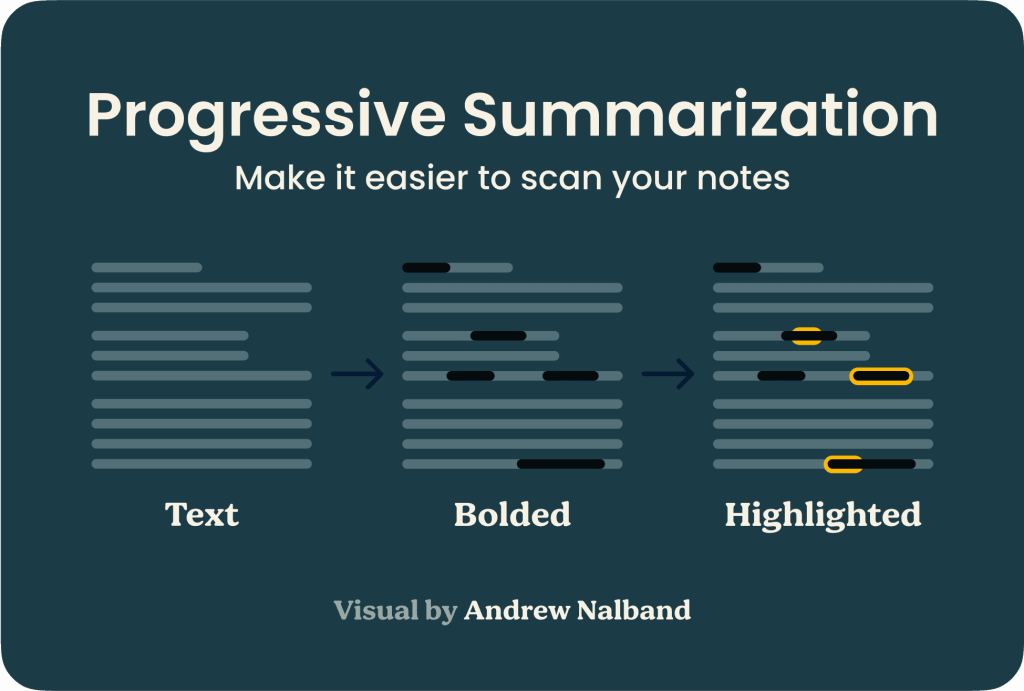
For your Zettelkasten workflow, the image should not be read as a rule that every capture must progress through every layer. Its real value is the idea that refinement is earned and can occur gradually.
A refinement decision can therefore be modest. It might mean:
- Reopen the source and check the surrounding context.
- Mark the exact sentence or data point carrying the claim.
- Separate the author’s claim from your reaction.
- Compare the capture with existing notes to determine whether it is truly new.
- State one concrete next action, such as “check this claim against the last three filings” or “locate the cited primary study.”
Only later, in the next module, will you turn the strongest refined items into carefully worded, self-contained durable claims.
A practical decision policy
Use the four lenses together rather than adding them mechanically. The following policy gives you a default.
Discard when the capture fails to earn another minute
Discard when one or more of these is true:
- It is outside the live question’s scope.
- It is a duplicate and does not provide stronger evidence, better precision, or a useful example.
- Its source cannot be recovered or checked, and it does not identify a worthwhile lead.
- You cannot name a plausible use.
- Keeping it would create more review obligation than research value.
Discarding a capture is not denying that it was interesting. It is recognizing that attention is finite. If the original source remains searchable or available in your reference manager, deleting a weak capture does not erase your ability to rediscover it.
Defer when the value is plausible but not actionable
Defer when the item has some combination of relevance, novelty, or evidence, but lacks a concrete current use. A deferred capture needs three fields:
Why deferred:
[What is promising but unresolved?]

Revisit trigger:
[When a named question, project, or condition becomes active.]

Review date or expiry:
[For example: next monthly review, or archive after 60 days.]
For example:
Why deferred: Strong paper on a mechanism that may matter for future analysis of software switching costs.
Revisit trigger: Revisit when researching enterprise retention or evaluating a company whose thesis depends on switching costs.
Review date: Monthly review; archive if no relevant inquiry appears within 60 days.
The trigger protects the defer queue from becoming a second inbox.
Refine when the capture can move research forward now
Refine when the item is directly relevant and has a likely near-term role. It does not need perfect evidence: an important but weakly supported item may deserve refinement precisely because you need to verify or challenge it.
A good refine instruction is specific:
| Weak status | Strong refine instruction |
|---|---|
| “Refine later” | “Read the full study; determine whether its sample includes the operating conditions in my question.” |
| “Important” | “Compare this management explanation with segment data from the same quarter.” |
| “Potential Zettel” | “Rewrite the source claim in my own words, preserving its stated limitation.” |
| “Look for links” | “Check whether this contradicts my current assumption about the cost driver.” |
The next action should fit in a focused session. If it would require a major investigation, create a bounded research task rather than leaving a vague refine label.
Watch a real inbox workflow
The following short demonstration is useful because it treats the inbox as an intermediate holding area rather than as part of the permanent note system. Its choices are personal workflow examples, not universal rules, but the discard, refine, and defer distinctions are clear.
How I Organise My Weekly Notes: Zettelkasten Workflow & Analog Thinking
Watch “How I Organise My Weekly Notes: Zettelkasten Workflow & Analog Thinking” by Just Pen & Paper for a concrete batch-review example.
In the note-review demonstration, watch review outcomes. Notice the three decisions: discard a duplicate, elaborate and integrate a promising idea, or retain it when its fit is not yet clear. Then watch the holding area for the rationale behind deferral. As you watch, distinguish a legitimate future trigger from merely keeping an item because deleting feels uncomfortable.
Triage a batch in one pass
For a sustainable workflow, triage batches rather than deciding the fate of each capture while reading. You need enough distance from the moment of capture to judge its value, but not so much delay that the queue loses context.
Set aside 10–12 minutes and process a batch of five to ten recent captures.
Step 1: Reopen the research brief
Keep the live research question and its inclusion/exclusion criteria visible. This prevents each item from being judged against your entire universe of interests.
Step 2: Make a fast first assessment
For each capture, write a compact profile such as:
R: 2  Directly addresses current margin question.
N: 1  Similar idea exists, but this supplies a clearer condition.
E: 2  Direct statement in a company filing, precisely located.
U: 2  Can test the current structural-cost hypothesis.
Decision: refine
Next action: compare with two earlier filings.
The notation is optional. What matters is preserving the reason for the decision, especially for defer and refine.
Step 3: Make the smallest justified decision
Here is how three hypothetical captures might fare in an investing research batch:
| Capture | Assessment | Decision |
|---|---|---|
| A management statement, precisely located in a filing, attributes margin pressure to product mix. | Directly relevant; moderately novel; strong evidence for what management said; useful for testing a current hypothesis. | Refine by comparing the statement with segment data and prior filings. |
| A generic productivity post claims that “companies should focus on efficiency.” | Only adjacent to the research question; not novel; weakly evidenced; no defined use. | Discard the capture. |
| A well-cited technical paper explains a mechanism relevant to future work on software switching costs, but no active inquiry concerns it. | Adjacent now; potentially novel; good evidence; plausible future use. | Defer with a trigger tied to a future retention or switching-cost inquiry. |
Notice that none of these decisions comes from a single number. The first item is refined because it can influence an active line of reasoning. The second is discarded because it adds little on every dimension. The third is deferred because it has substance but no current job.
Step 4: Clear the batch completely
At the end of the pass, every item should be in exactly one state:
- removed from the active queue;
- placed in a deferred queue with a trigger;
- assigned a concrete refinement action.
Do not leave items labelled inbox, maybe, or interesting after triage. Those labels describe uncertainty but do not make a decision.
Key takeaways
A triage decision is a decision about where to spend research attention, not a declaration that a capture is true, false, or permanently important.
Assess each capture through four lenses:
- Relevance: Does it serve the bounded question?
- Novelty: Does it add evidence, precision, a counterexample, or a new mechanism?
- Evidentiary value: Can it support a claim responsibly, or at least point toward verifiable evidence?
- Potential use: Can you name a concrete role in a current or foreseeable inquiry?
Then act decisively:
- Discard items that are out of scope, duplicative, unsupported, and without a plausible use.
- Defer promising but currently non-actionable items, always with a reason and review trigger.
- Refine items that can improve an active research question, argument, or decision now.
Next, you will calibrate a sustainable processing cadence by comparing how much you capture with how much you can actually refine.
Can't find a good explanation? Sign up and we'll make it for you
Sign up