
Hello! Welcome to your next lesson in our module on Audio Data Augmentation and Pipelines.
In the previous lesson, we explored how to denoise audio signals using spectral gating and Wiener filtering. A key takeaway was that both methods rely on having a good estimate of the noise spectrum, which is typically calculated from non-speech segments of the audio. This naturally raises the question: how do we automatically find those non-speech segments?
Today, we will answer that question by diving into Voice Activity Detection (VAD). Our learning outcome is to perform voice activity detection to segment speech from non-speech regions in an audio stream. You will learn the principles behind VAD, starting from simple energy-based methods and progressing to modern deep learning approaches, and you'll see how to use powerful libraries to apply VAD in practice.
1. The Role of VAD in Speech Processing
Voice Activity Detection (VAD) is a crucial pre-processing step in a vast number of audio applications. Its primary goal is to classify audio frames as either containing speech or not containing speech.
8.1. Voice Activity Detection (VAD) - Introduction to Speech Processing
To start, let's formally define VAD and understand its wide range of applications. This resource from Aalto University provides an excellent introduction.
Read the 'Introduction' section. Focus on the definition of VAD, its relationship to Speech Presence Probability (SPP), and the list of applications where it is used (speech coding, recognition, enhancement).
As you read, VAD is not just about finding silence. It's about distinguishing human speech from everything else, including background noise, music, or other ambient sounds. The output of a VAD system is often a sequence of timestamps marking the start and end of speech segments.
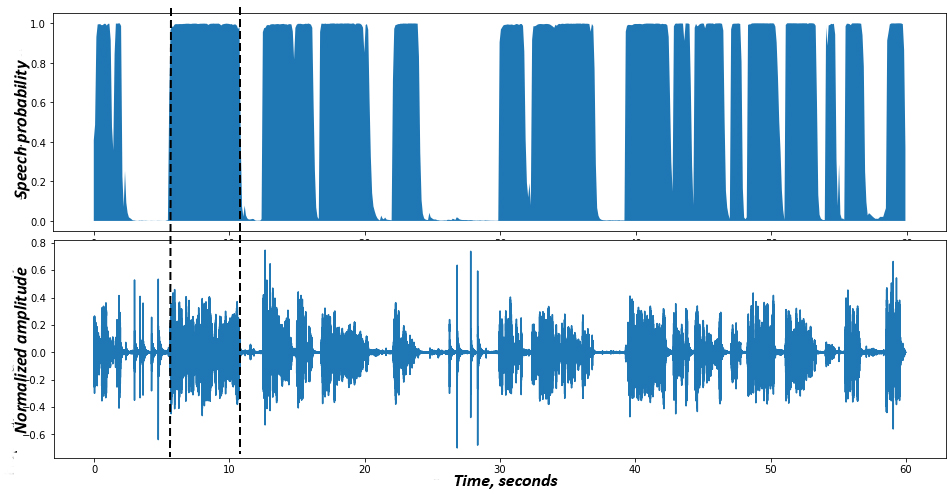
Visually, the goal is to take a raw audio waveform and produce a corresponding probability score over time, as shown below.
2. Foundational VAD: Energy Thresholding
The most intuitive way to detect speech is to assume that speech segments are louder than non-speech segments. This leads to the simplest VAD algorithm: energy-based thresholding.
The process is straightforward:
- Divide the audio signal into short, overlapping frames (e.g., 30 ms).
- For each frame, calculate its total energy. Since we are working with the Short-Time Fourier Transform (STFT), this is equivalent to summing the squared magnitudes of the frequency components in that frame's spectrum.
- Set an energy threshold.
- Label any frame with energy above the threshold as "speech" and any frame below it as "non-speech".
8.1. Voice Activity Detection (VAD) - Introduction to Speech Processing
The same resource we just looked at provides a clear explanation and a Python implementation of this trivial case. It also immediately highlights its limitations.
Read the section 'Low-noise VAD = Trivial case' to understand the energy thresholding algorithm. Skim the associated Python code to see how frame energy is calculated from a spectrogram. Read the section 'Performance in noise' to see why this simple approach is not robust in real-world scenarios.
As the resource demonstrates, energy thresholding works reasonably well in clean, silent environments. However, it fails dramatically in the presence of noise, as the energy of the noise can easily be higher than the energy of quiet speech sounds (like consonants or the trail-off of a word). This makes choosing a reliable threshold nearly impossible.
VAD Performance and Objectives
This failure highlights that VAD performance is application-dependent. We can evaluate a VAD using a standard confusion matrix:
| VAD Output | Ground Truth: Speech | Ground Truth: Non-speech |
|---|---|---|
| Speech | True Positive (TP) | False Positive (FP) |
| Non-speech | False Negative (FN) | True Negative (TN) |
The importance of each type of error depends on the task:
- For ASR or speech coding: A False Negative (missing actual speech) is highly detrimental as it leads to information loss. We prefer a VAD that is more sensitive, even if it means a few more False Positives.
- For keyword spotting ("OK Google"): A False Positive (detecting speech where there is none) is more costly, as it might needlessly trigger a computationally expensive downstream process. We prefer a more conservative VAD.
To overcome the limitations of simple energy features, modern VAD systems use more discriminative features (like MFCCs, which you're familiar with) and powerful machine learning classifiers.
3. Modern VAD with Deep Learning
Modern state-of-the-art VAD systems are based on deep neural networks. They learn to differentiate complex speech characteristics from various types of noise. A common architecture is a CRDNN (Convolutional-Recurrent-Deep Neural Network).
Voice Activity Detection — SpeechBrain 0.5.0 documentation
The SpeechBrain toolkit provides an excellent tutorial on its VAD system, which uses a CRDNN. This will give you a clear picture of a modern VAD pipeline.
Read the 'What is VAD useful for?' and 'Why is challenging?' sections to reinforce the motivation. Read the 'Pipeline description' section. Pay attention to the architecture: FBANK features are fed into a CRDNN, with a sigmoid output trained using binary cross-entropy. Given your background, this pipeline should be familiar.
The output of such a network is a frame-by-frame probability of speech. To get the final time-stamped segments, this probability curve must be post-processed.
The VAD Inference and Post-Processing Pipeline
Getting from a raw audio file to clean speech segments involves several steps. Let's walk through a typical pipeline, as implemented in SpeechBrain.
Voice Activity Detection — SpeechBrain 0.5.0 documentation
This is the most practical part of the lesson. The SpeechBrain tutorial breaks down the entire inference pipeline, from getting model probabilities to refining the final boundaries. Understanding these steps is key to effectively using and tuning a VAD.
Read the 'Inference' section and the detailed 'Inference Pipeline (Details)' section. Focus on understanding each of the seven steps. Don't worry about running the code right now, but pay close attention to the purpose of the hyperparameters like activation_th, deactivation_th, close_th, and len_th.
To summarize the key post-processing steps you just read about:
-
Thresholding: A simple threshold (e.g., > 0.5) isn't robust. Instead, two thresholds are used: a higher
activation_thto start a speech segment and a lowerdeactivation_thto end it. This hysteresis prevents the VAD from rapidly toggling on/off during short pauses or low-energy speech sounds.
This diagram shows how a probability curve (blue) is converted into speech segments. A segment starts when the probability exceeds the threshold and can tolerate brief dips below it. If a non-speech segment is too long (bottom example), the speech is split. -
Merging: After thresholding, we might have many small speech segments separated by tiny gaps (e.g., the silence in a stop consonant like /p/). The
merge_close_segmentsstep combines segments that are closer than a specified duration (close_th). -
Filtering: Finally, any remaining speech segments that are extremely short (e.g., a cough or a click misclassified as speech) can be removed using
remove_short_segmentswith a length threshold (len_th).
)
Practical Implementation with SpeechBrain
Now, let's see how to use this in code. SpeechBrain makes it incredibly simple to use their pre-trained VAD models.
First, make sure you have speechbrain installed (pip install speechbrain). You will also need to install torchaudio.
import torchaudio
from speechbrain.inference.VAD import VAD
import os


# Create a dummy audio file for demonstration
sample_rate = 16000


# A sequence of silence, speech, silence, speech, silence
signal_speech = torch.sin(torch.linspace(0, 440 * 2 * torch.pi, sample_rate)) * 0.5
signal_silence = torch.zeros(sample_rate // 2)
signal = torch.cat([
    signal_silence,
    signal_speech,
    signal_silence,
    signal_speech,
    signal_silence
], dim=0)


# Save to a temporary file
audio_file = "vad_test_audio.wav"
torchaudio.save(audio_file, signal.unsqueeze(0), sample_rate)


# Load the pre-trained VAD model from SpeechBrain's HuggingFace hub
vad = VAD.from_hparams(source="speechbrain/vad-crdnn-libriparty",
                       savedir="pretrained_models/vad-crdnn-libriparty")


# Perform VAD and get the speech segment boundaries
# The output is a tensor of shape [N, 2] where N is the number of speech segments
# and each row is [start_time, end_time] in seconds.
speech_segments = vad.get_speech_segments(audio_file)

print(f"Original signal duration: {len(signal)/sample_rate:.2f} seconds")
print("Detected speech segments:")
print(speech_segments)


# You can also get the frame-level speech probabilities
prob_chunks = vad.get_speech_prob_file(audio_file)
print(f"\nShape of speech probability tensor: {prob_chunks.shape}")


# Clean up the dummy file
os.remove(audio_file)


# Expected output will be something like:
# Original signal duration: 3.50 seconds
# Detected speech segments:
# tensor([[0.5000, 1.5000],
#        [2.0000, 3.0000]])
This simple example shows the power of a pre-trained VAD. With just a few lines of code, you can accurately locate speech in an audio file, a task that would be very brittle using simple energy-based methods.
4. VAD for Real-Time Applications: Silero-VAD
While SpeechBrain's VAD is powerful for offline batch processing, some applications like live transcription or voice-controlled assistants require extremely fast, low-latency VAD. For this, specialized lightweight models have been developed. A popular example is Silero-VAD.
Voice Activity Detection | The key to realtime voice chat - Silero VAD
This video provides a great overview and demonstration of Silero-VAD, highlighting its use case in real-time applications. Notice the different programming paradigm it encourages (event-based callbacks).
Watch the first four minutes of the video (until 00:03:50). Focus on: The key features of Silero-VAD: speed, small size, and language-agnosticism. The concept of using on_speech_start and on_speech_end callbacks to trigger actions, which is ideal for interactive systems.
Silero-VAD demonstrates a different but equally important application of VAD: as a trigger in an event-driven system. It's a great example of how model architecture and design are tailored to the specific constraints of a problem (in this case, low latency and computational cost).
Conclusion
In this lesson, we demystified Voice Activity Detection, a fundamental tool in any speech processing pipeline. You've seen how it works, why it's necessary, and how to apply it using modern libraries.
Key Takeaways:
- VAD is the process of identifying speech segments within an audio stream, separating them from silence and background noise.
- It serves as a critical pre-processing step for noise estimation, ASR, data cleaning, and real-time voice applications.
- Simple energy-based thresholding is a foundational concept but is not robust to noise.
- Modern VAD systems use deep neural networks (like CRDNNs) to generate a Speech Presence Probability (SPP) for each audio frame.
- A post-processing pipeline involving thresholding with hysteresis, merging close segments, and removing short segments is crucial for converting probabilities into clean, usable timestamps.
- Libraries like SpeechBrain provide powerful, pre-trained models for offline VAD, while tools like Silero-VAD are optimized for real-time, low-latency use cases.
Now that we can reliably isolate the speech portions of our audio files, we are well-equipped to move on to the next step: data augmentation. In the next lesson, we will focus on time-domain augmentation techniques, such as speed perturbation and pitch shifting, which are applied directly to the audio waveforms within these detected speech segments.