
Hello again. In the previous lesson, you used the series-circuit rule that the individual resistor voltage drops add to the supply voltage. Kirchhoff’s Voltage Law, usually shortened to KVL, is the formal version of that rule: it gives you a reliable way to write, solve, and check voltages around a complete circuit loop.
For your exam, KVL is particularly useful when one voltage is missing, when you need to prove that a set of calculated values is correct, or when you need to find circuit current by writing one loop equation. The key new skill is handling the signs of voltage rises and drops consistently.
The idea behind Kirchhoff’s Voltage Law
A loop is any closed path that starts at one point in a circuit, travels through components, and returns to the same point.
KVL states:
In exam form, write:
“Algebraic” means the signs matter. A voltage rise is written as positive; a voltage drop is written as negative, provided you keep the same chosen direction all the way around the loop.
The physical reason is straightforward: after travelling around a complete loop and returning to where you began, you cannot be at a different electrical potential from the starting point. Any energy per unit charge supplied by the source has been accounted for by energy used in the loads.
For a common single-source resistor circuit, KVL can be written as:
This is equivalent to:
So the familiar series rule from the last lesson is not a separate rule: it is a simple application of KVL.
Kirchhoff's Voltage Law - KVL Circuits, Loop Rule & Ohm's Law - Series Circuits, Physics
Watch “Kirchhoff's Voltage Law - KVL Circuits, Loop Rule & Ohm's Law - Series Circuits, Physics” from The Organic Chemistry Tutor. It gives a visual explanation of why sources are voltage rises and resistors are voltage drops, then applies that idea in a single-loop series circuit.
Watch the sign idea to connect voltage to energy gained or lost by charge. Then skip ahead and watch the series example, focusing on how the presenter writes the KVL equation before solving for current and resistor voltage drops.
A dependable sign convention
You may choose to travel around a loop clockwise or anticlockwise. The direction itself does not matter. What matters is that you use one direction consistently.
Use this rule every time:
| Component crossed while travelling around the loop | Voltage change written in KVL |
|---|---|
| Source from terminal to terminal | |
| Source from terminal to terminal | |
| Resistor from side to side | or |
| Resistor from side to side | or |
The resistor polarity normally follows the passive sign convention: conventional current enters the resistor’s side and leaves its side. When you travel with conventional current through a resistor, you travel from to , so it is a voltage drop.
A useful memory prompt is:
- Negative to positive: voltage rises, so write .
- Positive to negative: voltage falls, so write .
Do not decide a sign merely because a component is a resistor or a battery. Decide it from the polarity you cross while following your selected route.
Reading a KVL loop on a series circuit
The circuit below contains a source and three series resistors. The current is , flowing through all three resistors.
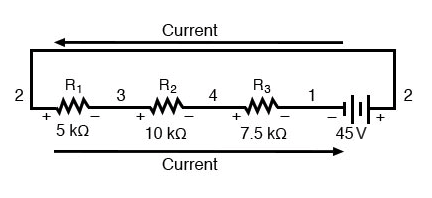
Choose a path that follows the marked conventional-current direction. You cross the source from to , then cross each resistor from to .
Therefore, the KVL equation is:
Substitute the source voltage:
To calculate the resistor drops, first find current. KVL lets you write the equation using :
Group the resistance terms:
Move the current term to the other side:
Now divide by :
This is the same answer you would obtain by first calculating total resistance and then applying Ohm’s law. KVL shows why that method works.
Now find each voltage drop:
Finally, verify with KVL:
That final line confirms the values are consistent.
Read the “Kirchhoff’s Voltage Law (KVL)” explanation from All About Circuits for a careful visual walk-through of voltage polarity, meter readings, and a series loop.
In the subsection “Demonstrating Kirchhoff’s Voltage Law in a Series Circuit,” begin with the numbered circuit diagram. Read the first measurement discussion to see why measured voltage polarity matters. Then continue through the loop walk-through. Focus on the fact that the route can start at any point and travel in either direction, as long as all signs match that route.
Solving for one missing voltage
A common written exam question gives the supply voltage and most of the voltage drops, then asks for the remaining drop.
Question: A source supplies three series loads. The measured voltage drops are:
Calculate .
Step 1: Write KVL before inserting numbers
Follow the current direction through the resistors:
Step 2: Substitute values
Step 3: Combine the known terms
Step 4: Isolate the unknown
The voltage across the second load is:
For a basic series circuit with one supply, you could calculate it more quickly as:
However, writing the full KVL equation first is safer in an exam because it shows your method and makes the signs visible.
Verifying a set of values
KVL is also a fast error check. Suppose you are given:
Write the signed KVL check:
The values pass the KVL check.
If you instead obtained:
then the values do not satisfy KVL. In an ideal exam circuit, that means at least one value, calculation, sign, or stated polarity is wrong.
In practical testing, a small mismatch can arise from meter accuracy, source variation, resistor tolerance, or rounded readings. But only accept a tolerance explanation if the question gives enough practical context. For a calculation question, the expected answer should normally balance exactly, apart from rounding.
Avoiding the common KVL mistakes
Mixing positive magnitudes with signed terms
A resistor drop can be described as “” in magnitude, but in a KVL equation it may appear as either or , depending on the direction you travel across it.
For the circuit, travelling with current gives:
Travelling the opposite way is also correct:
Both equations say exactly the same thing. The mistake is reversing direction halfway through an equation.
Forgetting the source voltage
A loop equation must include every component crossed on the selected route, including the source. If you write only the resistor drops, they cannot add to zero unless the circuit has no applied voltage.
Using resistance values directly in a voltage sum
KVL sums voltages, not resistances. If only resistor values are given, convert each resistor term to voltage using:
For a one-loop circuit, this gives a useful general form:
You can then factor out :
This leads directly to:
Losing units
Every term in a KVL equation must be in volts. Write on your working, especially when checking a final answer.
An exam routine for a single-loop KVL question
Use this sequence when you see a circuit with one closed loop:
- Mark or identify the source polarity and current direction. If the direction is not given, choose one for the purpose of writing the equation.
- Choose one travel direction around the entire loop.
- Write each voltage change with a sign. Crossing from to is positive; crossing from to is negative.
- Set the signed total equal to zero.
- Use when a resistor voltage must be expressed in terms of current and resistance.
- Rearrange one line at a time, keeping units beside values.
- Substitute the answer back into the original KVL equation and confirm that the result is .
For method marks, a strong final layout is:
Key takeaways
Kirchhoff’s Voltage Law states:
Around a complete loop:
- A crossing from to is a voltage rise and is written positive.
- A crossing from to is a voltage drop and is written negative.
- In a one-source series circuit, supply voltage equals the total of the resistor voltage drops.
- KVL can find an unknown voltage, calculate loop current when combined with Ohm’s law, and check whether calculated or measured values are consistent.
The main habit is simple: choose one direction around the loop, assign signs from the polarity you cross, and do not change direction halfway through.
Next, you will use the same series-voltage relationship in a faster form: the voltage-divider relationship, which lets you calculate a resistor’s voltage drop directly from its share of total series resistance.
Can't find a good explanation? Sign up and we'll make it for you
Sign up