
Hello, and welcome to the series-circuit revision module. In an exam, a series-circuit calculation is usually less about difficult mathematics than about keeping total values and individual component values separate. This lesson gives you a repeatable method for finding total resistance, circuit current, and each resistor’s voltage drop, with clear working for method marks.
By the end, you should be able to look at a single-loop resistor circuit and confidently decide which formula to use first, what to calculate next, and how to check whether your final answers make sense.
Recognising a series circuit
A series circuit has only one continuous path for current. If the circuit has no branches or junctions where current can split, its components are in series.
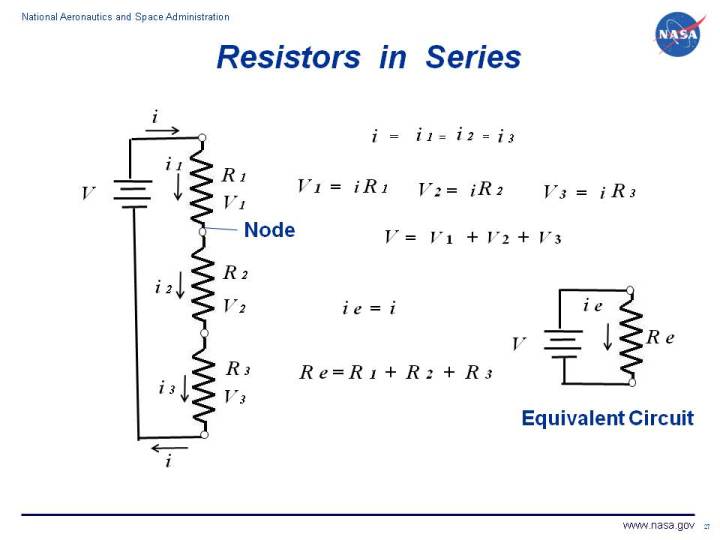
That one-path arrangement gives three rules that you should treat as an exam checklist:
Where:
- is resistance, measured in ohms
- is current, measured in amperes
- is voltage, measured in volts
- the subscript means total
- the subscripts , , and refer to individual resistors
The rules mean:
- Resistance adds. Each resistor makes it harder for current to move around the only available path.
- Current is the same everywhere. Charge cannot choose another route or disappear between resistors.
- Voltage drops add. The source voltage is shared among the resistors.
A useful physical check follows from these rules: in the same series circuit, the resistor with the largest resistance has the largest voltage drop, because every resistor carries the same current.
The calculation order: total first, then individual values
For the usual exam question where the supply voltage and resistor values are given, follow this fixed order:
- Add the resistors to find total resistance.
- Use total voltage and total resistance to find circuit current.
- State that this current is the current through every series resistor.
- Use for each resistor to find its voltage drop.
- Add the voltage drops to check that they equal the supply voltage.
The order matters. You cannot correctly calculate current by dividing the total supply voltage by just one individual resistor. For example, divided by would mix a total voltage with an individual resistance. Those quantities do not describe the same part of the circuit.
Use total quantities together:
Then use individual quantities together:
Since it is a series circuit, .
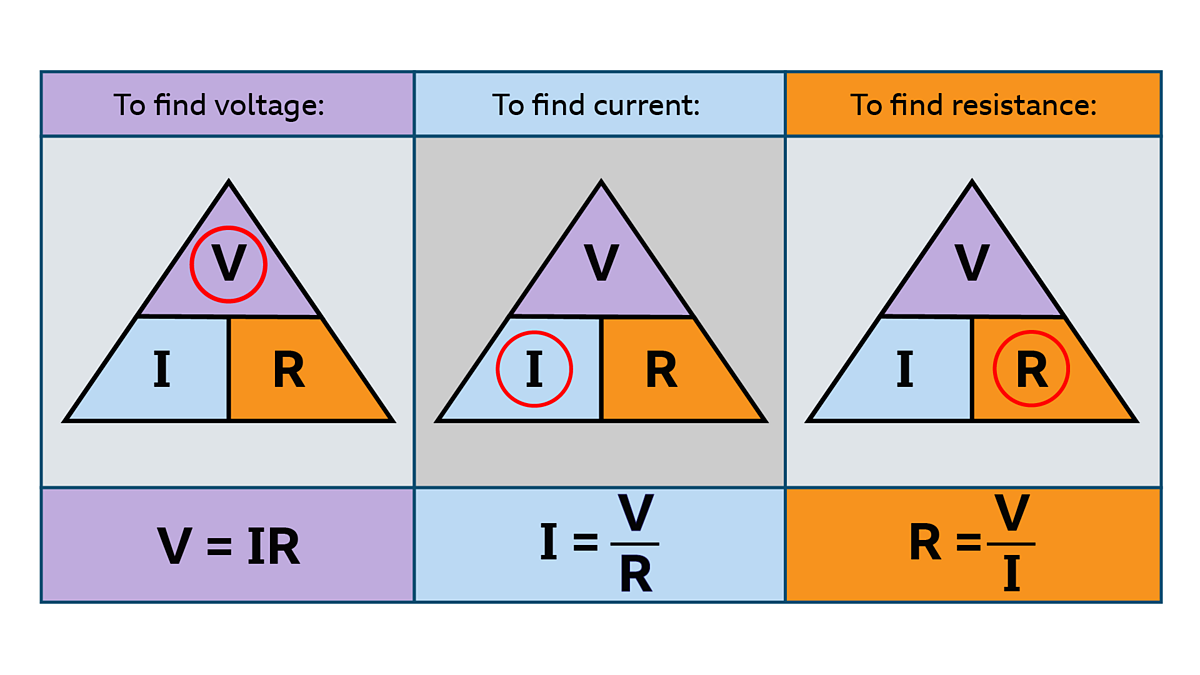
The Ohm’s law triangle can help you recall the three arrangements, but write the formula before inserting numbers. That makes your working easier to follow and helps prevent calculator-entry mistakes.
How to Solve a Series Circuit (Easy)
Watch “How to Solve a Series Circuit (Easy)” by Derek Maciaga for a compact worked demonstration of the same calculation sequence used in this lesson.
First watch the series rules to reinforce why resistance adds, current stays constant, and voltage drops add. Then watch total resistance and current, noting that the total voltage is paired only with total resistance. Finish with individual voltage drops and observe the final voltage-sum check.
Worked example: full series-circuit solution
Question: A DC supply is connected to three resistors in series:
Calculate:
- total resistance
- circuit current
- voltage drops , , and
Step 1: Identify the given and required quantities
Write the known values before calculating:
| Quantity | Value |
|---|---|
| Total supply voltage | |
| Resistor | |
| Resistor | |
| Resistor |
The circuit is series because there is one path. Therefore, resistance adds and current is identical through all three resistors.
Step 2: Find total resistance
Step 3: Find circuit current
Use Ohm’s law with the total voltage and total resistance:
Because this is a series circuit:
Step 4: Find each voltage drop
For :
For :
For :
Step 5: Check the answer
Add the voltage drops:
This matches the supply, so the answer is consistent.
Notice the pattern: is the largest resistance and has the largest voltage drop. That is what you should expect in a series circuit with the same current flowing through every resistor.
Handling kilo-ohms and milliamps
In pre-trade questions, resistors are often given in kilo-ohms , and the resulting current may be in milliamps .
A convenient pairing is:
For example, suppose:
First find total resistance:
Then calculate current:
Now calculate the voltage drops:
Check:
If you instead convert resistance to ohms, the same current is:
Both approaches are correct. The important point is to keep units consistent and write the unit on every line.
Series Circuits and the Application of Ohm's Law
Read this All About Circuits explanation to reinforce the physical reasons behind the rules and to see another complete example using total resistance, circuit current, and resistor voltage drops.
In the subsection “Current in a Series Circuit,” read the one path explanation and connect it to the rule that every resistor has the same current. Then move to “How to Calculate Total Resistance in a Series Circuit” and read the resistance discussion. Finally, in “How to Calculate Voltage Drop in a Series Circuit,” read the voltage drop calculation and pay particular attention to the final check that the drops equal the supply voltage.
Common exam errors and quick checks
Most wrong answers in series-circuit questions come from a small number of avoidable errors.
| Error | Why it is wrong | Better approach |
|---|---|---|
| Dividing total voltage by one resistor | Total voltage is across the whole network, not one resistor | Add resistances first, then use |
| Giving a different current for each resistor | A series circuit has only one path | Write |
| Adding currents in a series circuit | Current does not split in one path | Add resistances and voltage drops, not currents |
| Forgetting units | A correct number without a unit can lose marks | Write , , , or every time |
| Not checking voltage drops | A calculator error may go unnoticed | Add all drops and compare with supply voltage |
Before moving on, use this short desk check on every answer:
- Is greater than the largest individual resistor? It should be, if all resistors are positive.
- Is there only one current value throughout the circuit?
- Do the voltage drops add to the supply voltage, allowing for small rounding differences?
- Does the largest resistor have the largest voltage drop?
- Have total voltage and total resistance been used together?
For written calculations, a clear answer layout earns method marks even if you make a final arithmetic error:
- Write the formula.
- Substitute values with units.
- Show the calculator result.
- State the final answer with the correct unit.
- Show a voltage-sum check.
Key takeaways
For a resistor-only series circuit:
The reliable exam routine is: add resistance, calculate one circuit current, calculate each voltage drop, then check the voltage total.
Next, you will use the voltage-sum rule more formally through Kirchhoff’s Voltage Law, which is especially useful for checking a loop or finding one missing voltage.
Can't find a good explanation? Sign up and we'll make it for you
Sign up