
Hello again. Last lesson established the three elementary radiative processes and their rate forms: absorption raises an emitter from level to level , while spontaneous and stimulated emission lower it. We also introduced the coefficients , , and , without yet specifying how they are related.
This lesson supplies that connection. We will place a two-level ensemble and its radiation field in thermal equilibrium, combine Boltzmann populations with Planck’s blackbody spectrum, and derive the Einstein relations. The degeneracy factors will matter: gain is governed by population per available substate, not merely by comparing the total populations and .
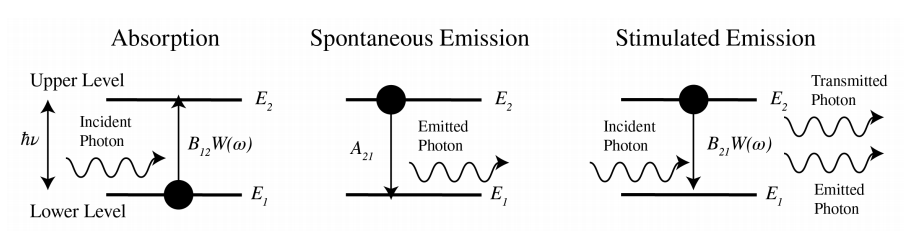
The equilibrium thought experiment
Let the two levels have energies and , separated by
We use and for the total number densities in the lower and upper levels. “Total” is important: if a level comprises several quantum substates with essentially the same energy, includes population in all of them.
For now, take the transition to be narrow and use , the spectral electromagnetic energy density at the transition frequency, expressed per unit ordinary frequency. The three event rates per unit volume are
The Einstein coefficients are transition properties under this idealized free-space description:
- is the spontaneous-emission probability per unit time for an emitter initially in level .
- converts spectral energy density into an absorption probability per unit time for an emitter in level .
- does the analogous job for stimulated emission from level .
For the derivation, imagine atoms and radiation enclosed in a perfectly equilibrated cavity at temperature . This is explicitly not a laser medium: it has thermal populations and a blackbody radiation field. Equilibrium does not mean that transitions cease. Absorption, spontaneous emission, and stimulated emission all continue, but their gross rates balance, leaving and constant.
Therefore,
so the upward absorption rate equals the sum of the downward rates:
A key distinction from the previous lesson: here refers to the isotropic equilibrium radiation field, integrated over all directions and polarizations. It is not the intensity of one collimated laser-like beam.
Read the standard thermal derivation
The following section gives the same derivation in a compact textbook form, using Planck’s law, the Boltzmann population ratio, and the rate-balance condition. Read it once before following the slower algebraic unpacking below.
15.2: The Dynamics of Transitions can be Modeled by Rate Equations - Chemistry LibreTexts
Read “The Relationship between A21, B12, and B21” from Chemistry LibreTexts. It provides a concise derivation of both Einstein relations using spectral energy density per unit ordinary frequency.
In the subsection “The Relationship between A21, B12, and B21,” begin at “In 1900, Max Planck derived a formula for the energy density per unit bandwidth” and read the thermal-equilibrium derivation through Eqs. 15.2.10 and 15.2.11. Track three substitutions in order: rate balance, the Boltzmann ratio containing g_2/g_1, and Planck’s spectrum. Notice that its \rho_\nu convention is the same one used in this lesson.
Deriving the Einstein relations step by step
First solve the equilibrium rate balance for the radiation spectral energy density:
So far, this says only that a radiation field of a particular spectral density can hold the populations stationary. Thermal equilibrium now supplies two independent physical inputs.
1. Boltzmann statistics for the atoms
If level has degeneracy , its equilibrium population is proportional to its number of available substates times the Boltzmann factor:
Hence,
or equivalently,
Substituting this into the rate-balance result gives
Factor out from the denominator:
This is the spectral energy density that the Einstein-rate model predicts at equilibrium.
2. Planck’s law for the photons
Thermal radiation in a cavity has the Planck spectral energy density
The factor multiplying the thermal occupation term,
arises from the density of electromagnetic modes in free space together with the energy per photon. The denominator, especially its , is the signature that creates the need for stimulated emission in Einstein’s argument.
The Einstein prediction and Planck’s law must agree for every temperature . Define
Then the two expressions have the forms
and
Since changes continuously as the temperature changes, the denominators can match for all only if the coefficient of is exactly unity:
The remaining numerators must then be equal:
or
These are the Einstein relations when the spectral density is defined per unit ordinary frequency, .
What degeneracy changes physically
The first relation is often remembered incorrectly as . That equality is true only when the two levels have equal degeneracy:
In general,
This is natural once one remembers what a level means. A “level” may summarize several magnetic, angular-momentum, or other substates. With the conventional level-averaged Einstein coefficients, a larger number of accessible substates changes the aggregate transition probability.
For example, suppose
Then
Even if the total populations happened to be equal, , absorption would exceed stimulated emission:
The relevant comparison for induced processes is obtained directly from their difference:
Using the degeneracy relation,
Therefore, transparency occurs when
and stimulated emission dominates absorption only when
This is the degeneracy-corrected population-inversion criterion. It will become central when we calculate gain, but already tells us why comparing and alone can be misleading.
Frequency conventions: why references can look different
Laser texts use either ordinary frequency in Hz or angular frequency in radians per second:
If the spectral density is written per angular frequency, it obeys
so that
The numerical value assigned to the corresponding coefficient must change consistently, because the physical rate cannot change. Under the angular-frequency convention, the second Einstein relation becomes
This is the form commonly encountered in laser-physics notes that use . It is not a different physical law. It is the same relation expressed using a different spectral variable and hence a differently normalized coefficient.
A reliable habit is to identify, before using a tabulated coefficient:
- whether the spectral density is per Hz or per radian per second;
- whether it is an energy density, intensity, or mean spectral radiance;
- whether degeneracies have been included explicitly.
Mixing conventions is one of the most common sources of incorrect factors of , , or a degeneracy ratio.
A useful physical consequence
The two Einstein relations also quantify the competition between the two downward processes in a thermal radiation field:
Insert Planck’s law and the relation between and :
At visible or near-infrared frequencies at ordinary temperatures, is much larger than , so spontaneous emission overwhelmingly dominates stimulated emission due to the ambient thermal field. A laser does not rely on the room-temperature blackbody field; it builds a highly occupied, selected optical mode and maintains a strongly nonequilibrium population distribution.
Takeaways and next step
Thermal equilibrium links the three Einstein coefficients through two requirements: atomic populations follow Boltzmann statistics, and equilibrium radiation follows Planck’s spectrum. The resulting relations are
and, for spectral energy density per unit ordinary frequency,
The degeneracy relation means that absorption and stimulated-emission coefficients are equal only for equally degenerate levels. More generally, optical gain requires the upper-level population per substate to exceed the lower-level population per substate.
Next, we will use these coefficients operationally: given a radiation spectral energy density and level populations, you will calculate the absorption and stimulated-emission rates and determine the net induced effect on a field.
Can't find a good explanation? Sign up and we'll make it for you
Sign up