
Absorption, Spontaneous Emission, and Stimulated Emission: State Transitions and Radiation Properties
Welcome back. In the previous lesson, we established a common quantitative language for radiation: intensity and spectral energy density describe electromagnetic energy transport, while photon flux and photon rate describe the same beam in photon-number terms. We will now connect that radiation field to a material’s discrete internal states.
This lesson distinguishes the three elementary light–matter processes underlying laser physics: absorption, spontaneous emission, and stimulated emission. You will track the atomic transition in each case, account for energy and photons, and—most importantly—identify the very different radiation properties of spontaneous and stimulated emission. The distinction between incoherent emission and emission into an existing optical mode is what makes laser amplification possible.
A two-level energy ledger
Consider a simplified atom, ion, molecule, or solid-state emitter with a lower state of energy and an upper state , where
A resonant optical field has frequency , or equivalently wavelength
The two-level model suppresses many real details—sublevels, continua, collisions, phonons, and multiple transitions—but it cleanly captures the bookkeeping required for a laser transition.
A photon near the transition frequency interacts appreciably only if the transition is allowed and its frequency lies within the material’s finite absorption or emission line. At this stage, take “resonant” to mean that the photon energy matches the energy gap to the required accuracy.
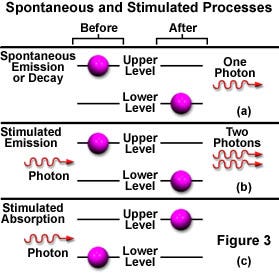
The diagram depicts three distinct events:
- A lower-state emitter absorbs a resonant photon and ends in the upper state.
- An upper-state emitter decays without an incident resonant photon, emitting spontaneously.
- An upper-state emitter encounters a resonant photon and emits an additional photon into the incident field’s mode.
The “electron” language is often useful, but the more general statement is that the emitter’s quantum state changes. The same basic processes occur for electronic, vibrational, rotational, excitonic, or semiconductor interband transitions.
Laser Physics - Einstein Coefficients & Stimulated Emission (Full Derivation)
Watch “Laser Physics - Einstein Coefficients & Stimulated Emission” from For the Love of Physics for a compact visual introduction to the three transitions.
Watch the three transitions. Focus first on which state is occupied before each event, then on whether an incident photon is required and how the emitted radiation is related to it.
Absorption: radiation becomes internal energy
In absorption, the emitter begins in the lower state. A resonant photon is removed from the radiation field, and the emitter acquires the corresponding internal energy.
The material change is from lower state to upper state. For the radiation field, one photon is removed from the incident mode. Energy conservation is simply
For a collimated probe beam, absorption therefore reduces the beam’s power, photon flux, and intensity. In the language of the previous lesson, every absorbed photon removes energy from the beam.
Absorption is sometimes called stimulated absorption because an electromagnetic field stimulates the upward transition. In laser physics, however, the usual shorter term is simply absorption.
Two qualifications matter in real media:
- A photon slightly detuned from can still be absorbed because transitions have finite linewidths. We will study the origins of linewidth later in this module.
- After excitation, the stored energy need not return as a photon on the same transition. It may be transferred to other internal states, collisions, vibrations, or heat. Absorption is therefore not generally the time reverse of a particular observed emission event.
Spontaneous emission: an excited state radiates without a driving field
In spontaneous emission, an emitter initially occupies the upper state and decays to the lower state without requiring an incident resonant photon. If the decay is radiative, a photon carries away approximately the transition energy:
The word spontaneous does not mean that energy appears without cause. The emitter must first have been excited—by a pump field, a discharge, collisions, an electrical current, chemical energy, or another mechanism. “Spontaneous” means that the decay event is not induced by a particular incident optical photon at the transition frequency.
For an isolated ensemble radiating into free space, spontaneous photons are emitted at random times and are distributed across allowed propagation directions and polarizations. Crucially, their phase is not locked to the phase of a chosen incoming optical field.
Consequently, spontaneous emission has no preferred reason to reinforce a particular narrow beam. It may create visible light—as in fluorescence, lamps, or LEDs—but most of its power spreads over many optical modes and directions. A small fraction may happen to enter the spatial mode selected by a later laser cavity, but that is very different from coherent amplification of that mode.
The characteristic spontaneous-emission lifetime is commonly written
where is the spontaneous-emission rate coefficient. The detailed Einstein-coefficient relationships will be derived next lesson; for now, the key point is that spontaneous decay has a nonzero rate even when the resonant radiation energy density is zero.
Stimulated emission: an excited emitter reinforces an existing field
In stimulated emission, an emitter starts in the upper state and interacts with a resonant incident field. The interaction induces the downward transition, and the atom’s stored energy appears as an additional photon.
There is still only one emitter making one downward transition, so the emitter supplies one photon’s worth of energy:
The essential difference from spontaneous emission is the radiation produced. Stimulated emission adds radiation to the same electromagnetic mode as the stimulating field. For a simple traveling plane wave, the added field has the same:
- frequency;
- propagation direction;
- polarization;
- phase relation.
The conventional picture says that one incident photon is accompanied by a second, matching photon. Avoid treating this as though one could label which outgoing photon was the original one. The physical content is simpler and more useful: the radiation field has gained one photon in the occupied mode, while the emitter has lost one excitation.
Because the emitted field is phase aligned with the driving field, the fields add constructively. If the incident and emitted electric fields are denoted by and , respectively, then the combined intensity depends on
The cross term is constructive when the fields are phase aligned. This is why stimulated emission does more than add an independent photon count: it amplifies the coherent optical field.
Read the opening subsection, “7.3.1 The Einstein Coefficients,” from the LibreTexts BSc Optics text. It gives a concise formal statement of all three processes and introduces the decisive idea that stimulated emission occurs in the same electromagnetic mode as the stimulating field.
Read all of Section 7.3.1, beginning with the two-energy-level setup and ending just before Section 7.3.2, “Relation Between the Einstein Coefficients.” In particular, follow the two emission mechanisms: contrast the random direction and uncorrelated phase of spontaneous emission with the mode and phase matching of stimulated emission.
One table, three processes
The following comparison is worth being able to reconstruct from memory.
| Process | Initial emitter state | Is a resonant incident field required? | Final emitter state | Effect on a chosen input optical mode | Radiation character |
|---|---|---|---|---|---|
| Absorption | Lower | Yes | Upper | Loses one photon | Incident field is depleted |
| Spontaneous emission | Upper | No | Lower | Usually receives no directed gain | Emission is distributed over allowed modes, with random timing and phase relative to a selected field |
| Stimulated emission | Upper | Yes | Lower | Gains one photon | Added field is phase matched to the stimulating mode |
A compact photon accounting makes the laser relevance clear. Suppose we monitor a particular forward-propagating resonant beam:
- Absorption subtracts one photon from that beam.
- Spontaneous emission produces a photon somewhere in the allowed radiation modes; on average it does not preferentially enhance the monitored beam.
- Stimulated emission adds one photon to the monitored beam’s mode.
Thus, absorption gives attenuation, while stimulated emission gives gain. Spontaneous emission provides radiative output, but not directional, phase-preserving gain by itself.
From single events to rates in a material
A laser gain medium contains an enormous number of emitters. Let and denote the populations in the lower and upper laser levels. Let denote the radiation spectral energy density sampled at the transition frequency.
The elementary rate dependences are
These equations encode the process distinctions directly:
- Absorption requires both lower-state emitters and resonant radiation.
- Stimulated emission requires both upper-state emitters and resonant radiation.
- Spontaneous emission requires upper-state emitters, but no applied resonant radiation field.
The upper-state population therefore changes according to
At this point, treat the and coefficients as labels for transition strengths. Their exact relations, including the role of level degeneracy and thermal equilibrium, are the subject of the next lesson.
Why stimulated emission alone does not guarantee amplification
A material containing upper-state emitters can undergo stimulated emission, but a probe beam will be amplified only if stimulated emission exceeds absorption on the relevant transition. In the simplest equal-degeneracy two-level picture, the induced processes scale as
Consider a weak resonant beam traversing a medium with nine times as many lower-state emitters as upper-state emitters. Even though some excited atoms produce stimulated emission, absorption events are much more frequent, so the beam attenuates. The spontaneous emission from upper-state atoms appears as broadly distributed fluorescence rather than as a compensating coherent beam.
In contrast, if the upper state is populated more strongly than the lower state—subject to a degeneracy correction that we will add shortly—the stimulated-emission contribution can dominate. That condition is population inversion, the necessary material condition for optical gain.
A laser needs more than stimulated emission:
- A pumping mechanism must create and maintain an inversion.
- Stimulated emission must exceed absorption and losses.
- Optical feedback must select and build up particular modes.
The next modules develop these requirements systematically.
Common confusions to eliminate
“Spontaneous emission is just weak stimulated emission.”
No. Spontaneous emission occurs in the absence of an applied resonant field and has no fixed phase relation to a chosen external field. Stimulated emission is explicitly field-driven and mode-selective.
“Two photons from stimulated emission simply means twice the intensity.”
Only under a fixed geometry and mode definition. Laser amplification is fundamentally coherent field addition. Because intensity scales with squared field amplitude, phase relation matters, not merely photon count.
“A spontaneously emitted photon has no frequency relation to the transition.”
Not quite. Its central frequency is set by the energy difference between the states, but its precise frequency lies within a finite spectral line. Finite lifetime, collisions, motion, and environmental coupling all contribute to linewidth.
“Every photon emitted by an excited atom is useful laser output.”
No. Spontaneous photons are usually emitted into modes that are not the intended laser mode. Laser operation relies on preferentially building radiation in selected resonator modes through stimulated emission.
Takeaways and next step
The three processes have the following physical signatures:
- Absorption transfers energy from a resonant photon to an emitter, raising its internal energy and depleting the incident mode.
- Spontaneous emission transfers an excited emitter’s energy into a photon without a driving resonant field; the radiation is generally emitted with random timing, direction, polarization, and phase relative to any chosen beam.
- Stimulated emission transfers an excited emitter’s energy into radiation in the same mode as a resonant driving field. Its phase-preserving character produces coherent amplification.
The rate structure already foreshadows the central laser competition: lower-state population causes absorption, while upper-state population enables stimulated emission. Next, we will impose thermal equilibrium to derive the relationships among the Einstein coefficients, including the level-degeneracy factors that refine the simple population-inversion criterion.
Can't find a good explanation? Sign up and we'll make it for you
Sign up