
Hello again. In the previous lesson, thermal equilibrium gave us the relations among the Einstein coefficients, including the degeneracy correction
We also saw that has the meaning of a field-induced transition probability per emitter per unit time. We now turn that statement into a reliable calculation procedure: given level populations and a spectral energy density at the transition frequency, find the absorption and stimulated-emission event rates, then interpret their net effect on both the medium and the radiation.
From a spectral field to transition rates
Consider a transition with resonance angular frequency
We will use the angular-frequency convention throughout this lesson. Thus is spectral electromagnetic energy density per unit angular-frequency interval. The narrow-line Einstein rate laws are
Here:
- and are the lower- and upper-level number densities, in ;
- and are event rates per unit volume, in ;
- and are Einstein coefficients defined for ;
- is evaluated at the atomic transition frequency.
The superscript is a useful safeguard. A coefficient tabulated for energy density per hertz, , is numerically different from one defined for energy density per radian per second, . The physical rate itself must of course be the same when the convention is used consistently.
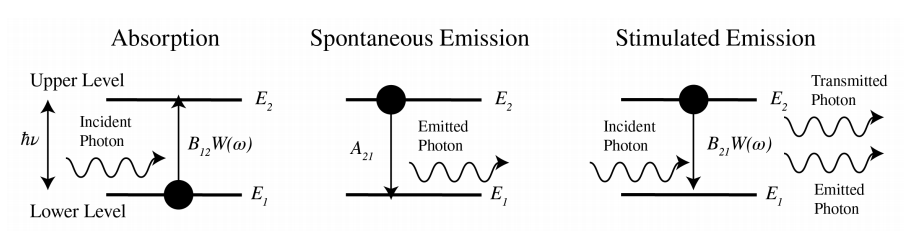
The rate laws can be separated into a per-emitter probability and a population factor:
The quantities and , each in , are the rates for one atom already in the appropriate initial level. Multiplication by or gives the rate density for the whole ensemble.
The following short reference is worth consulting because it states precisely what the population and radiation quantities mean.
[PDF] Laser Physics for Paper B3
Read the opening of Lecture 1, “Conditions for optical gain,” in the Oxford laser-physics notes. It establishes the Einstein rate postulates and, importantly, distinguishes total level populations from a spectral radiation density.
In Lecture 1, subsection “1.1 Review of Einstein description” (pp. 1–2), read from the three postulates. Focus on the initial population for each process and on the fact that the induced rates use the spectral energy density at the resonance frequency, not the total energy density integrated over all frequencies.
What the rates mean physically
An absorption event removes one resonant photon from the field and transfers one emitter from level to level . A stimulated-emission event adds one photon to the stimulating optical mode and transfers one emitter from level to level .
Therefore the induced contribution to the upper-level population is
or explicitly,
The corresponding net induced photon-production rate density is the negative of this expression:
This sign distinction is worth making habitual:
| Comparison | Consequence for atoms | Consequence for resonant field |
|---|---|---|
| Upper level is populated | Field is attenuated | |
| Induced processes balance | Medium is transparent to induced processes | |
| Upper level is depleted | Field experiences induced amplification |
Spontaneous emission is a separate downward contribution,
so the complete radiative population balance, neglecting pumping and nonradiative channels, is
For the present outcome, keep the conceptual distinction clear: spontaneous emission affects the population regardless of the applied field, while the two -driven processes scale linearly with the resonant spectral energy density.
Degeneracy and the induced-rate comparison
The degeneracy relation from the preceding lesson lets us write
Consequently,
This makes the rate criterion transparent. Stimulated emission exceeds absorption precisely when
Notice what is and is not field dependent. Increasing raises both induced rates by the same multiplicative factor. It cannot, by itself, reverse whether a fixed population distribution is absorbing or amplifying. That sign is set by the degeneracy-corrected populations.
Worked calculation
Suppose a transition has
and an angular-frequency Einstein coefficient
At the transition frequency, let the field have
1. Obtain the absorption coefficient
Using the degeneracies,
2. Calculate the per-emitter rates
For an atom initially in level ,
For an atom initially in level ,
The absorption probability is larger per atom because the upper level has three degenerate substates while the lower level has one.
3. Calculate the ensemble rate densities
and
Thus,
The negative sign means that the radiation field suffers net induced loss. Equivalently, induced processes populate the upper state at the rate
The same conclusion follows immediately from the degeneracy-normalized populations:
The lower state is more populated per substate, by a factor of ten, so the medium is absorptive.
Spectral density is not total energy density
A recurring practical error is to insert a total electromagnetic energy density
directly into . That is generally incorrect. Only radiation within the atomic transition’s spectral acceptance contributes effectively. In the narrow-line approximation used above, this means using .
For a directed plane-wave beam, spectral intensity and spectral energy density are related by
Therefore, if the beam’s spectral intensity at resonance is specified, first convert:
then apply the Einstein rate law.
If instead only a beam’s total intensity and a bandwidth are given, you need a spectral model. For a roughly flat spectrum centered on resonance,
and hence
This estimate is appropriate only when the stated bandwidth and spectral shape genuinely describe the radiation near the transition. In later lessons, line shapes will make this frequency weighting explicit rather than treating the transition as perfectly sharp.
A calculation checklist
When an Einstein-rate problem gives you populations and radiation information, proceed in this order:
-
Identify the spectral convention. Determine whether the radiation field is given as , , spectral intensity, or a total intensity. Match it to the convention used to define .
-
Evaluate the field at resonance. Use , not an energy density integrated over an irrelevant bandwidth.
-
Use the population of the initial state. Absorption uses ; stimulated emission uses .
-
Compute each rate independently.
-
Use degeneracy consistently. If only one coefficient is supplied, recover the other with
-
Interpret the sign. Compare with , or compare with .
If the question asks for the number of events per second in a sample of volume , multiply the rate density by that volume:
Takeaways
The induced Einstein processes are calculated from the same structure: initial-state population times an intrinsic coefficient times the resonant spectral energy density.
Absorption removes photons and raises atoms; stimulated emission adds photons to the stimulating mode and lowers atoms. Their difference determines whether the medium produces net induced attenuation or amplification. With degeneracy included, the decisive condition is not simply , but rather
Next, we will use that criterion directly: given populations and degeneracies, determine whether a medium is inverted, transparent, or absorptive.
Can't find a good explanation? Sign up and we'll make it for you
Sign up